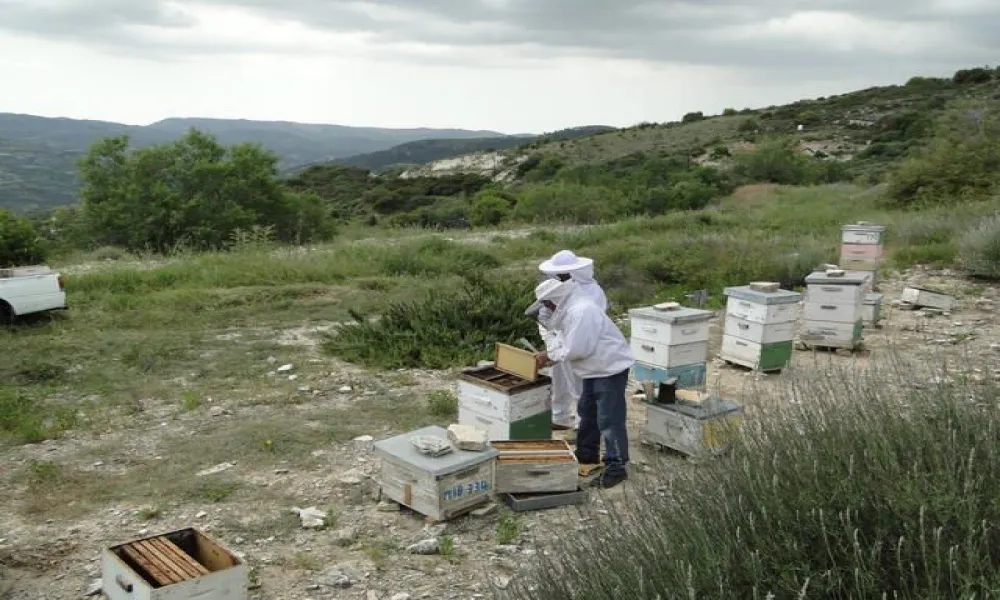

Scientists are currently ahead of the Tropilaelaps mite threatening beekeeping in Cyprus, according to Alexandros Papachristoforou, an associate professor at the University of Thessaly, who is in Cyprus to train local beekeepers on how to recognise and respond to the emerging threat.
The warning follows the recent confirmation by Veterinary Services of the presence of the Tropilaelaps spp. mite in Turkey, prompting efforts to prepare Cyprus' beekeeping sector should the parasite eventually reach the island.
Better prepared than in the past
Speaking to Politis, Papachristoforou said the situation differs significantly from the arrival of the Varroa destructor mite in Cyprus in 1982, when the sector was caught unprepared.
"At that time, we did not have today's knowledge, tools, technology or communications," he said.
Scientists are now travelling to countries where infestations are already present, including Kazakhstan and Georgia, participating in programmes to study and manage the threat.
Unlike previous mite infestations, beekeepers now have access to treatments and scientific expertise. Papachristoforou noted that research has shown biological treatments are currently the most effective way to combat Tropilaelaps, while chemical treatments appear to have limited impact.
"We are informed and we are ahead of the mite," he said, urging beekeepers not to panic.
Arrival in Cyprus not expected soon
Papachristoforou said the mite has so far been identified in northeastern Turkey, near the border with Georgia, a considerable distance from Cyprus.
As a result, he said the spread is expected to be relatively slow and, even under pessimistic scenarios, the mite is unlikely to reach Cyprus for another two to three years.
However, he cautioned that accidental introduction through human activity could occur sooner.
Cooperation across communities vital
Addressing concerns that the mite could enter the Republic through the occupied areas, Papachristoforou stressed the importance of cooperation between Greek Cypriot and Turkish Cypriot beekeepers.
While he said Turkish Cypriot beekeepers generally import bee colonies from southern rather than northeastern Turkey, he emphasised there was no room for complacency.
He called for ongoing communication and information-sharing between beekeeping communities across the island.
Coordinated response required
Asked what should happen if the mite is eventually detected in Cyprus, Papachristoforou said a coordinated response would be essential.
"This is a unique case where all beekeepers must act together," he said.
He explained that treatment would need to be applied simultaneously and according to a common strategy, rather than individual beekeepers acting at different times or not at all.
With scientific guidance, he added, it should be possible to limit the damage caused by the mite, even if complete eradication proves impossible.