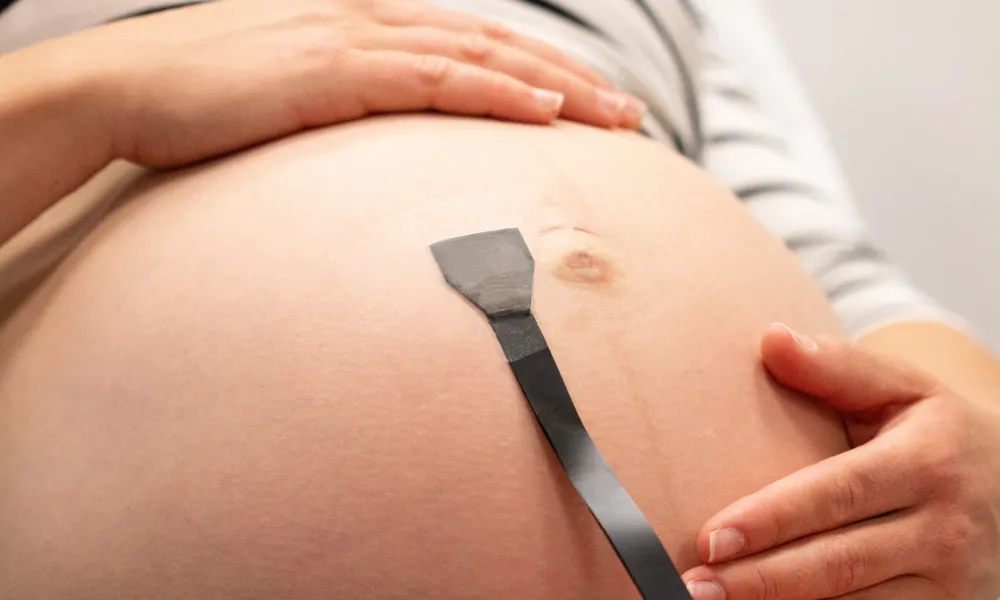

Researchers in the US and the UK have developed a wearable ultrasound patch that can continuously monitor a fetus during pregnancy, raising hopes that doctors may one day be able to detect warning signs between routine hospital appointments.
The device, known as UPatch, is placed on the abdomen like an adhesive dressing and records fetal heart activity and blood flow in real time. Scientists say this could help overcome some of the limitations of existing monitoring methods, which usually provide only brief assessments at scheduled scans or rely on systems that can produce false alarms.
Professor Sheng Xu of Stanford University, one of the senior researchers involved in the work, said current diagnostic tools often offer only limited windows into fetal health. Important changes can therefore go unnoticed during the long periods between medical visits.
Unlike a standard ultrasound examination, the new patch is designed to collect information over an extended period, including while the pregnant woman carries out normal daily activities. The system remains at the prototype stage and still requires external equipment. It also needs an initial conventional ultrasound scan to ensure correct placement.
Even so, the researchers say it is the first device of its kind able to capture hours of fetal imaging and blood-flow data, including from moving structures such as the umbilical cord.
The findings were published in Nature Biotechnology, following trials involving pregnant women in the US and the UK.
How the device was tested
In one part of the study, the team compared blood-flow readings from UPatch with those taken using conventional portable ultrasound devices in 62 pregnant women. Tom Park, of the UC San Diego Jacobs School of Engineering and lead author of the study, said the results showed a strong match between the wearable patch and existing ultrasound systems.
The researchers also used the device to monitor fetal heart rate and blood flow continuously in 52 pregnant women. In one case, the system recorded signs of severe fetal growth restriction.
According to the research team, the information collected by the patch helped support the decision to proceed with an emergency caesarean section in order to prevent the risk of intrauterine death.
Scientists say the main value of continuous monitoring is that it can capture changes that might be missed during a short hospital scan. Park noted that fetal blood flow can fluctuate temporarily, which means a single reading may not always reflect the wider picture.
Work is now under way on a fully wireless version of the technology, which researchers hope could eventually be used at home without limiting movement.
Professor Antoniya Georgieva of the University of Oxford said the approach could become an important tool in efforts to reduce stillbirths, while also offering researchers a clearer picture of how the fetus develops throughout pregnancy.
Source: lifo.gr