


Conflicting signals from the United States and Iran over the status of talks to end their five-month war deepened uncertainty on Tuesday, after a fresh attack on shipping in the Strait of Hormuz underlined the risks still facing global energy flows, Reuters reported.
US President Donald Trump said on Monday that talks were under way, warning Tehran it faced a "last chance" to sign a deal. Speaking to reporters at an Oval Office event, Trump said the two sides were talking at the request of Iran, Saudi Arabia, the United Arab Emirates and Qatar, among others. "This is a last chance for them to sign a good document," he said.
Iran, however, denied that any negotiations were taking place or planned. Foreign ministry spokesman Esmail Baghaei said earlier on Monday that Tehran had no meetings scheduled and no plans to host foreign delegations or send negotiators abroad in the coming days. He added that Iran's negotiating team remained in the country, with the exception of Foreign Minister Abbas Araghchi, who was on a religious pilgrimage in Iraq. The only discussions under way, according to Baghaei, concerned arrangements with Oman over management of the Strait of Hormuz.
Trump's comments followed his decision over the weekend to call off what he described as "massive attacks" on Iran, a now familiar pattern in which he has threatened major strikes only to step back and cite diplomatic contacts as the reason.
Shipping disruption continues
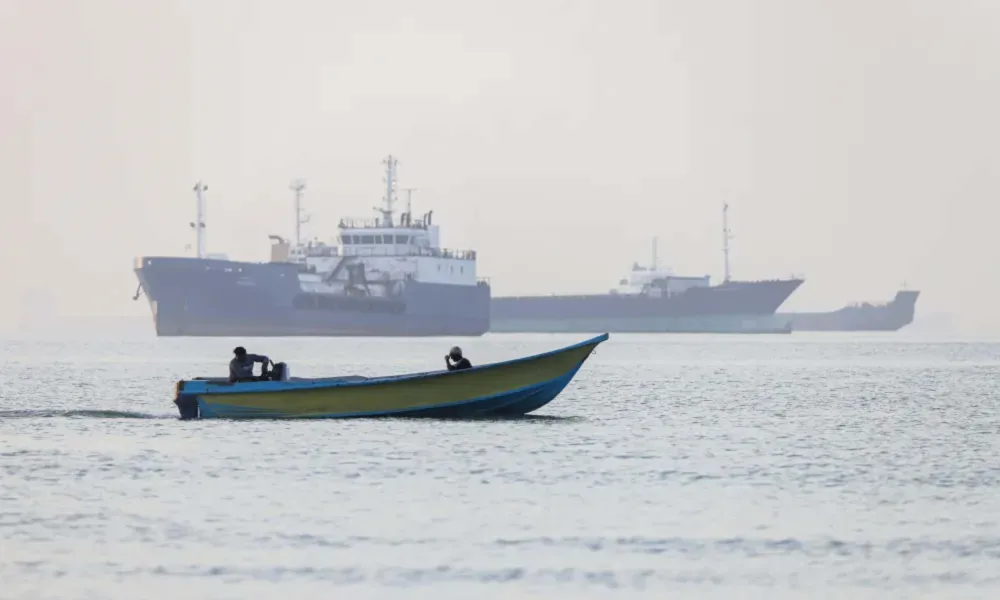
The stand-off in the Gulf continued to affect shipping through Hormuz, the route that carried around a fifth of global crude oil and natural gas shipments before it was blockaded during the war. One cargo vessel reported it had been struck by an unidentified projectile near the strait off the coast of Oman, according to the United Kingdom Maritime Trade Operations agency. Traffic through the strait remained slow, with data from Kpler showing six vessels, three tankers and three bulk carriers, transiting on Monday, down from seven the day before.
Despite this, hopes that tensions between Washington and Tehran were easing pushed oil prices lower and lifted stock markets on Monday. Brent crude futures fell around 7% to about $83.77 a barrel, while the Dow Jones Industrial Average closed at a record high. Asian shares and oil prices both edged higher on Tuesday.
Analysts see a war of attrition
Gulf officials and analysts say Iran is betting it can outlast the United States by using the region's trade routes, shipping lanes and energy infrastructure as pressure points, gradually raising the cost of continued confrontation in the hope of persuading Washington and its allies that containment is more costly than accommodation. Michael Knights of the Washington Institute said Tehran's central advantage lies in its capacity to inflict economic pain regionally and globally.
Later on Monday, in a post on Truth Social, Trump called Iran's leadership "unbelievably duplicitous," saying they had requested a meeting and that further talks were scheduled for the near future. He again asserted that the US Navy had complete control over the Strait of Hormuz, describing the American presence there as a "Wall of Steel" and warning that nothing would reach Iran without a deal or total surrender.
Monday's exchanges fit a pattern that has held since Trump launched "Operation Epic Fury" alongside Israel more than five months ago, repeatedly threatening military action before stepping back in favour of renewed diplomatic contact. Iran, for its part, has publicly rejected negotiations with Washington since a memorandum of understanding signed by both sides collapsed in early July.
Trump has yet to achieve the objectives he set at the start of the war: dismantling Iran's nuclear programme, curbing its ability to strike regional rivals, and creating the conditions for Iranians to overthrow their clerical leadership. Each round of US pressure has been met with escalating Iranian responses against American forces in the region, Washington's Gulf Arab allies and shipping, with Trump ultimately stepping back each time.
The dispute over the Strait of Hormuz remains central to the impasse. Washington maintains that the June memorandum required Iran to open the waterway, while Tehran says the text explicitly preserved its authority over shipping traffic through the strait.
Source: Reuters