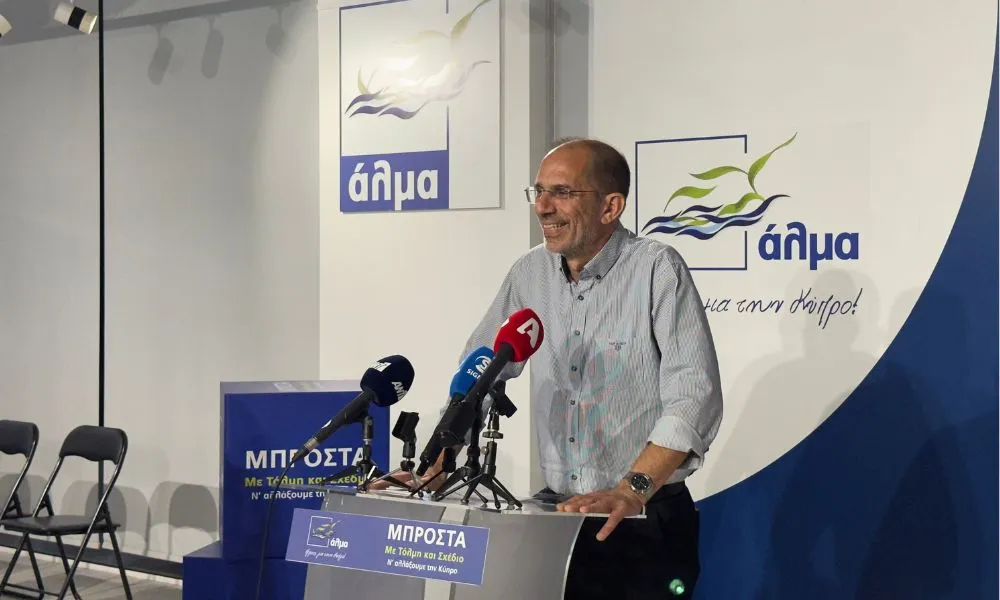

When Odysseas Michaelides announced his entry into politics on 19 May 2025 through the 'ALMA – Citizens for Cyprus' movement, which later became a party, he set an initial target of securing a double-digit result in the parliamentary elections. He also outlined a longer-term ambition, contingent on public support, to take over governance in the 2028-2033 period.
His expectations were shaped by the broad public support he enjoyed as Auditor-General, his reputation as a campaigner against corruption and strong backing on social media. However, one year later, the election result leaves a mixed picture.
A bittersweet outcome
The result gives Michaelides reason for both satisfaction and disappointment. On the one hand, ALMA secured four seats and finished fifth nationwide, a notable achievement for a new party without an established organisational machine. On the other hand, it fell short of expectations, with its vote share dropping from around 12.5% in February polls to 5.8% at the ballot, securing 21,700 votes.
Despite projecting confidence on election night, the lower-than-expected result may complicate Michaelides’s ambitions for the 2028 presidential election.
ALMA performed best in Nicosia, where it secured nearly half of its votes, achieving 7.8% and two seats. Michaelides himself was elected, along with Irene Charalambidou, who received around 6,000 votes. The party also secured a seat in Limassol with 6.3% and another in Famagusta, despite a lower share of 3.9%. Results in Larnaca and Paphos remained more modest.
Overall, the party’s anti-system narrative did not attract the level of support initially anticipated. Internal disputes and organisational challenges may have limited its appeal, although Charalambidou’s candidacy helped bolster the result.
A more moderate tone
In his first post-election statement, Michaelides acknowledged that polls had suggested stronger support, but argued that traditional party mechanisms had succeeded in bringing voters back in the final phase of the campaign. He thanked voters who supported ALMA despite “pressure and alarmist rhetoric”.
He pledged that ALMA’s four MPs would promote transparency, justice and citizens’ rights, while challenging powerful private interests. He stressed that the party would act as a force of stability, moderation and rationalism.
Opening to AKEL
On the issue of electing the Speaker of the House, Michaelides said discussions with other opposition parties would begin immediately. He ruled out cooperation with what he described as the bloc of DISY, DIKO and ELAM, which he said was supported by the President.
This leaves AKEL and Direct Democracy as potential partners. Despite a tense pre-election confrontation with AKEL leader Stefanos Stefanou, Michaelides indicated that cooperation remains possible, suggesting that political differences could be set aside.
Looking ahead to 2028
Turning to the presidential election, Michaelides said meaningful reform cannot be achieved through parliament alone, reaffirming that ALMA’s primary objective remains a change of government in 2028.
He argued that the same political forces have dominated governance for too long and signalled openness to alliances aimed at political change. The first test of such cooperation is likely to come in the vote for Speaker of the House.