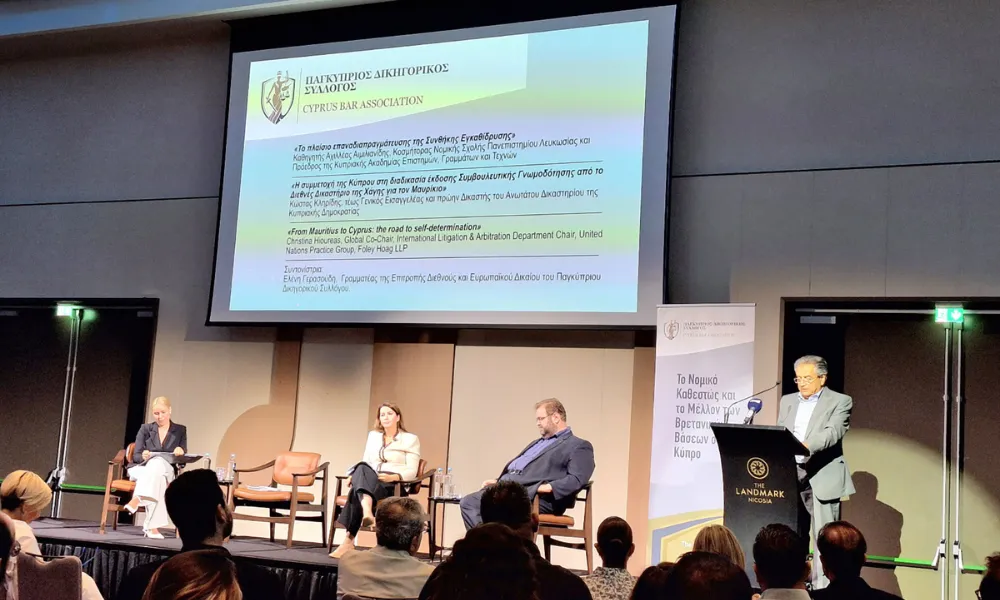
The legal status of the British Sovereign Base Areas in Cyprus has returned to the centre of public and legal debate, as developments linked to the Chagos Archipelago case continue to shape discussions on decolonisation, sovereignty and the right to self-determination. At an event organised by the Cyprus Bar Association on Thursday, June 25, academics, legal experts and government representatives examined whether the reasoning of the International Court of Justice in the Chagos case could offer Cyprus stronger political and legal ground in any future discussion with the United Kingdom.
The message that emerged was cautious but clear: the Chagos case does not, on its own, create new rights for the Republic of Cyprus or automatically change the status of the British Bases. However, speakers argued that it has created a new international legal environment in which the issue can be re-examined with greater seriousness. The Sovereign Base Areas, retained by Britain when Cyprus gained independence in 1960, were presented not only as a historic remnant of colonial rule, but as a live legal and political question touching on jurisdiction, land use, environmental protection, the rights of residents and the role of the Bases in a changing regional security landscape.
Cyprus Bar Association President Michael Vorkas framed the event as an exercise in institutional responsibility, saying the issue cannot be treated as a purely academic matter. He linked the discussion directly to questions of sovereignty, independence and decolonisation, noting that recent statements by President Nikos Christodoulides and the wider debate around Chagos make it necessary for Cyprus to study international precedents carefully and prepare well-founded legal arguments. Deputy Minister of Migration and International Protection Nicholas Ioannides, who represented the President of the Republic, also underlined the timing of the discussion, pointing out that the escalation in the Middle East has once again drawn attention to the strategic role of the British Bases.
A central part of the discussion focused on Cyprus’ own participation in the Chagos proceedings before the International Court of Justice. Ioannides and former Attorney General Costas Clerides both referred to the arguments advanced by the Republic, particularly the position that the right to self-determination is a peremptory norm of international law. Cyprus, they noted, had a direct interest in the case because of its own experience of independence from British rule and the continued presence of the Sovereign Base Areas. Clerides said Cyprus’ intervention was important not only for the development of international jurisprudence on decolonisation, but also for the protection of the Republic’s long-term legal interests.
The event also addressed a key political and legal question: who would need to be involved in any future discussion over the Bases. Professor Achilleas Emilianides, Dean of the School of Law at the University of Nicosia, challenged the view that Turkey would have to participate in any renegotiation of their status. He argued that the Treaty of Establishment concerns the legal regime of the Sovereign Base Areas and not the existence of the Republic of Cyprus itself. On that basis, he said, the relevant legal relationship is between Cyprus and the United Kingdom. He pointed to previous arrangements, including Cyprus’ EU accession protocol, post-Brexit agreements and the 2013 deal on non-military development in the Base Areas, as examples of changes reached without Turkey’s involvement.
Kyrenia Bar Association President Nicolas Constantinides placed the debate within a longer legal history, recalling the Cyprus Bar Association’s past interventions and important court judgments, including a 1991 Supreme Court decision that examined the legal status of the British Bases in depth. He said the Chagos Advisory Opinion had given fresh relevance to questions that have existed for decades, moving the issue beyond a local Cypriot concern and placing it within the wider international debate on unfinished decolonisation and self-determination.
The experience of Mauritius was presented by Christina Hioureas of Foley Hoag LLP, part of the legal team involved in the Chagos case. She described how international law can be used strategically by smaller states when confronting more powerful countries, provided the legal framework is carefully chosen and court findings are followed by sustained diplomatic and political action. She also highlighted Cyprus’ role in the Chagos proceedings, saying its submissions helped support the Court’s conclusion that the right to self-determination had already become part of customary international law before 1960, a point considered particularly relevant to Cyprus.
Despite the renewed interest generated by Chagos, the speakers avoided suggesting that the case provides an immediate legal shortcut for Cyprus. Instead, the discussion pointed towards a more gradual approach, based on preparation, international legal arguments and structured dialogue with the United Kingdom. Ioannides stressed that the government’s aim is constructive engagement within the framework of international law, with the protection of the Republic’s interests and the rights of its citizens at the centre of any future process. He also recalled that the European Commission has expressed readiness to participate in proposed discussions on the British Bases.
The United Kingdom continues to maintain two Sovereign Base Areas in Cyprus, Akrotiri and Dhekelia, which were established in 1960 as part of the arrangements under which Cyprus gained independence from British colonial rule.
Source: CNA