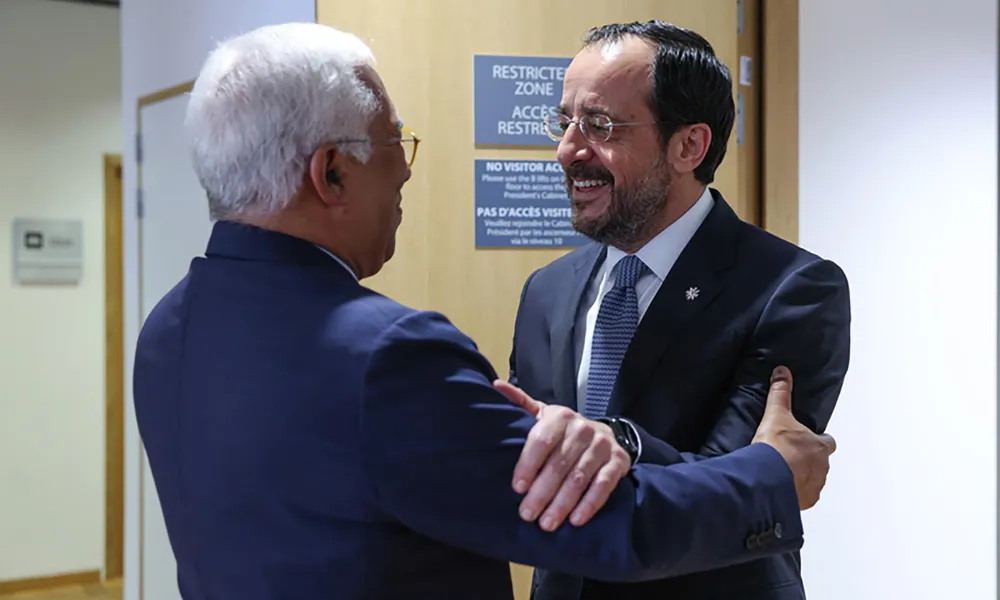



European Council President António Costa arrives in Cyprus tomorrow, Friday, 4 September, as part of his tour of European Union member state capitals, with talks with President Nikos Christodoulides expected to cover the Cyprus problem, EU-Turkey relations and the EU's new budget.
Costa will travel to the Presidential Palace in the morning, where he will first hold a private meeting with Christodoulides, followed by expanded talks. The two presidents are expected to make statements to the media at 10.35am.
The visit comes at a time of significant discussions at European level, and at a critical juncture for efforts to relaunch substantive negotiations on the Cyprus problem.
EU budget on the table
One of the main topics of the talks will be the EU's new Multiannual Financial Framework for 2028-2034. According to Government Spokesperson Konstantinos Letymbiotis, Nicosia is entering the discussion with specific positions and demands.
The Republic of Cyprus will call for an "ambitious and fair" European budget that takes into account the particular needs of small island states and supports growth and social cohesion. Particular weight is being placed on preserving national allocations under Cohesion Policy, the Common Agricultural Policy and migration funding.
Also on the agenda will be EU enlargement, competitiveness and migration, along with international developments in Ukraine, the Middle East and the Gulf.
A dedicated focus on the Cyprus problem
The Cyprus problem will hold a central place in the talks, with Christodoulides briefing Costa on the latest developments and ongoing efforts to relaunch substantive negotiations.
The discussion is expected to touch on the recent visit to Cyprus by the United Nations Secretary-General, as well as the European Union's enhanced involvement, including the role taken on by European Commission Executive Vice-President Raffaele Fitto as the Commission's special representative for Cyprus.
Nicosia's position is that while the Cyprus problem process is conducted under the auspices of the United Nations, the European Union can play a supportive and catalytic role, drawing on its political weight, tools and incentives.
Particular importance is also being placed on EU-Turkey relations. The government's assessment is that further progress in EU-Turkey relations could serve as a tool to help Ankara contribute substantively to relaunching negotiations and to efforts to resolve the Cyprus problem, within the framework of UN Security Council resolutions.
Nicosia also reiterates that any solution to the Cyprus problem must ensure a functional European state, fully compatible with the European acquis and with the principles and values of the European Union.