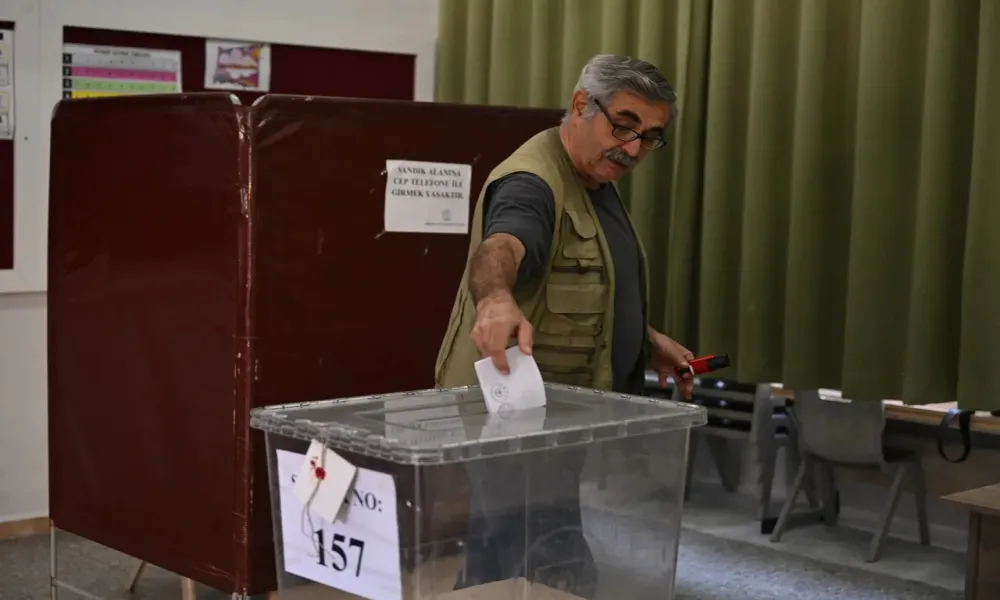

The Turkish Cypriot “parliament” has abolished split-ticket voting, ending a system that has long been the subject of political dispute in the north.
Under the new rules, voters will no longer be able to select candidates from different political parties in the same “election”. The single electoral district will remain, along with the option of choosing preferred candidates from within the party being supported.
Voters will therefore retain the right to choose among candidates on the same party list, but will no longer be able to divide their vote between parties.
Supporters of the mixed voting system argued that it gave voters greater freedom to choose individual candidates. Critics, however, said its complexity resulted in a high number of invalid ballots and caused problems during the “electoral process”.
Amendment approved by majority
The amendment to the “law on elections and referendums” was approved by a majority during a plenary session, following an article-by-article debate.
The change will apply at the next “elections”, bringing the mixed voting system to an end.
Üstel cites invalid ballots
Turkish Cypriot “Prime Minister” Ünal Üstel rejected criticism that the amendment had been introduced shortly before the “elections”.
He said the proposal had first been submitted to the “parliament” in 2023 and discussed by a “parliamentary committee” before being withdrawn to allow the opposition to contribute to its preparation.
Üstel said the issue had remained on the political agenda for some time, pointing in particular to the number of invalid ballots cast during the 2022 “parliamentary elections”.
According to Üstel, invalid ballots accounted for 41% of votes in that election. He added that in 2023, the “Supreme Electoral Council” had informed the “government” in writing that split-ticket voting should be abolished.
He said the council’s observations were taken into account when preparing the amendment, with the main objective of ensuring that “the will of the voter is accurately reflected at the ballot box”.
Arıklı backs the change
Erhan Arıklı, leader of the Rebirth Party (YDP), also supported the abolition of split-ticket voting. Arıklı was recently removed from the so-called government following reactions to the deadly shipwreck off Kyrenia.
He argued that although the system theoretically offered voters a wider choice, it had developed into a problematic process that “polluted political life and cast a shadow over elections”.
According to Arıklı, political parties are the principal institutions of democratic systems, while “governments” are formed on the basis of party programmes. He also claimed that split-ticket voting had gradually become a “mechanism serving vested interests”.
Arıklı said the YDP had supported abolishing the system since the party was founded, adding that a significant number of parties represented in the “parliament” also backed the change.
İncirli questions timing
Republican Turkish Party (CTP) leader Sıla Usar İncirli focused her criticism on the timing of the amendment.
Although the issue has been under discussion for approximately three years, she said it was wrong to alter the electoral system less than three months before the “elections”.
İncirli said electoral rules should not be shaped according to personal or party interests, but should instead strengthen “parliamentary democracy and the credibility of the political system”.
She added that changes of such importance should be introduced with the agreement of all political parties and at a time not directly linked to an imminent “election”.
Mixed voting system comes to an end
Supporters of mixed voting maintained that it offered voters greater freedom to select individual candidates. Its critics argued that the system’s complexity produced large numbers of invalid ballots and undermined the “electoral process”.
Following the decision by the Turkish Cypriot “parliament”, the system will no longer be used at the next “elections”.