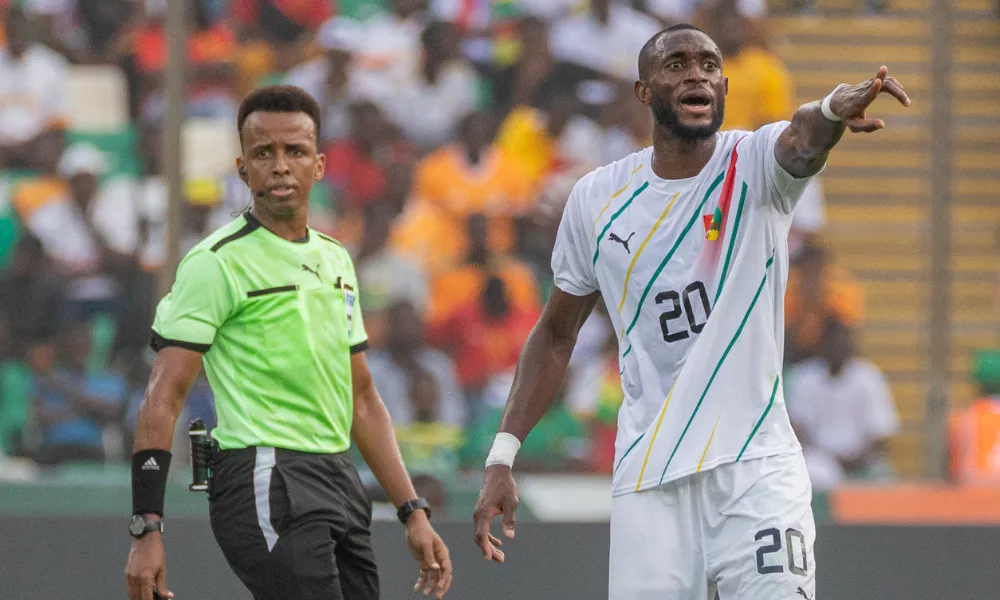

For Omar Artan, the trip to Miami was supposed to open the biggest chapter of his refereeing career. He was not travelling as a fan, nor as an ordinary visitor, but as one of the officials selected by FIFA for the World Cup. Instead, the Somali referee was stopped at the airport, questioned for hours, refused entry to the United States and eventually removed from the tournament.
What this meant was not only a personal setback for Artan. It also ended, at least for now, a historic moment for Somali football. His appointment would have put a Somali official on the World Cup refereeing stage for the first time, a milestone for a country that has rarely had such representation in football’s biggest competition.
The explanation from US border authorities was limited. US Customs and Border Protection said further checks had made Artan inadmissible, referring only to “vetting concerns”. A US official later said the refusal was connected to alleged links with suspected members of terror organisations, speaking anonymously because visa matters are protected by privacy laws. The decision came despite the fact that Artan had been issued a US visa last week, according to Somalia’s embassy in Kenya, which processed it.
Questioned for hours
Artan told The New York Times that he was questioned for 11 hours after landing in Miami. According to his account, officials asked about the purpose of his visit, Somali politics and al-Shabab, the militant group fighting Somalia’s government.
He said he tried to prove his role by showing FIFA documents and material from his refereeing career. Nevertheless, he was later placed in a holding area and sent back to Istanbul, where he had taken his connecting flight to the US. Artan told the newspaper that he believed his nationality played a role in the decision. He also said he had travelled with the correct documents and a valid visa, but was not given a clear explanation for why he was refused entry.
Andrew Giuliani, executive director of the White House FIFA Task Force, defended the decision on Tuesday, saying there was a strong reason for Artan being denied entry, without providing further details.
The question that arises is how a FIFA-appointed official, already selected for the tournament and carrying a recently issued visa, could still be stopped only days before the World Cup begins. Part of the answer may lie in the wider political climate. Somalia is among nearly 40 countries affected by new travel restrictions introduced under the Trump administration’s immigration crackdown. Many of those countries are in Africa, raising concerns that players, officials and fans could face problems entering the US even when they hold valid documents. Somalia’s Youth and Sports Ministry said its embassy in the US was trying to resolve the matter. Isse Aden Abshir, a senior adviser at the ministry, told The Associated Press that the refusal may be linked to the wider restrictions on Somalia, rather than a specific allegation against Artan.
FIFA says the host country decides
FIFA distanced itself from the border decision, saying entry into a host country remains a matter for that government. The organisation said it had been informed by US authorities that Artan’s status would not change for now, meaning he would not be able to attend training or officiate at the tournament.
This places FIFA in a difficult position. The organisation selected Artan as one of its World Cup officials, but the final decision on whether he could enter the country rested with the US authorities. In practice, that meant a referee chosen for the tournament was removed not because of a footballing decision, but because of an immigration one.
The case is also sensitive because FIFA and its president, Gianni Infantino, have built close ties with President Donald Trump’s government as the US prepares to co-host the tournament with Mexico and Canada. Those ties had been presented as part of the effort to ensure that the World Cup would run smoothly. Artan’s case now shows how complicated that promise can become when global sport meets national border policy.
A missed moment for Somalia
Artan’s absence will be felt strongly in Somalia. His selection had been seen as a rare international achievement for Somali football and a sign of how far he had come in difficult conditions.
His credentials were not in doubt. In 2025, he was recognised as Africa’s leading male referee, and only weeks ago he handled the decisive leg of the CAF Champions League final between AS FAR Rabat and Mamelodi Sundowns in Morocco, one of the biggest club matches on the continent.
In a recent interview with Al Jazeera, Artan described the challenges of training and working in Mogadishu, including having to change routes because of explosions in the capital. His rise, therefore, was not only about professional success. It was also about persistence in a country where even daily movement can be shaped by insecurity. He had described reaching the World Cup as the major target of his career. That target will now have to wait.FIFA later released a statement on Artan’s behalf, in which he said he remained positive despite what had happened and was now focused on the next stage of his refereeing career.
Source: Associated Press