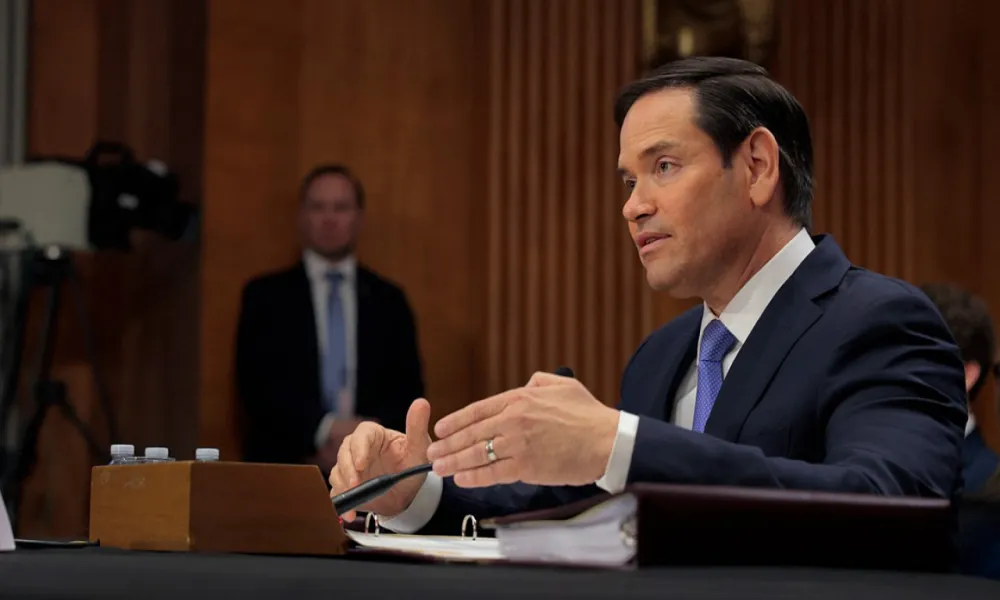



The picture around a potential agreement between the United States and Iran remains murky on Sunday, with American and Iranian officials offering sharply different assessments of how close a deal actually is. US Secretary of State Marco Rubio said that "significant progress, although not final progress" has been made in talks to end the US-Israeli war on Iran, adding that he believed "perhaps there is the possibility that in the next few hours the world will get some good news." Rubio made the remarks to reporters in New Delhi, where he is on an official visit.
Iranian sources struck a more cautious tone. The Iranian news agency Tasnim, citing an Iranian source, said that if the United States continued to raise obstacles, there would be no possibility of reaching a final memorandum of understanding. The same source indicated that disagreements persist over one or two clauses of the draft agreement.
The most significant point of contention concerns Iran's stockpile of highly enriched uranium. A senior Iranian official told Reuters on Sunday that Tehran has not agreed to surrender that stockpile, and that the nuclear file does not form part of the current preliminary agreement. According to a source familiar with the negotiations, the deal is expected to unfold in two phases, with Iran reopening the Strait of Hormuz in the first phase and the nuclear issue to be addressed in a second phase. The Iranian official was quoted as saying: "The nuclear issue will be discussed in negotiations for a final agreement and is therefore not part of the current deal. There has been no agreement to transfer Iran's highly enriched uranium stockpile out of the country."
Iran executes man accused of spying for US and Israel
Against this diplomatic backdrop, Iran carried out the execution on Sunday of a man convicted of passing intelligence to the United States and Israel during the war. The Iranian judiciary's website Mizan reported that Mojtaba Kian was hanged in the early morning hours after being found guilty of providing the enemy with information relating to units of the country's defence industry. According to Mizan, the information he allegedly supplied concerned Iranian defence capabilities during the conflict that was ignited at the end of February by the US-Israeli attack on the Islamic Republic. This is the first execution directly linked to that conflict, though executions for espionage and national security offences have risen sharply since the war began, with earlier cases relating to prior offences.
The broader context is one of acute pressure: Trump said on Saturday he had spoken with leaders from Saudi Arabia, the United Arab Emirates, Qatar, Pakistan, Turkey, Egypt, Jordan and Bahrain, as well as with Israel, and that "final aspects and details of the deal are currently being discussed." Iran's record on executions meanwhile continues to draw international condemnation. According to human rights organisations Iran Human Rights and Ensemble contre la Peine de Mort (ECPM), Iran executed at least 1,639 people in 2025, a record figure since 1989, making it the second-highest executing country in the world after China, according to Amnesty International.
Source: AMNA