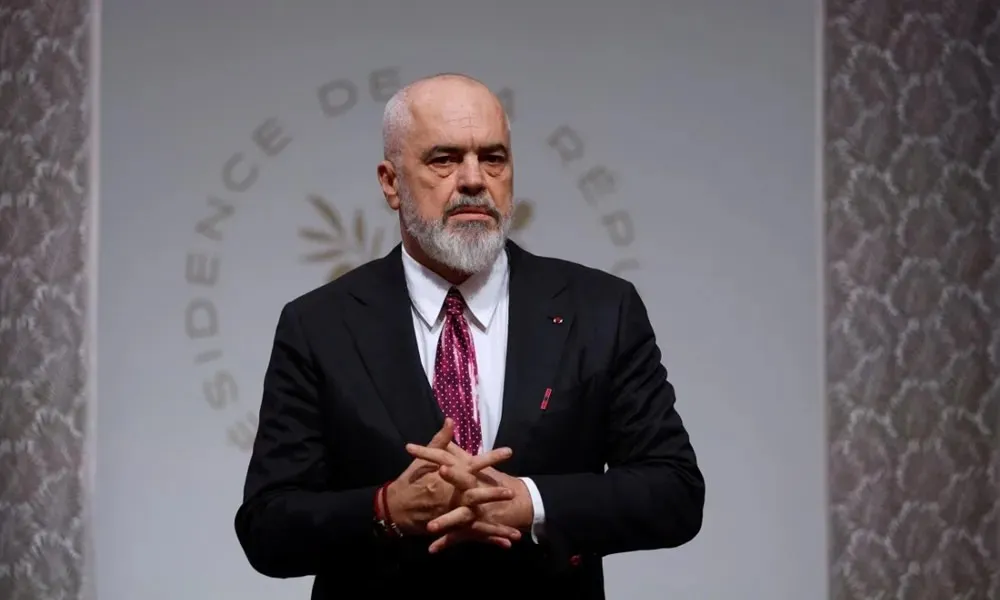

Albanian Prime Minister Edi Rama considers that the protests against the planned construction of a luxury resort on an island off the country’s Adriatic coast are driven by misinformation, while rejecting claims that a protected area has been sold to investors, including the son-in-law of US President Donald Trump.
“The fact is that no agreement has been concluded for Sazan island,” he said in an interview with the German Press Agency in Berlin. “It is all lies,” he insisted.
According to Rama, his government is still negotiating a possible public-private partnership for the construction of what could become the country’s largest luxury resort on Sazan island.
He confirmed that Jared Kushner, Trump’s son-in-law, is among the potential investors.
However, he категорically denied, describing them as false reports, that “the Kushners have acquired the island” or that “Albania has sold the island”.
“Albania has turned into a platform for all the anger against Trump across the world,” Rama argued.
In the Balkan country, which is a candidate for European Union membership, large-scale protests have been taking place for weeks against the planned investment. Thousands of people have taken part in demonstrations in the capital Tirana, where clashes with police have been reported.
Beyond Sazan, the plan also includes granting a small peninsula near the town of Zvernec to private developers. The peninsula separates the Narta lagoon from the Adriatic Sea and is a protected area, as it is classified as a habitat for birds and other wildlife species.
Rama stated that preparatory and exploratory work there has been temporarily suspended due to pressure, but insisted that the investment will proceed.
According to the Albanian Prime Minister, plans have not yet been submitted for either of the two locations. He stressed that environmental impact assessments are a prerequisite.
Environmental organisations have criticised amendments to Albania’s legislation on protected areas, which were approved in 2024. Rama’s government says the changes were merely “clarifications” regarding the status of protected areas. The EU, however, has assessed that the legislative changes weakened the legal framework for environmental protection.
Prime Minister Rama rejects this view, stressing that there is “no possibility” that a country on the path to EU accession would approve plans that are not in “full compliance” with European environmental standards.
Source: CNA