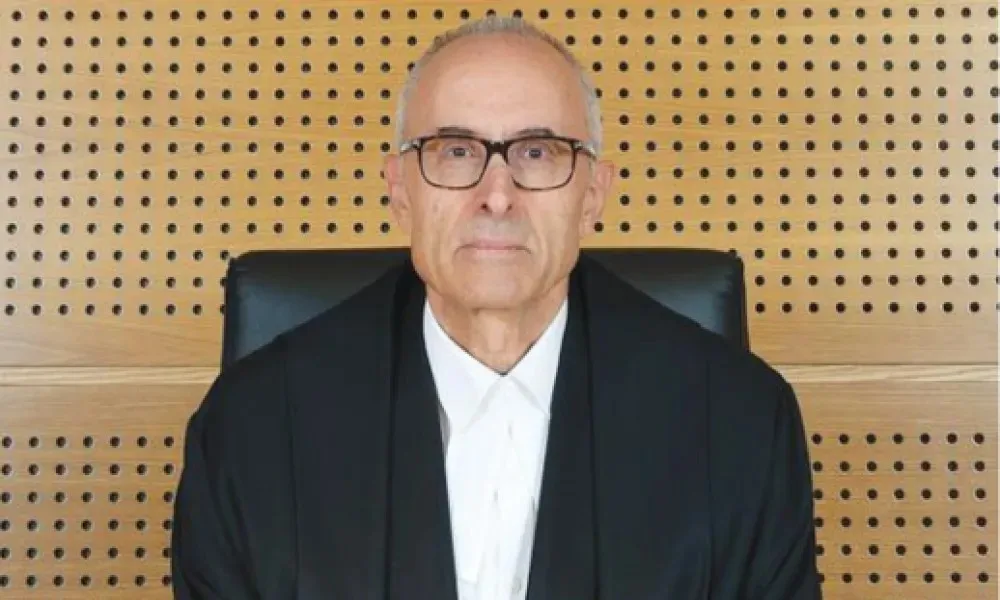

“The Anti-Corruption Authority’s report is there. I understand that other procedures will now follow, investigations and so on. Undoubtedly, I cannot in any way touch the presumption of innocence. It is a case that may be examined by a court within the framework of the appropriate procedures.”
The findings of the Anti-Corruption Authority’s report on the so-called Mafia State judicial reform, court delays, the widely discussed dismissal of former Auditor General Odysseas Michaelides for inappropriate conduct, and other major issues are addressed in an interview with Politis by Antonis R. Liatsos, President of the Supreme Constitutional Court.
Within the limits imposed by his position, and without interfering with any ongoing or potential future proceedings, Liatsos answered questions put to him. Although the interview had been scheduled several days earlier, it took place last Wednesday, coincidentally one day after the report was published. Inevitably, he was asked to comment on its findings.
“No one is beyond scrutiny”
The Anti-Corruption Authority has issued its report on the “mafia state”, identifying findings that strike at the institutions of the Republic and naming specific individuals. Asked for his comment, Liatsos began by thanking the newspaper for the opportunity to address readers.
“In recent times, justice has been at the centre of attention due to the major, unprecedented reforms taking place in our country,” he said. “The effectiveness and quality of judicial work and the way judicial bodies exercise their powers are directly linked to the daily life of citizens, as they have a decisive impact on human rights and fundamental freedoms.”
“For these reasons, and also as a form of accountability to citizens, justice – as the primary guarantor of any modern democratic system – must maintain open channels of communication with civil society, from which it derives and for whose benefit it operates.”
Referring to the report, he reiterated: “The Anti-Corruption Authority’s report is there. I understand that other procedures will now follow, investigations and so on. Undoubtedly, I cannot in any way touch the presumption of innocence. It is a case that may be examined by a court within the framework of the appropriate procedures.”
However, he stressed a broader principle: “Everyone is equal before the law and it must be clear that no one is untouchable.”
“Anyone who is found guilty before a competent court, following due judicial process and in accordance with the law, must face the penalties provided for by law,” he said, adding that “strict punishments” are necessary given the seriousness of potential offences linked to the functioning and credibility of state institutions.
“If substantiated, these would be serious offences. Such messages must be sent to protect society and the rule of law. But it is equally clear that all this must operate within institutional procedures, and if guilt is proven in court, then consequences must follow.”
Corruption and the judiciary
The report also makes reference to a judge, reviving concerns about corruption within the judiciary. Liatsos was asked whether such corruption exists.
“I have been a judge for 35 years and I have never become aware of any issue of corruption,” he said. He acknowledged, however, that in some cases judges had failed to meet their responsibilities, committing disciplinary offences such as delays in completing cases.
“But these do not constitute acts that point to corruption,” he said.
He added that the Supreme Constitutional Court would take a firm stance if proven corruption emerges. “It is our established and firm position that the provisions of the law apply to everyone, regardless of who is involved.”
“If a judge commits such a serious offence, they do not only expose themselves. They expose the judiciary as a whole,” he said. “It is an affront to the judicial body and to all other judges who perform their duties with integrity and diligence. Above all, it undermines the foundations of the rule of law by eroding public trust in justice.”
Addressing delays
Roughly three years after sweeping judicial reforms and the creation of new courts, delays remain a concern, particularly in administrative law cases.
“The main objective of the reform was to address the major problem – the scourge of delays,” Liatsos said. He noted that Cyprus previously lacked a third level of jurisdiction and that reforms introduced a Court of Appeal as a second tier, with the Supreme Constitutional Court and the new Supreme Court functioning as third-tier courts where the law provides.
“A key goal was mutual oversight among judges,” he said, noting that decisions of judicial councils are no longer beyond scrutiny following the establishment of the Supreme Constitutional Court in 2023.
Separating the former unified Supreme Court was “very important” to enable this oversight and to allow specialisation, particularly in constitutional and public law matters.
He said the reform is already yielding positive results. “As far as the Supreme Constitutional Court is concerned, there is no longer any delay,” he said, noting that cases are completed within six to nine months from filing.
He addressed criticism that the Michaelides case was resolved quickly: “All cases before the Supreme Constitutional Court are completed within the same timeframes. Safeguarding the rule of law also requires the swift adjudication of cases.”
Progress is also being made at the Administrative Court of Appeal, where three additional judges have been approved, allowing two divisions to operate from September instead of one. Cases currently being heard date back to 2022, with about 800 appeals pending.
“I expect that within one to two years, the processing of appeals will be much faster,” he said. Currently, cases take three to four years, but accumulated cases are expected to be resolved within one to two years.
Liatsos described delays as a “systemic dysfunction” rather than a recent problem, attributing them partly to years of underinvestment in the justice system.
“It is now understood that a country’s economic development is directly linked to the existence of a reliable justice system,” he said, adding that further state support will be required to meet European standards.
Erosion of trust in institutions
Asked about growing public distrust of institutions, Liatsos described it as a complex, multi-factor phenomenon seen internationally.
Some responsibility lies with individuals serving in institutions, he said, but social media and the rapid spread of accusatory rhetoric also fuel generalised suspicion. Public discourse often favours impression over evidence, including in criticism of court decisions.
“Freedom of expression and criticism of judicial decisions are not only fully respected but essential,” he said. “Judges judge and are judged.”
While citizens have every right to express views without technical expertise, he stressed that legal professionals must apply scientific rigour, avoid disparaging language and ground their criticism in facts and law.
“Good-faith criticism, however harsh, is welcome and particularly helpful,” he said, adding that it strengthens the justice system and informs the public.
Restoring trust requires “seriousness, consistency, transparency, public accountability and meaningful engagement between institutions and society.”
Transparency and public understanding
On improving transparency, Liatsos said the legitimacy of justice lies in the reasoning behind its decisions. Efforts are under way to make rulings more accessible and understandable through traditional media, social media and simplified summaries.
“Justice is not delivered only for lawyers, but for citizens,” he said, adding that understanding court decisions is essential for building trust.
Surveillance and separation of powers
On sensitive issues such as surveillance and separation of powers, Liatsos stressed the importance of checks and balances.
“No state function should remain unchecked,” he said. Any legislation in such areas must respect the constitution, be justified by serious grounds, comply with proportionality and provide effective safeguards for citizens.
6,500 cases pending at Administrative Court
Liatsos identified the biggest delays at the first-instance Administrative Court, a point also highlighted in the European Commission’s latest rule of law report. Around 6,500 cases are currently pending.
Only seven judges serve at the court, a number he described as insufficient. Plans are under way to seek additional judicial and support staff positions.
“Judges alone cannot solve the problem. There must be an adequate number of assistants to support their work,” he said.
At the Administrative Court of International Protection – the asylum court – delays persist, although it has played a key role in managing migration flows. He noted that it operates in completely unsuitable premises and faces infrastructure and support challenges despite the addition of four judges.
Authorities maintain near-daily contact with first-instance courts, providing guidance to speed up proceedings. “Problems exist,” he said. “A reform does not end with the passage of laws. It is a continuous process.”
Reforms introduced in 2023, including the Administrative Court of Appeal and the integration of administrative courts under the Supreme Constitutional Court, were implemented in 2025, reflecting the evolving nature of the reform process.
“You identify problems and move forward with corrective actions,” he said, underscoring that judicial reform remains an ongoing effort.