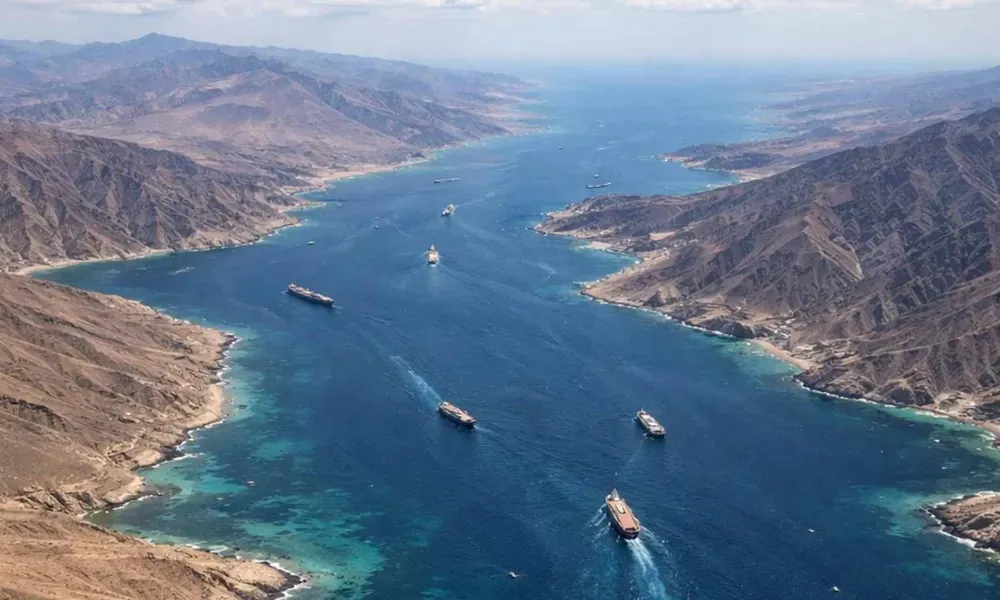
Conflicting claims over the status of the Strait of Hormuz, warnings from Tehran and fresh interventions by Donald Trump are creating a highly volatile backdrop ahead of key US–Iran talks in Switzerland, as tensions continue in southern Lebanon.
The negotiations, set to take place on Sunday on the implementation of a recently signed memorandum of understanding, are expected to be held in a heavy political climate marked by serious doubts over compliance.
Trump warns of “tolls” in Hormuz
US President Donald Trump introduced a new dimension to the crisis, warning in a post on Truth Social that Washington could impose transit charges in the Strait of Hormuz once the current ceasefire period ends, if no comprehensive agreement is reached with Tehran.
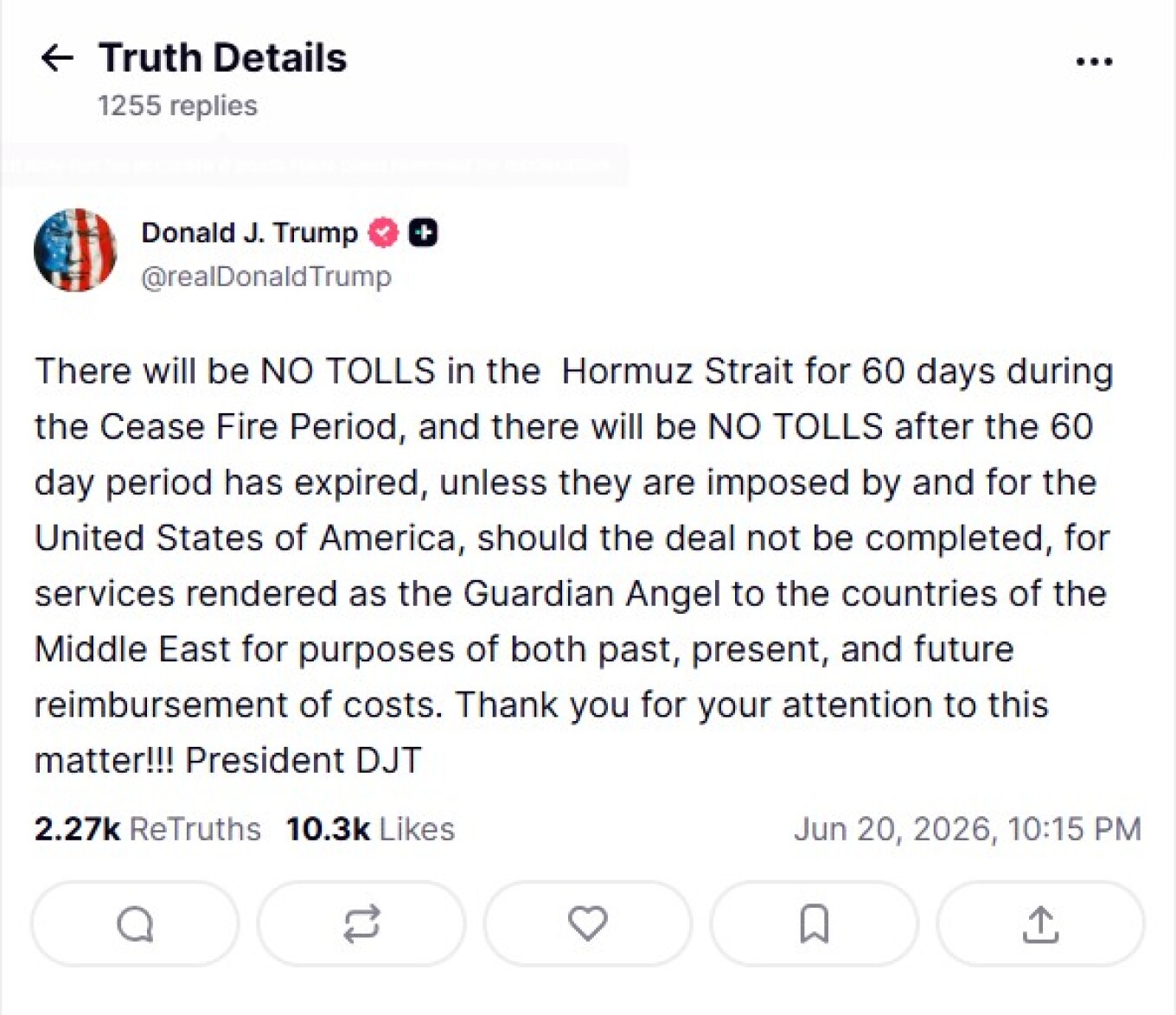
He said that for 60 days no “tolls” would be imposed along the strategically vital maritime route but left open the possibility of charges thereafter, referring to “Guardian Angel” services provided by the United States to Middle Eastern countries.
Trump’s intervention comes at a time of heightened uncertainty, with US–Iran negotiations reaching a critical phase.
Iran announces renewed closure of the strait
On Saturday, Iran’s Joint Armed Forces Command announced it was moving again to close the Strait of Hormuz, saying the decision was a response to ongoing Israeli operations in southern Lebanon.
#BREAKING: Iran's top joint military command says Strait of Hormuz is closed due to alleged US and Israeli violations of ceasefire MoU – Iranian media pic.twitter.com/SEJLDGXpeb
— TRT World (@trtworld) June 20, 2026
In a statement, the Iranian command described the move as a “first measure” and warned that further steps would follow if the attacks continued.
At the same time, Iranian media broadcast an audio message attributed to the Revolutionary Guards calling on all vessels not to attempt passage through the strait.
US: “The strait remains open”
Tehran’s claims were immediately rejected by the United States.
US Vice President JD Vance told Fox News that Washington had no indication the Strait of Hormuz had been closed.
US Central Command (CENTCOM) delivered a similar message, stating that navigation was continuing normally and noting that dozens of commercial vessels passed through the waterway during the day, transporting millions of barrels of oil.
CENTCOM spokesman Captain Tim Hawkins said: “Iran does not control the Strait of Hormuz,” adding that US forces are closely monitoring the situation.
Tehran warns deal at risk
At the same time, Iran’s foreign ministry warned that the memorandum of agreement between Tehran and Washington could collapse if its provisions are not implemented immediately.
Foreign ministry spokesman Esmaeil Baghaei said the other side must take the necessary steps to enforce the agreement, otherwise the entire framework would be jeopardised.
Iran also confirmed that a delegation had departed for Switzerland, where technical talks with the United States are to take place on Sunday, in the presence of representatives from Pakistan and Qatar.
Hezbollah and Israel trade accusations
Developments in southern Lebanon remain central to the crisis.
Hezbollah accused Israel of continuing military operations in violation of ceasefire agreements, describing Israeli actions as a continuation of the war.
Israel’s foreign ministry responded that Hezbollah itself is systematically breaching the ceasefire, insisting that Israel is acting to safeguard its security.
Netanyahu orders limited de-escalation
Against this backdrop, Israeli Prime Minister Benjamin Netanyahu ordered a reduction in military operations in southern Lebanon, though Israeli forces will remain in their current positions.
According to Israeli media, the decision followed coordination with the United States in an effort to prevent further escalation that could undermine negotiations with Tehran.
Despite these de-escalation steps, the situation remains highly fluid.
Talks begin as Vance arrives in Switzerland
In what is seen as a pivotal moment for regional stability, the US–Iran talks are set to begin in Switzerland, following the arrival of US Vice President JD Vance.
Speaking this morning on FOX & Friends, U.S. Vice President JD Vance stated that President Trump’s son-in-law Jared Kushner and Special Envoy Steve Witkoff are currently on the ground in Switzerland for negotiations with Iran, and that talks are “going well,” adding that he will… pic.twitter.com/JTfyebQyxQ
— OSINTdefender (@sentdefender) June 20, 2026
He and his wife arrived at 06:59 Cyprus time at the Emmen air base near Lucerne, in central Switzerland, according to his spokesman.
Earlier, before departure, Vance said the United States would lay the groundwork for negotiations with Iran and that progress might be possible on issues related to nuclear energy and de-escalation in the region.
The outcome of Sunday’s talks is viewed as critical not only for the future of the US–Iran agreement but also for broader stability in the Middle East.