Two powerful earthquakes measuring 7.2 and 7.5 magnitude struck Venezuela within seconds of each other on Wednesday, causing multiple building collapses and sparking panic across the capital, Caracas.
Venezuela's Interim President Delcy Rodríguez said at least 32 people have died in the earthquake and some 700 people are injured.
Rodríguez declared a state of emergency and said the international airport serving Caracas had suffered significant damage and would remain closed until further notice.
Country on shutdown
Schools and rail services have also been suspended, she said.
According to the US Geological Survey (USGS), the first quake, described as a foreshock, struck at 6:04pm local time at a depth of 21.9 kilometres, around 200 kilometres west of Caracas. A second, stronger earthquake measuring 7.5 magnitude followed just 39 seconds later at a depth of 10 kilometres and about 45 kilometres from the first epicentre.
Around 20 strong aftershocks were subsequently recorded.
The USGS warned that the twin earthquakes could cause widespread destruction and potentially result in thousands of deaths.
The absolute terror. Just awful. It's so bad. I think this is the worse quake I've covered.
— Volcaholic 🌋 (@volcaholic1) June 25, 2026
This was during the M7.1 earthquake hit Venezuela today. pic.twitter.com/L2gH3BUt3S
Search for survivors
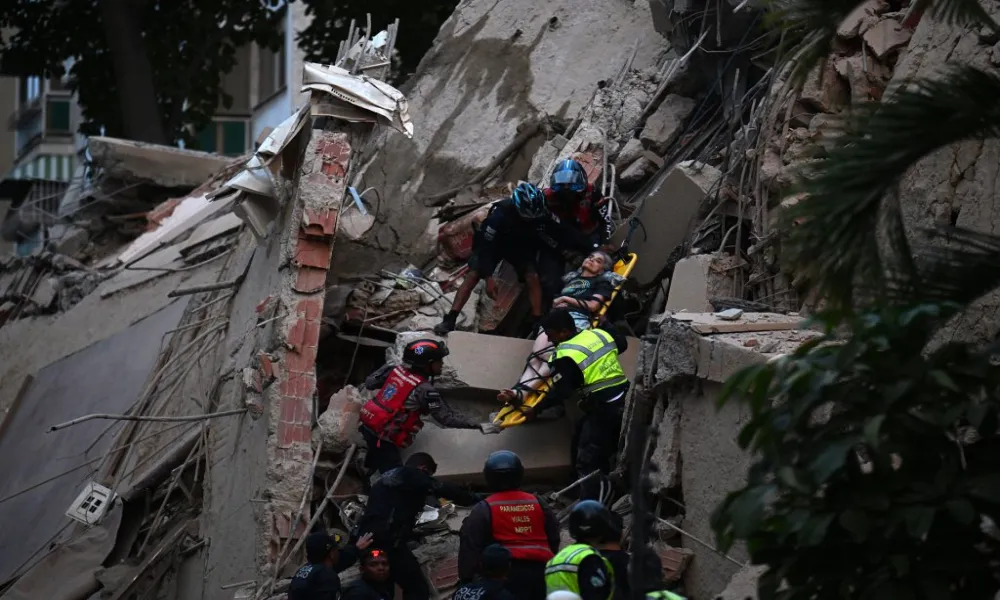
In Caracas, AFP journalists witnessed rescue operations being organised around collapsed buildings. Emergency workers were seen pulling survivors from the rubble on stretchers and transferring others to ambulances.
An AFP correspondent reported that a 22-storey residential building in the Altamira district had collapsed completely. Outside the wreckage, relatives called out the names of loved ones while volunteers climbed over debris in search of survivors.
"We need torches," one volunteer shouted as darkness fell.
Interior Minister Diosdado Cabello confirmed that several buildings had collapsed in the capital and said he had ordered the suspension of gas supplies.
"Some structures have been damaged and we want to avoid any gas-related accidents," he said.
While he confirmed there had been injuries, he did not provide any figures.
The situation remains unclear in the cities of Puerto Cabello and San Felipe, which are closer to the epicentre and home to more than 400,000 people.
Residents spend night outdoors
Thousands of residents rushed into the streets as the earthquakes struck. Many remained outside into the evening, fearing further aftershocks and additional building collapses.
"It was unbelievable. I don't even know how long it lasted," said Heidi Romero, a 42-year-old shop owner working in a shopping centre in Altamira.
"I was on the top floor and things started falling."
Odalis Escalona, a 54-year-old bank employee, said cracks appeared across a wall as items fell from the ceiling.
"It was terrifying," she said.
BREAKING: Multiple structures have reportedly collapsed in Caracas, Venezuela, following a powerful earthquake that struck the region. pic.twitter.com/9KSN4srhwB
— Breaking911 (@Breaking911) June 24, 2026
Power outages were reported across parts of the capital, while many streets were littered with broken glass.
Carmen Guedes, 69, said she was caring for her bedridden sister when the ground began to shake.
"The intensity just kept increasing," she said.
"I saw the windows shaking and then everything started moving. My sister, a neighbour and I held on to each other. We couldn't get outside."
Airport closed
Simón Bolívar International Airport, located in Maiquetía in La Guaira state around 40 kilometres from Caracas, was closed after suffering what Rodríguez described as "serious damage".
Images released by MP Wilmer Azuaje appeared to show sections of the terminal roof collapsing as frightened passengers fled the building.
The earthquakes were also strongly felt in neighbouring Colombia, although Bogotá lies around 1,000 kilometres from Caracas.
Colombia's National Unit for Disaster Risk Management said there was no tsunami threat to the country's Caribbean coastline.
The US Tsunami Warning System initially warned that potentially destructive waves could affect Puerto Rico, the US and British Virgin Islands, and islands off Venezuela's coast, including Aruba, Curaçao and Bonaire.
The warning was withdrawn approximately one hour later.