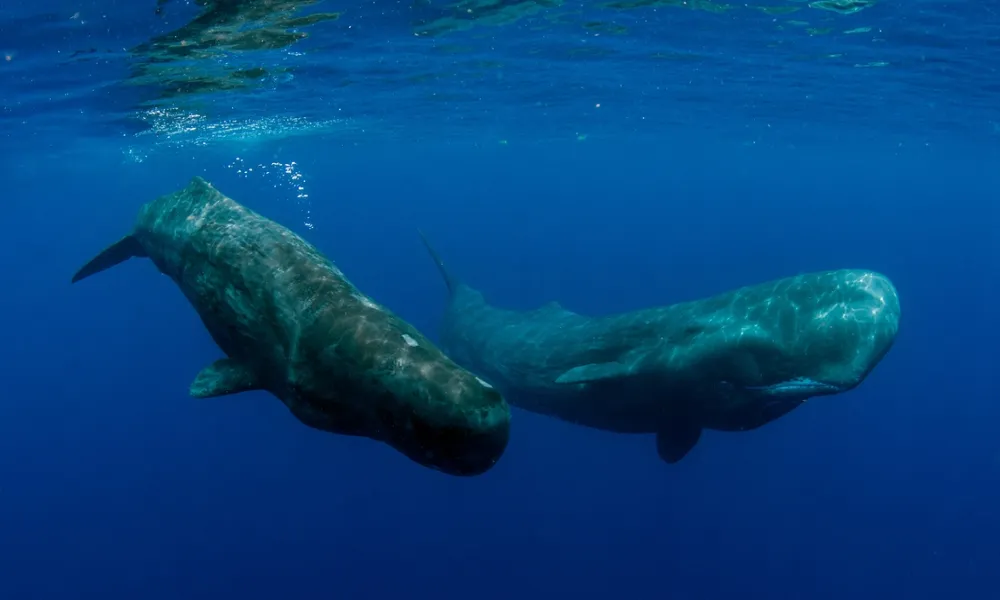

Sperm whales in the Mediterranean appear to be developing their own vocal dialects, offering researchers a rare glimpse into how animal culture can evolve over time.
New research led by the University of St Andrews and published in Proceedings of the Royal Society B found that sperm whales living in the eastern Mediterranean, around the Hellenic Trench off Greece, use a distinct and faster version of a vocal pattern previously associated with whales in the western Mediterranean.
The findings are based on two decades of underwater recordings from different parts of the basin, including the waters around the Balearic Islands and the deep marine habitats off Crete.
Sperm whales communicate through “codas”, short rhythmic sequences of clicks used in social interaction. These sounds are not random noise. They help the animals identify themselves as members of wider cultural groups, known as vocal clans, and are passed on through social learning.
Until now, scientists believed Mediterranean sperm whales largely belonged to a single vocal group, identified by a dominant coda pattern known as “3+1”: three clicks followed by a pause and then a fourth click.
The new study complicates that picture. Researchers found that whales recorded near the Hellenic Trench produced a quicker version of the same pattern, setting them apart from sperm whales recorded farther west, between Gibraltar and Italy.
What makes the discovery especially striking is that the eastern whales did not appear to have lost the older vocal form. On some days, they also used the slower western version of the coda, suggesting they were familiar with both styles.
Researchers say this points to cultural evolution in progress: a new dialect emerging while an older one remains part of the whales’ vocal repertoire.
The study also fits with what scientists believe about the history of sperm whales in the Mediterranean. The species is thought to have entered the basin through the Strait of Gibraltar around 20,000 years ago before gradually spreading eastwards.
That long movement across the Mediterranean may have helped shape differences between groups over time. In the eastern basin, the Hellenic Trench appears to have become an important centre for a distinctive whale community.
For the scientists involved, the discovery adds a new dimension to how the Mediterranean is understood. Its cultural history is not only human. While civilisations around the sea developed their own languages, customs and identities, sperm whales were also passing down vocal traditions from one generation to the next.
The findings may also have conservation importance. Mediterranean sperm whales are genetically isolated from other populations and number only a few thousand animals. They are considered endangered, with ship strikes and entanglement in fishing gear among the major threats they face.
The Hellenic Trench is one of their most important habitats, particularly for the eastern Mediterranean population. Better understanding how these whales communicate, organise socially and differ between regions could help researchers identify population structures that are otherwise difficult to see in the open sea.
Sperm whales have the largest brain of any known animal and live in complex social groups. Their communication is essential for life in deep water, where they coordinate social behaviour and hunting far below the surface.
The study does not answer every question. Scientists still do not know why the faster eastern dialect emerged, why it developed in that particular area, or how long such changes take to become established.
But the research offers one of the clearest examples yet that the Mediterranean’s living history is not confined to its shores. Beneath the surface, its largest toothed whales appear to be carrying their own cultural memory.
With information from CNA, University of St Andrews, Marine Mammal Protected Areas Task Force