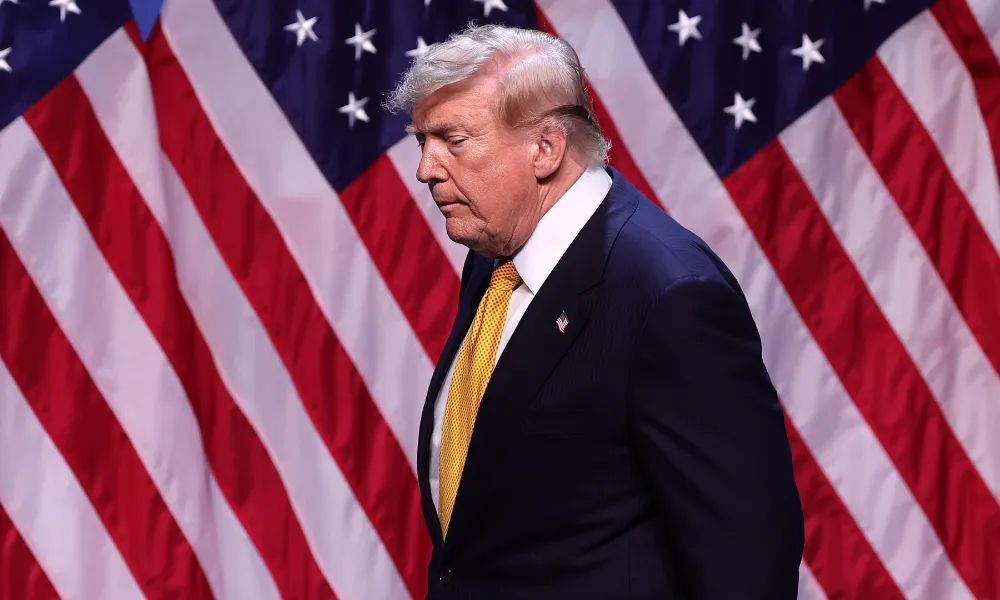

President Donald Trump renewed his campaign to cast doubt on US elections on Thursday, declassifying intelligence he said exposed fraud and foreign interference, despite intelligence findings and independent studies that undercut several of his claims, according to Reuters. Trump has asserted more than 100 times over the first half of 2026 that the 2020 election was "rigged," using those claims to push Congress toward a restrictive voter ID law known as the SAVE America Act, which would impose strict identification requirements on voters and expand federal involvement in elections. The bill has passed the Republican-controlled House of Representatives several times but lacks the 60 votes needed to overcome a Senate filibuster.
Trump accused Beijing of working to help Democrats in the 2018 midterms and to damage his 2020 re-election chances, and of compromising voter data. A prior US intelligence assessment reached a different conclusion. A 2021 review, conducted under John Ratcliffe, then Trump's director of national intelligence and now his CIA director, found that China considered running an influence operation to change the 2020 outcome but ultimately decided against it. That assessment found China had sought to collect information on US voters, public opinion and political parties dating back to at least 2008, but that the voter data obtained was not confidential and was not used to alter any votes.
Trump cited CIA documents on alleged election manipulation under former Venezuelan president Nicolás Maduro to argue that US voting machines are vulnerable to hacking, saying Maduro's government had been able to digitally alter vote totals. A CIA document summarising intelligence gathered between 2004 and 2020 found that the Venezuelan government had the technical capability to digitally manipulate votes domestically. There is no evidence such manipulation has occurred in a US election, and Trump did not allege it had. A theory spread by some of his supporters that the Maduro government hacked US voting machines in 2020 has been widely debunked.
Non-citizens on the voter rolls
Trump said a Department of Homeland Security review had identified around 278,000 non-US citizens registered to vote in federal elections, a claim he and his allies have repeatedly used to push for tighter voting restrictions. Several Republican-led states have voluntarily shared voter data with the administration to try to identify and remove non-citizens from their rolls, while the administration has lost 15 lawsuits seeking to compel other states, mostly Democratic-led, to hand over similar data, according to the election security publication Democracy Docket. Independent research has found non-citizen voting to be rare. The Bipartisan Policy Center found that when states checked voter eligibility, only 0.04% of cases involved non-citizens, and election experts have warned that large-scale voter roll purges risk disenfranchising eligible voters.
Trump also revived a long-debunked claim of fraud in Muskegon, a strongly Democratic city in Michigan, involving a large-scale voter registration operation. A police raid had recovered voter registration applications collected by a Tennessee-based registration company, and a subsequent review found some were legitimate while others were fraudulent or highly suspicious, due to forged signatures, incorrect addresses or other errors. The fraudulent registrations were voided before election day, and authorities said no votes tied to them were ever cast. The case was referred to the FBI in 2021, but no one was charged; Trump said FBI Director Kash Patel would reopen the investigation. Michigan Secretary of State Jocelyn Benson criticised the president for reviving what she called "long debunked and baseless conspiracy theories."
Suspicion over California's vote count
Trump equated the slow pace of vote-counting in last month's closely watched California governor and Los Angeles mayoral races with fraud, questioning the handling of mail-in ballots. The results were certified last week, more than a month after the primaries. California's count is typically slow in part because 80 to 90% of its 23 million voters cast ballots by mail. Neither Trump nor his allies have publicly produced evidence of fraud, and Trump-endorsed Republican candidate Steve Hilton finished second in the governor's race, advancing to the November general election. California Attorney General Rob Bonta disputed the fraud claims, telling NPR that "every count, recount, hand count, court case and audit" had repeatedly found no evidence of widespread voter fraud.
Source: Reuters