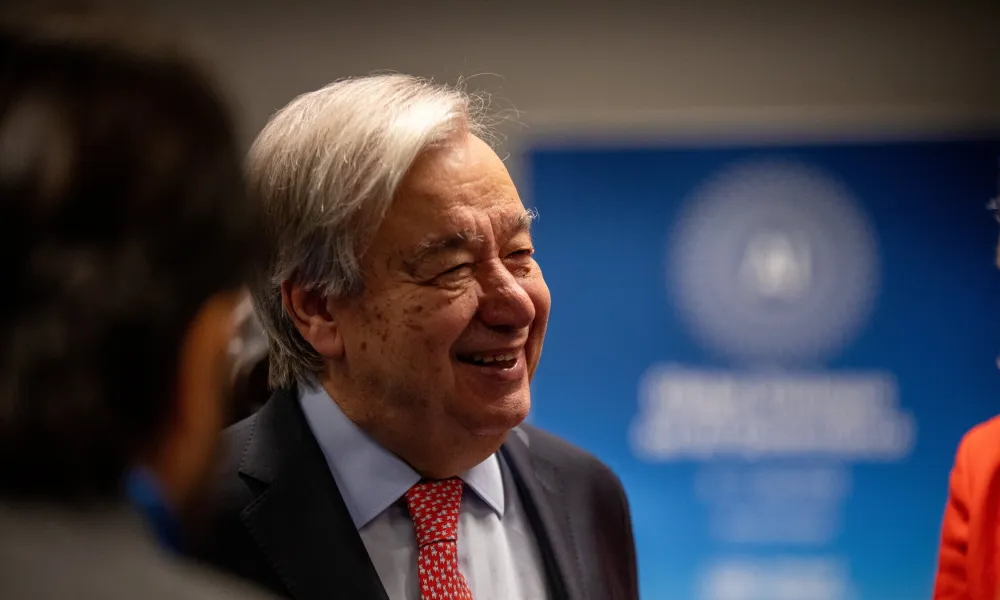

United Nations Secretary-General António Guterres will arrive in Cyprus on the evening of July 27 for a visit intended to determine whether the parties are ready to move from renewed diplomatic engagement to negotiations on the practical terms of a possible settlement.
During two days of meetings, Guterres will hold separate talks with Turkish Cypriot leader Tufan Erhürman and Greek Cypriot leader Nikos Christodoulides before chairing a trilateral session. He will also meet representatives of the bicommunal technical committees, highlighting the UN’s growing emphasis on implementation, practical cooperation and the durability of any future agreement.
The visit will be the first to the island by a serving UN Secretary-General since Ban Ki-moon in 2010. Its importance, however, lies less in its symbolism than in the political assessment Guterres is expected to make: whether sufficient common ground exists to convene another enlarged informal meeting involving the two Cypriot leaders, Türkiye, Greece and the United Kingdom.
Should that 5+1 meeting proceed, diplomatic sources say the Secretary-General is unlikely to present another all-or-nothing settlement blueprint. Instead, he is expected to advance an integrated framework of ideas that would allow the parties to negotiate individual chapters separately, with particular emphasis on implementation, sequencing, reciprocal commitments and safeguards against the consequences of failure.
Pending consultations with Ankara and Athens following the Cyprus visit, diplomats expect the enlarged meeting to be proposed for the final week of August or the beginning of September. The timetable has slipped from earlier expectations of a meeting in late July or early August, suggesting that the UN believes further political preparation is necessary before bringing the parties and guarantor powers back around the same table.
Holguín prepares the ground
Before Guterres arrives, his Personal Envoy María Ángela Holguín is expected to conduct another round of consultations with the two sides. Those meetings will focus on their assessments of the ideas circulated privately in recent weeks and on the corrections, clarifications and safeguards they want incorporated into any future negotiating framework.
UN officials continue to deny that a formal settlement blueprint or non-paper exists. Both sides also reject suggestions that they have been presented with a completed UN proposal. Nevertheless, diplomatic contacts acknowledge that a relatively coherent collection of ideas has become the reference point for current discussions.
Those ideas reportedly include politically equal constituent states exercising extensive internal authority, limited common competences, effective Turkish Cypriot participation in central decision-making, phased territorial arrangements, direct trade and direct flights, transitional measures and simultaneous referendums after an implementation period of two or three years.
Rather than transforming those ideas immediately into a formal UN plan, Guterres is expected to invite the parties to examine each component separately. Diplomats describe the proposed methodology as modular and implementation-oriented, allowing agreement to be built chapter by chapter instead of requiring the parties to accept or reject a comprehensive package at the outset.
Such an approach would mark a departure from earlier Cyprus initiatives, particularly the Annan Plan, in which a highly detailed constitutional and territorial package was ultimately submitted as a single settlement proposition. The emerging strategy appears designed to prevent disagreement over one chapter from bringing the entire process to an immediate halt.
It also carries risks. Deferring final decisions may keep negotiations alive, but it could transfer unresolved political differences into the implementation stage, where disagreements would affect functioning institutions, economic arrangements and people’s daily lives rather than theoretical constitutional provisions.
From constitutional design to implementation
Diplomatic sources say the principal concern expressed by both sides is no longer only the institutional form of a settlement. Increasing attention is being devoted to what would happen during the transition between political agreement and final approval in simultaneous referendums.
Current discussions envisage a period of two or three years in which elements of a settlement would gradually enter into force. Territorial adjustments, new administrative structures, economic integration, security arrangements and changes in international access could begin before the final constitutional order was permanently endorsed.
Supporters of the approach argue that a transition would allow both communities to test cooperation, experience practical benefits and correct problems before taking a final decision. It could also reduce the uncertainty that has surrounded previous referendum campaigns, when voters were asked to approve complex arrangements that had never been tested.
The central difficulty is irreversibility.
If implementation begins before final approval, new political and economic realities may emerge that cannot easily be dismantled should either community later reject the settlement. Officials involved in the discussions say both sides want clearer guarantees that transitional steps will not expose them to permanent losses if the broader process collapses.
That concern explains why diplomats increasingly speak of an implementation architecture rather than a timetable. The issue is not merely when each measure enters into force, but under what legal authority, with what safeguards and subject to what consequences if the final agreement fails.
Varosha, Ercan (Tymbou) and Famagusta
Varosha is frequently cited as the clearest example. Greek Cypriot officials are seeking details of proposals under which former residents could begin returning to the fenced-off district before the final settlement formally takes effect. Such a move is widely viewed as a reciprocal measure linked to the opening of Ercan (Tymbou) Airport and Famagusta Port to international travel and trade.
The difficulty is what would follow if the settlement later failed. Once residents had returned, property had been restored and commercial life had resumed, reversing the process would be practically and politically impossible. Greek Cypriot officials are therefore asking for legal certainty over territorial arrangements and the authority responsible for their implementation.
The Turkish Cypriot side is raising a comparable concern regarding direct flights, direct trade and direct international contacts. If those measures were introduced during the transition, Turkish Cypriot officials want to know whether they would survive the collapse of the broader political process or disappear once again, leaving the community to absorb the economic and political costs.
Similar questions surround the legal operation of Ercan (Tymbou) Airport and Famagusta Port. International aviation, customs supervision, taxation, regulatory authority and commercial liability require precise arrangements from the first day. Constructive ambiguity may help negotiators begin discussions, but it cannot indefinitely govern airports, ports and international commerce.
Türkiye’s implementation of the Additional Protocol to the Ankara Agreement presents another sequencing challenge. Full diplomatic normalisation between Ankara and the Republic of Cyprus is generally expected only after a settlement, yet transitional arrangements could require Türkiye gradually to open its ports and airports to Greek Cypriot traffic while Turkish Cypriot access to international markets expands in parallel.
Diplomatic sources say neither side is prepared to make potentially irreversible commitments without guarantees that reciprocal measures will advance simultaneously and remain legally protected throughout the transition.
Schengen complicates the timetable
The implementation debate is unfolding as the Republic of Cyprus advances towards membership of the Schengen Area. The European Commission is expected to transmit its technical assessment to the Council of the European Union in September, moving the process into its political phase at roughly the same time as the anticipated 5+1 meeting.
Greek Cypriot officials maintain that accession will not transform the Green Line into an external Schengen border and that movement across it will continue under the Green Line Regulation. Even so, Schengen membership will introduce additional obligations involving border management, travel documents, visa procedures and information-sharing systems.
Those obligations intersect directly with the settlement discussions. If Ercan (Tymbou) Airport and Famagusta Port begin operating internationally during a transition, their relationship with the Schengen system will require a clearly defined legal arrangement.
Questions also remain over Turkish nationals married to Turkish Cypriots, children from mixed marriages and others whose citizenship or travel status remains unresolved. Turkish Cypriot officials fear that Schengen could deepen existing restrictions unless accompanied by measures protecting movement and international access. Greek Cypriot officials insist that any arrangement must preserve the integrity of the EU’s border regime.
Diplomats say Schengen is therefore no longer a separate technical process. Its timing and implementation could shape the environment in which any new Cyprus framework would have to operate.
The EU’s necessary but disputed role
The European Union has emerged as another sensitive component of the diplomacy. The UN remains the recognised political facilitator, but many of the measures under discussion fall within EU competence, including customs, trade, Schengen, financial assistance, infrastructure, application of the acquis communautaire and post-settlement economic integration.
The debate intensified after the European Commission appointed Executive Vice-President Raffaele Fitto as its Special Representative for Cyprus. Brussels presented the appointment as support for the UN-led process and an effort to improve coordination between the Commission and the negotiations.
The Turkish Cypriot side and Ankara reacted critically. Tahsin Ertuğruloğlu described the appointment as unilateral and argued that the European Union had again disregarded the political equality of the two communities. Turkish Foreign Ministry spokesman Öncü Keçeli said the decision was an internal EU matter carrying no political standing for Türkiye or the Turkish Cypriot side.
Erhürman, who has argued that the EU should not become a political party to the negotiations but must remain sufficiently close to deal with the legal consequences of a settlement, did not publicly comment on the appointment. He is nevertheless expected to meet Fitto during the Commission representative’s contacts on the island.
The controversy reflects a longstanding disagreement. Turkish officials argue that the EU lost its claim to neutrality when it admitted the Greek Cypriot-controlled Republic of Cyprus in 2004 despite the Greek Cypriot rejection of the Annan Plan and the Turkish Cypriot endorsement of it. From Ankara’s perspective, Brussels is institutionally bound to support one of its own member states.
At the same time, excluding the EU from implementation would be impractical. A settlement would have to operate within the Union’s legal and economic order. Permanent derogations, transitional provisions, customs arrangements, financial support, infrastructure and Schengen-related questions would all require European approval and technical participation.
Diplomats increasingly distinguish between mediation and implementation. Under that emerging division of labour, the UN would retain political control of the negotiations, while the EU would provide legal, financial and technical support without becoming a separate political mediator.
Maintaining that distinction may prove essential. Too little EU involvement would leave major implementation questions unresolved. Too much political involvement could reinforce Turkish and Turkish Cypriot concerns that the process is no longer being managed by a neutral facilitator.
Security and the Türkiye-EU dimension
Security remains one of the least developed areas of the discussions. Reports have referred to possible multinational arrangements involving NATO countries, but diplomatic sources say no formal proposal has been tabled.
Turkish Cypriots continue to regard Türkiye’s effective guarantee as indispensable, while Greek Cypriots maintain that a reunited island should not remain subject to unilateral intervention rights or the permanent military presence of another state. Neither side appears ready to embrace NATO membership for a future partnership state.
The Cyprus process is also becoming more closely connected to the wider relationship between Türkiye and the European Union. Diplomatic sources say implementation is being examined alongside Customs Union modernisation, visa facilitation, cooperation through the SAFE defence instrument and a broader restoration of political dialogue.
The objective is to allow progress on Cyprus and in EU-Türkiye relations to advance in parallel rather than making one entirely dependent on the prior completion of the other. Ankara has long opposed a sequence in which it undertakes major commitments on Cyprus while European decisions remain uncertain. EU officials, meanwhile, continue to link meaningful improvement in relations with Türkiye to progress on the island.
Binding the two tracks together could provide reciprocal incentives, but it would also make the process more vulnerable. Delays over the Customs Union, SAFE or visa issues could weaken confidence in Cyprus implementation, while difficulties on the island could obstruct wider political normalisation.
A test of political readiness
Guterres’ visit is not expected to produce an immediate breakthrough. Its purpose is to establish whether the two leaders and the guarantor powers are prepared to move from general declarations towards negotiations on implementation, sequencing and reciprocal commitments.
The agenda has expanded far beyond traditional constitutional questions. It now includes Varosha, Ercan (Tymbou), Famagusta, Schengen, the Ankara Protocol, guarantees, direct trade, direct flights, Customs Union modernisation, SAFE cooperation, the EU’s institutional role and the legal consequences of a settlement failing after implementation has begun.
The proposed chapter-by-chapter methodology may make it easier to begin negotiations by avoiding an immediate all-or-nothing confrontation. Its success, however, will depend on whether separate agreements can ultimately be assembled into a coherent settlement without leaving the most difficult political questions unresolved.
That is the central test facing Guterres in Cyprus. Earlier initiatives were judged largely by whether the parties could agree on a constitutional formula. The next phase is likely to be judged by whether they can construct an implementation framework capable of surviving political uncertainty before a final settlement takes effect.
Whether the parties are prepared to accept that risk will determine if the anticipated 5+1 meeting opens a substantive negotiating process or becomes another carefully managed episode in Cyprus’ long diplomatic history.