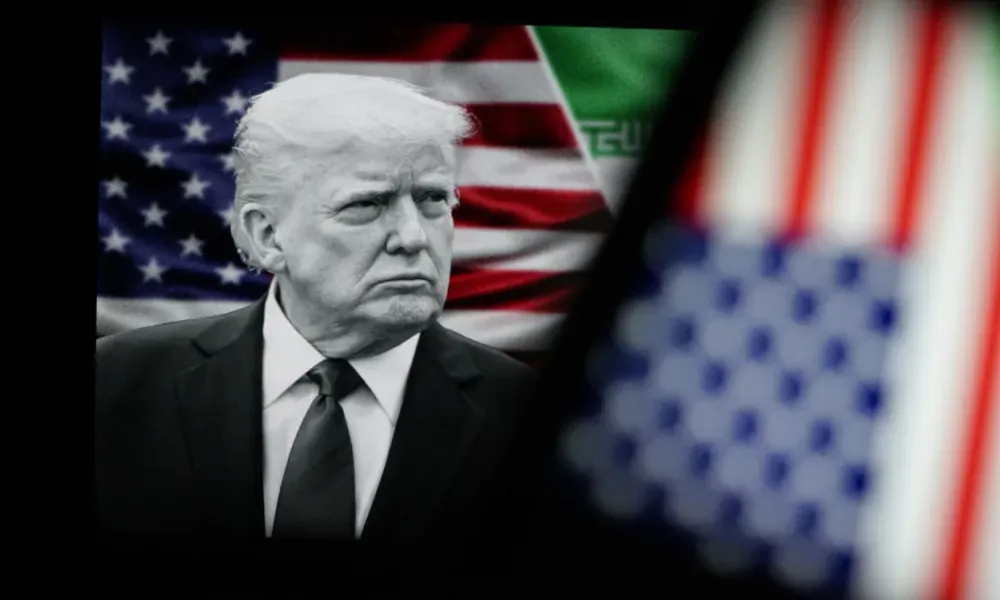

US President Donald Trump said on Monday there was a "good chance" that talks with Iran could produce results, while Iranian officials denied that any negotiations were taking place with Washington, on the third day of a pause in hostilities between the two countries.
"We'll see what happens. I think there's a good chance something can be worked out," Trump told reporters aboard Air Force One before travelling to Michigan.
"Right now, they're talking to us about reaching a deal," he claimed, without providing further details.
Iran's position was markedly different.
Foreign Ministry spokesman Esmaeil Baghaei said that Iran was currently conducting "no negotiations whatsoever with the United States".
At the same time, Trump warned that the United States could resume bombing Iran if talks fail, dismissing concerns raised in media reports, including a report by The New York Times, about potential shortages of munitions for American air defence systems.
After 15 days of exchanges of strikes that effectively destroyed the initial Islamabad Memorandum of Understanding, signed in mid-June and intended to end the conflict, hostilities were suspended on Saturday.
Conflict spreads beyond main front
Although fighting has stopped on the main front of the war, which began six months ago on 28 February with the US-Israeli attack on Iran, tensions have continued elsewhere in the region.
Saudi Arabia, a key US ally, announced on Monday that it had intercepted a drone attack launched from Iraqi territory.
Riyadh blamed what it described as "Iran-backed terrorist militias," although no group claimed responsibility.
After Saudi Arabia demanded that Iraq take all necessary measures to prevent its territory from being used as a launch point for attacks, the Iraqi government announced an investigation.
During earlier stages of the conflict, Saudi Arabia and other Gulf monarchies frequently blamed Iraqi Shiite armed groups aligned with Tehran for similar attacks. However, those groups have not claimed responsibility for any strikes since hostilities resumed earlier this month.
Houthi attacks on Saudi targets
In Yemen, the Ansar Allah movement, better known internationally as the Houthis, announced that it had struck "sensitive targets" and facilities involved in Saudi Arabia's crude oil transport and delivery operations near Yanbu on the Red Sea coast.
Yanbu is the terminal point of one of Saudi Arabia's major oil pipelines.
Saudi Arabia, the main backer of Yemen's internationally recognised government, and the Houthis resumed hostilities on 13 July, ending a four-year truce.
On 20 July, the Houthis declared that they would prevent Saudi vessels from operating in the Red Sea and Gulf of Aden, targeting the world's largest oil exporter.
Iran rejects US role in Hormuz talks
Speaking in Tehran, Baghaei said Washington had played no role in recent discussions with the Sultanate of Oman concerning management of the Strait of Hormuz, which Iran has once again closed.
Before the conflict, approximately 20% of the world's oil and liquefied natural gas supplies passed through the strategic waterway.
US-Iran hostilities resumed on 7 July, fuelled by tensions surrounding the strait.
US forces have since announced strikes against hundreds of military targets, while Iranian forces launched missiles and drones against regional US allies, primarily targeting American military installations.
Iran insists on maintaining control of the strait and intends to impose transit fees, a proposal firmly rejected by Washington.
According to Iranian state television, the Revolutionary Guards navy prevented six commercial vessels from transiting the strait on Monday because they were following unauthorised routes.
In response, the United States has reinstated a blockade of Iranian Gulf ports since the middle of the month.
Iran's Khatam al-Anbiya Central Headquarters accused the United States of threatening several vessels in the region over the past three days and warned that it would respond, describing the move as an expansion of the conflict.
Markets show signs of relief
Despite the continuing tensions and shipping disruptions, oil markets appeared increasingly optimistic.
The price of Brent crude, the international benchmark, fell to around $90 per barrel on Monday, down approximately 11%, in what analysts interpreted as a sign of growing confidence that the crisis may ease.
Meanwhile, Israeli Prime Minister Benjamin Netanyahu is expected at the White House on Tuesday for his first meeting with Trump since the conflict began on 28 February.
Despite reported tensions between the two leaders, Netanyahu said on Sunday that he fully supports Trump's efforts to end what Israel describes as Iran's pursuit of nuclear weapons.
Iran has repeatedly denied for decades that it seeks to develop a nuclear arsenal.
"If we could achieve that without intense fighting, that would be good," Netanyahu told Fox News.