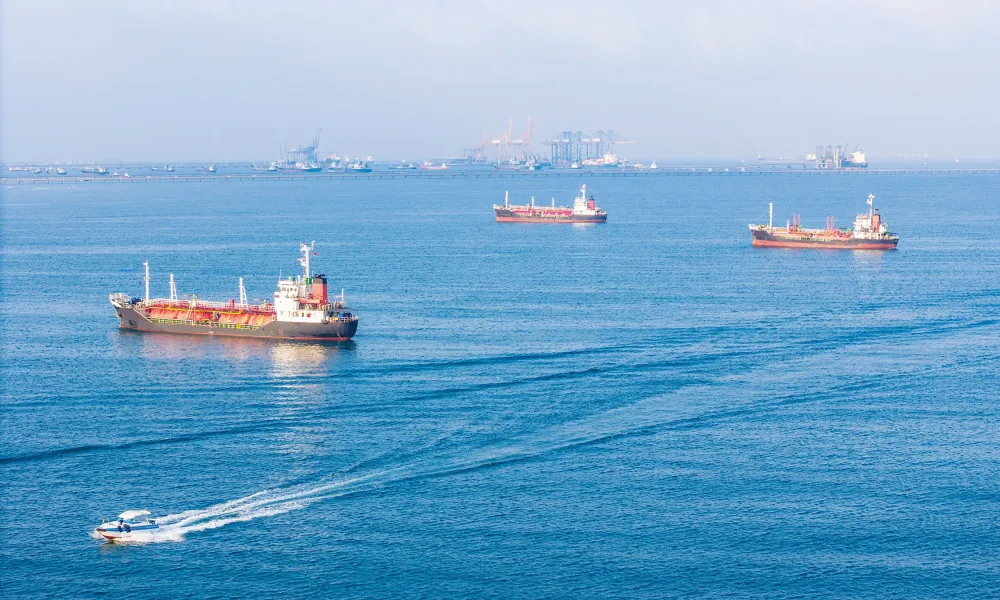

Tensions in the Middle East escalated sharply again on Wednesday after Iran's Revolutionary Guards announced they had struck three oil tankers in the Strait of Hormuz and launched ballistic missiles at US military targets in Jordan, ending several days of relative calm in the conflict.
The renewed hostilities came only days after US officials said an informal understanding had been reached to halt military operations, raising hopes of de-escalation.
Iran rejects Omani proposal
The escalation came hours after Tehran rejected an Omani proposal for joint regional management of the Strait of Hormuz.
The plan envisaged a system of voluntary contributions from transiting vessels to fund navigation, search and rescue services, modelled on arrangements in the Strait of Malacca.
A senior Iranian official told Reuters that the proposal had no chance of success, insisting that the inbound shipping channel must remain under exclusive Iranian control. The official also accused the United States and Saudi Arabia of pressuring Oman to promote what he described as "unrealistic plans."
Missile attack
According to the US Central Command (CENTCOM), Iran's Revolutionary Guards launched multiple ballistic missiles from Iranian territory towards US forces in the Middle East, although all were successfully intercepted.
Jordan's military said it shot down five Iranian missiles.
Meanwhile, the Revolutionary Guards' naval force, speaking through the Tasnim news agency, claimed that the three tankers targeted in the Strait of Hormuz had violated Iranian instructions and ignored warnings. No details were provided regarding the vessels' flags or nationalities.
The United States and Saudi Arabia responded with joint air strikes against pro-Iran militias in eastern Iraq, citing attacks on US forces and Saudi oil facilities.
The Popular Mobilisation Forces (PMF), an umbrella organisation of paramilitary groups formally incorporated into Iraq's security apparatus in 2016, said its headquarters in Basra had been struck, leaving two people injured.
Several of the PMF's most powerful factions maintain close ties to Iran's Revolutionary Guards and form part of Tehran's so-called Axis of Resistance, alongside Hezbollah, Hamas and the Houthis.
Trump vowed a strong response, telling Fox News that US forces had only minutes to intercept the missiles before they reached their targets.
"We will defeat them completely. We will hit them very hard," he said.
The US president described the pro-Iran militias as "a cancer on the world" and said additional warnings to Iran were under consideration.
Trump added that he had reviewed footage showing US personnel relaying coordinates in real time during the interception operation, while noting that the strikes in Iraq had been carried out in coordination with the Iraqi government.
Oil prices jump
Global markets reacted immediately to the escalation.
US benchmark WTI crude rose 3.67% to $82.17 a barrel, while Brent crude gained 3.39% to $86.94 a barrel, reversing declines recorded in previous days.