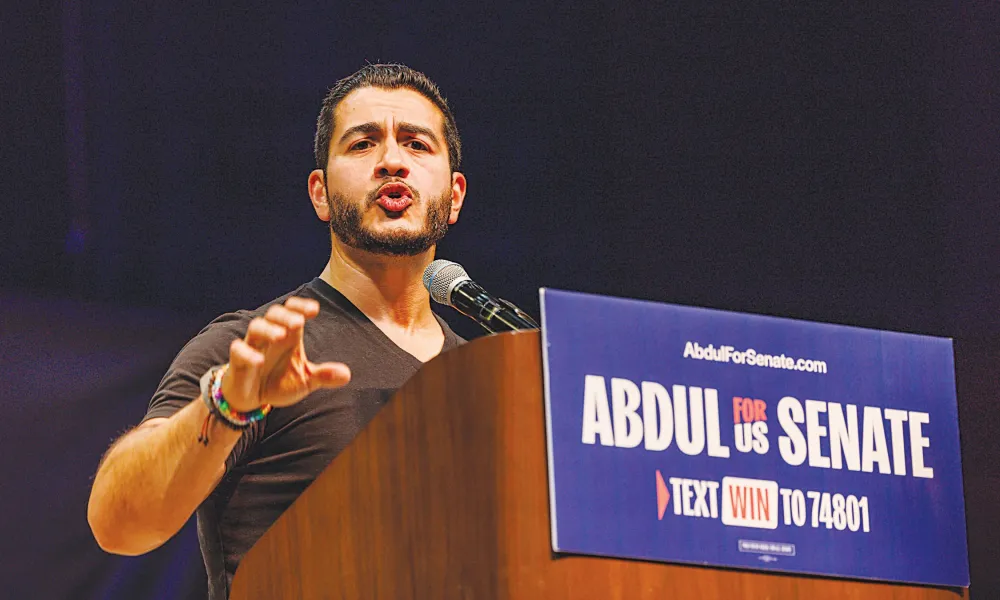

Progressive Democrat Abdul El-Sayed celebrated his victory in Michigan's Democratic Senate primary wearing a suit, a change that was more than symbolic.
The candidate who had turned a black T-shirt and jeans into his political trademark appeared already to be moving from the confrontational logic of an internal party battle to the demands of a highly competitive general election campaign.
His victory over moderate Congresswoman Haley Stevens is being viewed as one of the most significant successes for the Democratic Party's progressive wing in recent years. The result is notable not only because it came in a state won by Donald Trump in 2024, but also because it was achieved despite a massive financial effort by organisations linked to the pro-Israel lobby group AIPAC in support of Stevens.
In November, El-Sayed will face Republican Mike Rogers, a former member of the House of Representatives, in a contest that extends beyond the two candidates and has become a test of competing theories about how to win over the political centre.
Defeat for the party establishment
El-Sayed's victory carries added significance because Stevens enjoyed the backing of influential sections of the Democratic establishment and political figures who viewed her as the safer candidate.
The race became one of the most expensive Democratic primaries in recent history, with tens of millions of dollars in outside spending directed against El-Sayed.
Rather than isolating him, however, that strategy strengthened his image as a candidate willing to challenge entrenched centres of power.
Whether that approach will succeed in the general election remains uncertain. Republicans are expected to portray his positions on Israel, healthcare and immigration as evidence of political radicalism.
The challenge of party unity
El-Sayed's first task is to reunify Democrats after a particularly hard-fought primary contest.
The party's moderate wing remains concerned that his positions could cost Democrats a Senate seat considered crucial to efforts to regain control of the chamber.
Nevertheless, Stevens and other party figures have said they will support him against Rogers.
That support will now need to translate into fundraising and active voter mobilisation among constituencies that backed Stevens in the primary, particularly African American communities, Jewish voters across the state and suburban voters around Detroit.
Rogers responded aggressively to the result, accusing his opponent of ideological extremism that would make Michigan less safe.
At the same time, leading figures in the progressive movement quickly rallied behind El-Sayed's campaign, viewing the victory as proof that a clear political identity can be more effective than adapting to traditional assumptions about electability.
A high-stakes test for Democrats
Michigan is a seat Democrats cannot easily afford to lose if they hope to regain control of the Senate.
El-Sayed's candidacy represents both opportunity and risk. It could demonstrate that a progressive candidate is capable of building a new electoral coalition. Equally, it could validate moderate concerns that the rhetoric of intra-party confrontation struggles to appeal to the broader electorate.
His gradual return to wearing a suit is being interpreted as an early sign of adaptation, as the combative primary candidate seeks to present himself as a credible senator-in-waiting ahead of one of November's most closely watched races.