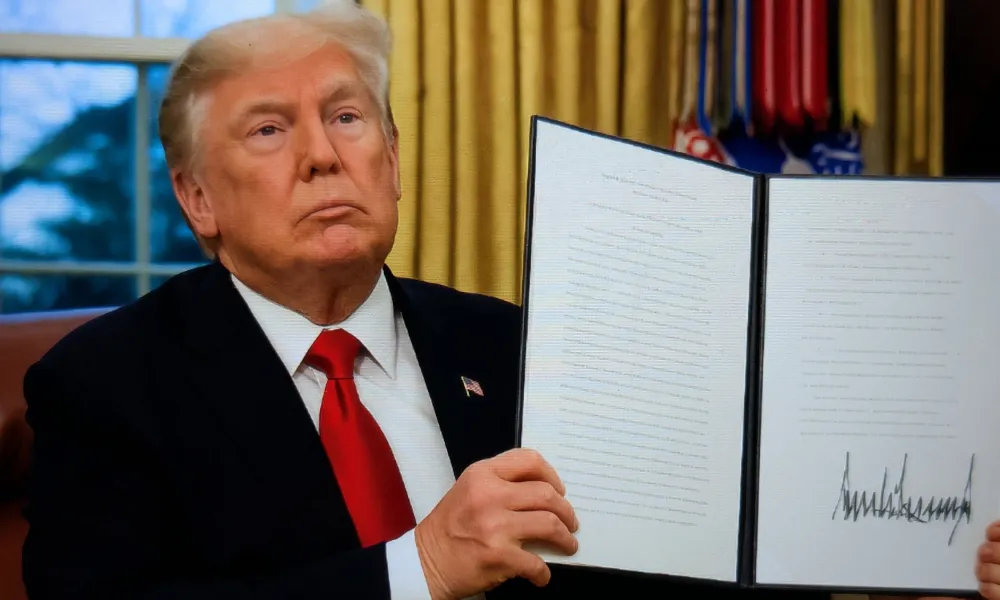



President Donald Trump signed two executive orders on Thursday aimed at limiting who qualifies for birthright citizenship and cracking down on what the administration calls "birth tourism," in which women travel to the United States to give birth so their newborns automatically receive citizenship, the New York Times reported.
The orders came weeks after the US Supreme Court, in a six to three ruling, rejected Trump's earlier attempt to end birthright citizenship for undocumented immigrants through executive action. According to the New York Times, Trump told reporters during an Oval Office event that the court's ruling on 30 June was a "very, very unfortunate decision."
What the orders would do
The New York Times reported that it remained unclear how the two orders could realistically be enforced. They would narrow eligibility for birthright citizenship to exclude the children of staff working for foreign governments while posted in the United States, as well as the children of mothers who misrepresent their reasons for visiting the country while pregnant. A third category, covering babies born in US territories, would first require action by Congress. The orders would also apply to children of parents the government designates as members of known terrorist groups or as "alien enemies."
The paper noted that Trump has criticised birthright citizenship for years, using it as a political tool in his broader push to restrict legal immigration, and that he took the unusual step of attending oral arguments in the case at the Supreme Court, a first for a sitting president.
Officials defend the orders
According to the New York Times, Stephen Miller, Trump's top domestic policy adviser, and Will Scharf, the White House staff secretary, described the orders as important corrections to the current system. Miller argued that the 14th Amendment's citizenship guarantee had a single, narrow original purpose, saying it "had no other meaning and purpose outside of that." Scharf described birth tourism as having grown from isolated cases into what he called "organised rings, at times criminal rings," facilitating the practice for tens of thousands of people, and said the administration was considering denying visas to visitors suspected of travelling to the country solely to give birth there.
A Department of Homeland Security official, granted anonymity because they were not authorised to discuss the orders, told the paper that the birth tourism order added nothing new from an enforcement standpoint, since it largely restated existing law.
The New York Times reported that when a reporter noted the administration's own solicitor general had been unable to tell the Supreme Court how many people benefit from birthright citizenship, Trump said the number was in the hundreds of thousands. The paper cited a study by Pennsylvania State University researchers, published around the time of the court's ruling, which found that fewer than 0.3% of all births in the United States in any given year were to tourists. Trump went on to cite unverified accounts of individuals arriving in the country with dozens of children and again described birthright citizenship as intended for the children of formerly enslaved people. The New York Times noted this account was inaccurate, since the amendment was ratified more than three years after the end of the Civil War, not immediately afterward as Trump suggested.
Legal challenges expected
The paper reported that any new attempt to restrict which children automatically receive citizenship would likely face fresh legal challenges, including over how the administration defines "alien enemies" and invading armies, categories lower courts have already rejected in separate cases involving the administration's immigration policies. Federal law grants the government broad authority over entry to the country but also prohibits discrimination in immigrant visa decisions, meaning restrictions targeting pregnant women from certain countries could similarly face discrimination claims, the New York Times reported.
In its ruling on 30 June, a five-justice majority found that birthright citizenship is guaranteed under the Constitution, meaning changing the principle would likely require a constitutional amendment rather than an executive order. A sixth justice, Brett Kavanaugh, said he would have rejected Trump's order on statutory rather than constitutional grounds. The New York Times noted that Trump asked the court to reconsider its decision shortly afterward, a request rarely granted, and that the deadline for such a filing passed last week without the White House following through.
Responding to Thursday's orders, Cody Wofsy, deputy director of the ACLU's Immigrants' Rights Project, said in a statement that the Supreme Court had already settled the matter, arguing that "no additional executive order can change the meaning of the Constitution."
Source: The New York Times