
Developments surrounding Iran and the United States shifted sharply in New York on Tuesday, from President Donald Trump threatening the “elimination” of the Islamic Republic to reports of a three-hour meeting between US and Iranian officials on the sidelines of the UN General Assembly.
Trump later described the talks between members of his administration and Iranian officials as “very good”, while Iranian state media reported that Foreign Minister Abbas Araghchi met US Special Envoy Steve Witkoff.
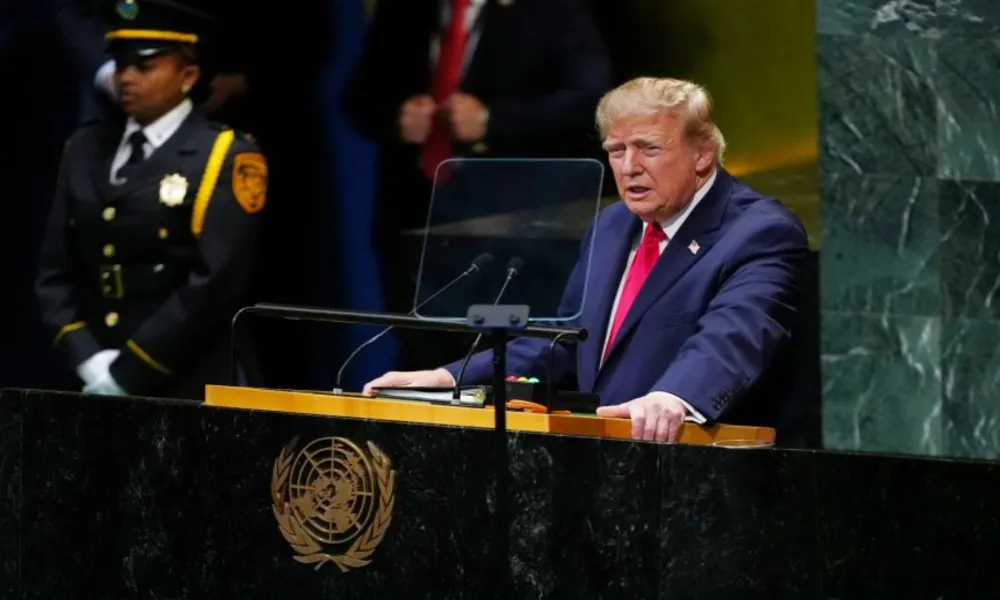
The meeting came just hours after Trump addressed the General Assembly, presenting Tehran with a choice between reaching an agreement or facing the “elimination” of the Islamic Republic.
Tehran sets three conditions for Hormuz
According to Iranian state media, Araghchi presented Witkoff with Tehran’s conditions for reopening the Strait of Hormuz.
The three reported conditions are:
- The immediate lifting of the US naval blockade.
- The immediate release of frozen Iranian funds.
- An end to hostilities on all fronts.
An Iranian official had earlier told Reuters that Tehran could reopen Hormuz within seven days if Washington eased military pressure and lifted the blockade of Iranian ports.
‘Rebuilding or elimination’
In his UN address, Trump said he faced a major decision, presenting the alternatives as reaching an agreement that would allow Iran to rebuild or the “elimination” of the Islamic Republic.
The US president also suggested that an agreement with Tehran could be reached after the US midterm elections in November.
Iranian President Masoud Pezeshkian is expected to address the UN General Assembly on Wednesday, as attention remains focused on the possibility of further contacts between the two sides.
Arab states seek to mediate
Behind-the-scenes diplomacy has also continued in New York, with Arab states seeking to facilitate further engagement between Washington and Tehran and encourage de-escalation.
Araghchi held talks with Qatar’s Prime Minister and Foreign Minister Mohammed bin Abdulrahman Al Thani, who has been playing a role in contacts between the United States and Iran.
US Secretary of State Marco Rubio has said Trump remains open to meeting Iranian officials in New York, although no such meeting has been finalised.
Revolutionary Guards warn of escalation
Meanwhile, Islamic Revolutionary Guard Corps spokesman Hossein Mohebi warned that Iran would intensify its retaliation in the event of further US attacks.
Speaking to AFP in Tehran, he said Iran’s response would become more aggressive and claimed that Tehran had tightened its conditions for ending the war.
Mohebi also said the Revolutionary Guards do not want direct dialogue with the United States, arguing that diplomatic contacts are the responsibility of Iran’s diplomats.
The contrasting signals leave open the possibility of further diplomacy in New York, but with substantial differences remaining over Hormuz, military pressure and the terms under which the conflict could be brought to an end.
Source: CNN, AP and AFP