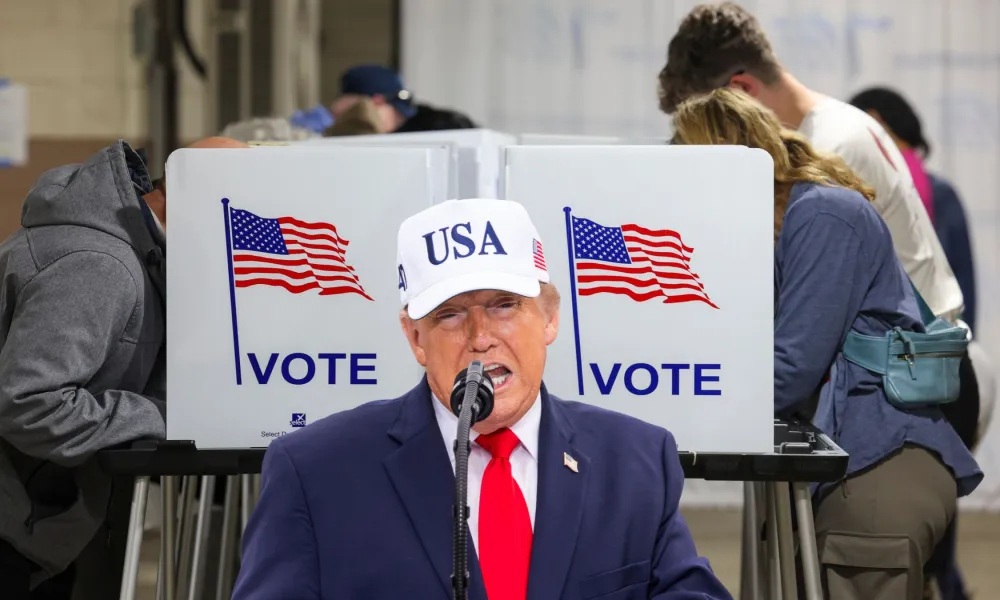

European leaders may be tempted to welcome a Democratic victory in the US midterm elections, but such an outcome would not necessarily lead to smoother transatlantic relations, according to a Politico analysis.
In an article titled Why Europe Shouldn't Celebrate a Democratic US Midterm Victory, journalist Jamie Dettmer argues that while Democratic control of Congress could constrain President Donald Trump on domestic issues, it would do little to limit his authority in foreign policy and trade.
Limits on Trump at home, not abroad
The analysis suggests that a Democratic Congress would be able to challenge parts of Trump's domestic agenda through oversight and investigations.
However, foreign policy remains an area where the White House retains broad executive powers, meaning Trump could continue to shape Washington's approach to security, diplomacy and trade with relatively limited congressional interference.
Warning from Wolfgang Ischinger
Former Munich Security Conference chairman Wolfgang Ischinger cautioned against assuming that a Republican setback would automatically improve relations between Washington and European capitals.
According to Ischinger, public celebrations in Europe over a Democratic victory could even irritate the White House and deepen tensions.
He also suggested that if Trump were confronted with congressional investigations or impeachment efforts, he could increasingly focus his presidency on international affairs, resulting in:
- Greater pressure on European allies
- New trade disputes
- More difficult cooperation on security matters
Ukraine and NATO remain uncertain
Former US ambassador to NATO, Kurt Volker, offered a similar assessment.
While Democrats are generally more supportive of Ukraine and the Atlantic alliance, he argued that congressional control would not allow them to dictate Trump's foreign policy decisions.
Although Congress can approve funding, disputes could still arise over how money is allocated and managed, particularly regarding support for Kyiv.
Volker also said a Democratic victory could trigger extensive congressional investigations into Trump, members of his family and administration officials.
On Iran, he noted that it remains unclear whether Trump would favour stronger military measures or shift more responsibility for managing regional tensions to European and Asian partners.
European populism and MAGA
A different perspective came from Nathalie Tocci, a former adviser to two EU foreign policy chiefs.
Tocci argued that European restraint is unlikely to alter Trump's behaviour significantly and said the US president does not require much encouragement to clash with Europe.
At the same time, she suggested that a weaker MAGA movement could encourage liberal and centrist political forces in Europe because of its links with several European populist and far-right parties.
The analysis notes, however, that it would be premature to conclude that populism is in decline, pointing to the continued strength of Marine Le Pen in France and growing support for Alternative for Germany (AfD).
A broader shift in US priorities
The wider issue, according to Bronwen Maddox, director of Chatham House, is that changes in American politics extend far beyond Trump himself.
Maddox argues that Trump's two presidential victories reflect a broader shift among US voters towards domestic priorities and a reassessment of America's global role.
In her view, European governments initially underestimated both the significance of the MAGA movement and the longevity of its influence.
That shift, she said, is increasingly shaping both major US parties, meaning Europe cannot simply assume a return to traditional transatlantic relations if political control changes in Washington.
Europe's strategic challenge
The central conclusion of the Politico analysis is that a weaker Trump at home would not necessarily mean a weaker Trump abroad.
Instead, domestic political pressures could encourage the US president to focus more heavily on areas where he retains substantial executive authority, including foreign affairs and trade.
For Europe, the key issues remain:
- Security and defence
- Support for Ukraine
- NATO cooperation
- Trade relations with Washington
- The pursuit of greater strategic autonomy
The article argues that European governments should prepare for long-term changes in the transatlantic relationship regardless of the outcome of the US midterm elections.