
The frustration of Limassol residents on the question of traffic is enormous. The situation is out of control and worsens with every passing day. The central government fools us and cannot find solutions: in Nicosia two ring roads are being built, while in Limassol we are still searching for a way to finally get the northern bypass off the ground. The park-and-ride scheme has become a running joke, and the local municipalities, however willing they may be to help, have neither the authority nor the funds for the large-scale interventions that would actually make a difference. Into this picture enters the notorious Sustainable Urban Mobility Plan, known by its Greek acronym SUMP, which has been gathering dust in some drawer since 2019, with minimal political will to advance it and minimal funds to make even a start.
The Department of Public Works finally decided in 2022 that something had to be done about Limassol. Discussions had begun before that, but wherever planners tried to intervene and make real changes, they found resistance at every turn. One resident objected to a one-way street, another disliked a pedestrian zone, the next scoffed at bus lanes, another mocked the cycling paths, yet everyone shouts that solutions must be found. We commissioned experts to produce studies, but stubbornly refuse to implement what every one of them tells us. Demolishing the city and rebuilding it with wide roads and endless avenues is not an option. So what choice do we have? To do what every other city in the world has done.
The formula is straightforward. Today, nearly 95% of our journeys are made by private car. If we do not find a way to reduce that figure dramatically, nothing will improve. How do we reduce it? By promoting public transport and increasing the use of alternatives, meaning bicycles, scooters and other forms of micro-mobility.
Take the first of those. We have a terrible public transport network that, despite receiving tens of millions in funding, cannot serve our real needs. Incomprehensible routes, expensive tickets, timetables that make no sense and zero reliability. What would it take to fix them? Among other things, making them more attractive and faster than private cars. How does that happen? Only with dedicated bus lanes. Which means we must immediately give over part of the road network exclusively to buses, and that will require extensive one-way systems. For as long as we yield to opposition and fail to move decisively, we will see no result.
When the conversation turns to micro-mobility, everyone immediately raises the need to build infrastructure, and some even tried to ban scooters by law because we lack it. Now in Limassol they are building that infrastructure, and still there is resistance. "Why are they putting in so many cycle lanes when nobody cycles?" We truly cannot find a straight line. We prefer to use pavements and roads as free parking wherever we please. We want European solutions and we want to listen to the experts, just not outside our own home, our shop or our workplace. Let them do the works, but somewhere else. Do not pedestrianise Anexartisias Street because of the bollards they put elsewhere; do not put an island on Omonias because of the bollards they put elsewhere; do not fix the pavements on Gladstone Street because they are building a cycle lane somewhere else; do not introduce bus lanes because we want to park wherever we feel like it.
The real damage
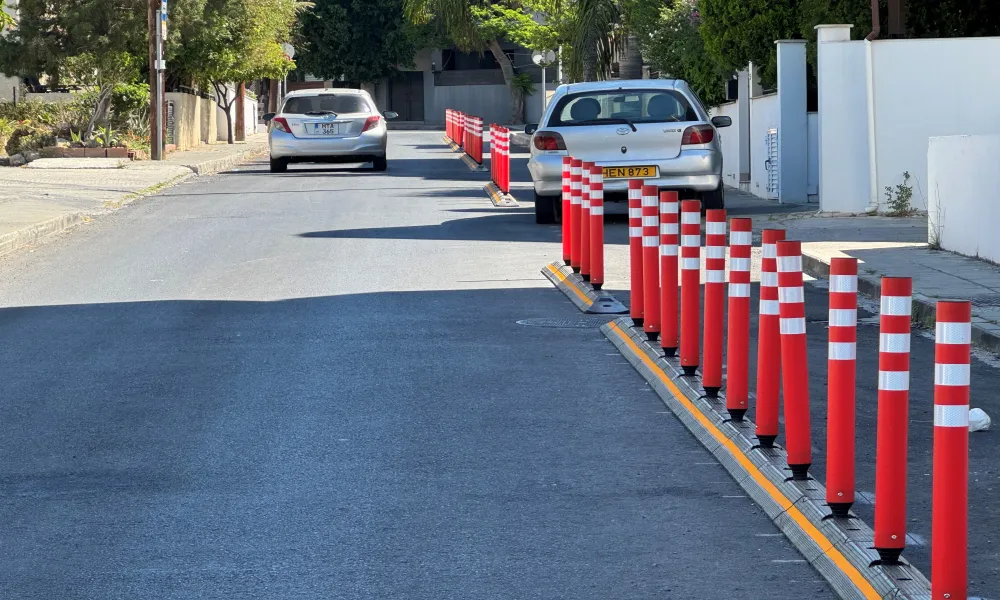
If there is something truly disheartening, it is when real decisions are taken, when eggs are broken to make an omelette, and the result still fails to justify the effort. In Limassol today, Public Works decided to act, but everyone can see it is not being done well. It is extraordinary that we are filling the city with plastic bollards to mark out cycle lanes. It is extraordinary that we are converting wide roads into one-way streets just to secure funding, and end up with seven- or eight-metre pavements that exist for show rather than for use.
The work being carried out in Limassol today, though sound in its philosophy and approach, is creating a damaging precedent. It is not attractive, it is not considered, and it was not communicated properly to the public. People are rightly frustrated, and alongside them a cast of excitable voices who hear the words "sustainable urban mobility plan" and erupt in indignation. The whole affair has given everyone an excuse to spin conspiracy theories about bicycles, scooters, pedestrians and a host of other grievances. Those at Public Works should take another look, because they risk poisoning the entire concept, discarding what are genuinely among the most ambitious decisions ever taken in this area of policy. Either we invest properly to do this well, or we remain forever under the rule of the car, stuck in traffic and choking in pollution.