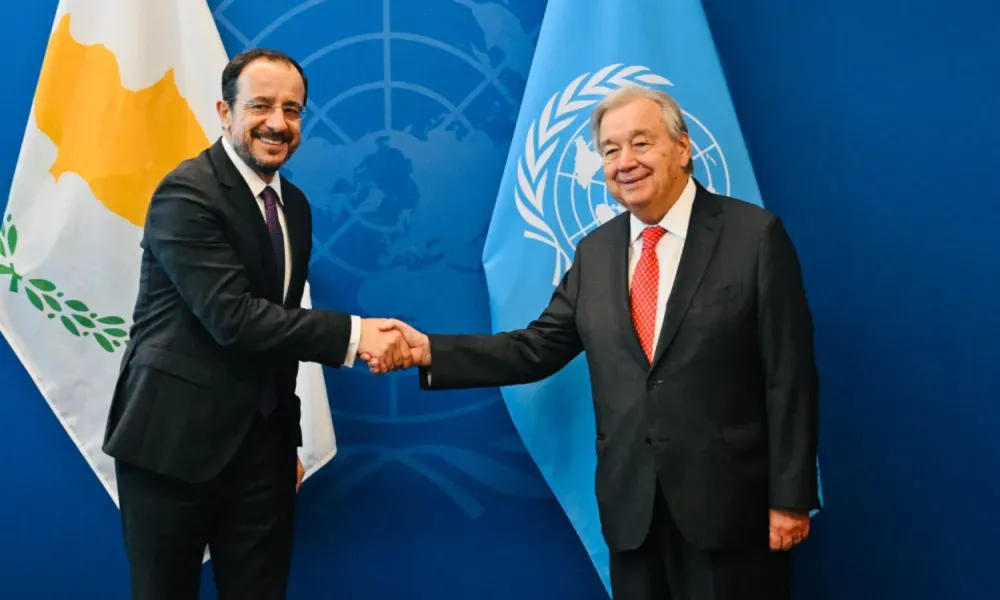
A crucial week of intensive diplomatic contacts begins in Nicosia today with President Nikos Christodoulides meeting María Ángela Holguín, the personal envoy of United Nations Secretary-General António Guterres on the Cyprus issue, at the Presidential Palace.
The week will culminate with the arrival of Guterres himself.
The unanswered question remains whether this latest burst of diplomatic activity can bring the sides closer to a resumption of substantive negotiations aimed at resolving the Cyprus problem, or whether it will become another unsuccessful attempt to bridge the divide between the two sides.
Holguín's arrival follows a final round of contacts in Ankara and Brussels, during which she sought to assess the prospects for convergence ahead of this week's meetings.
According to information available, the Secretary-General's envoy is expected to brief President Christodoulides on the positions conveyed by the Turkish side through Foreign Minister Hakan Fidan, who reportedly does not reject a return to dialogue outright, while linking any progress to broader issues relating to EU-Turkey relations.
Behind the scenes, according to the same sources, Ankara continues to raise issues such as Turkey's participation in the European defence programme SAFE, visa liberalisation for Turkish citizens and the upgrading of the EU-Turkey Customs Union.
This reflects the Turkish diplomatic strategy of placing the Cyprus issue within a broader negotiating framework with the European Union.
Distance from the UN
For his part, President Christodoulides has repeatedly argued in recent months that there is increased European Union interest in the Cyprus issue and that conditions are emerging that could prove decisive in efforts to restart negotiations.
In his public statements, he has consistently maintained that the Cyprus issue is a European problem and that deeper EU involvement strengthens the prospects for progress.
He has also recently referred to the possibility of expanding the Guterres Framework, or a "Guterres Plus" approach, creating new parameters that could facilitate the return of the two sides to the negotiating table.
According to sources close to the United Nations, however, such an approach is not supported by the information currently before the organisation.
The same sources interpret Christodoulides' remarks within the context of domestic political considerations ahead of the next presidential election.
It is no secret in political circles that the President benefits politically from maintaining momentum on the Cyprus issue.
The United Nations is nevertheless keeping expectations low, although Guterres' personal involvement could ultimately lead to the convening of a new five-party conference.
There are, however, significant obstacles.
"The EU is not moving. Fidan is tougher than ever," a senior UN source told Politis, expressing doubts over whether Turkey's positions have substantively changed or whether there is genuine movement from the European side.
This assessment contrasts with Christodoulides' public position that the current diplomatic activity is a consequence of his government's initiatives.
Politis understands that, from the perspective of those observing developments internationally, there remains a gap between rhetoric and action.
The international community is also expecting moves from Christodoulides, particularly if Turkey shows flexibility in its own positions.
The Presidential Palace, meanwhile, again emphasised its commitment to restarting negotiations.
"Thanks also to our own persistent initiatives, momentum has been generated around the Cyprus issue, and the forthcoming visit of United Nations Secretary-General António Guterres to Cyprus is particularly significant," Deputy Government Spokesman Yiannis Antoniou said yesterday during a memorial event organised by the Community Council of Assia marking the anniversaries of the 1974 coup and Turkish invasion.
"We welcome the head of the United Nations to Cyprus," he added, "with a clear political will to seek a solution based on the agreed United Nations framework, with respect for the negotiating acquis, as well as the principles, values and laws of the European Union. We are investing in Mr Guterres' mission because, more than anyone else, we seek a solution to the Cyprus problem, because we are the ones who live with the consequences of occupation."
The atmosphere
These differing interpretations reflect the central uncertainty surrounding the current phase of diplomatic efforts.
On the one hand, the Greek Cypriot side is investing politically in the heightened international interest and in the personal diplomacy of António Guterres.
On the other, diplomatic sources remain sceptical as to whether even the minimum conditions required for a return to negotiations have been created.
And that scepticism is not limited to Turkey's position.
The significance of the UN Secretary-General's forthcoming presence in Nicosia lies precisely in the fact that he has personally assumed responsibility for keeping dialogue alive at a time when the prospect of a federal solution is under intense pressure.
Diplomatic circles believe that the current initiative may represent one of the last serious efforts to determine whether there is still scope for returning to a process based on UN resolutions and the agreed settlement framework.
Erhürman keeps expectations low
Turkish Cypriot leader Tufan Erhürman also adopted a cautious tone in a social media post.
He said the Turkish Cypriot side has completed its preparations for the process beginning with the visit of Secretary-General envoy María Ángela Holguín.
At the same time, he reiterated that excessive expectations should not be attached to António Guterres' visit to the island.