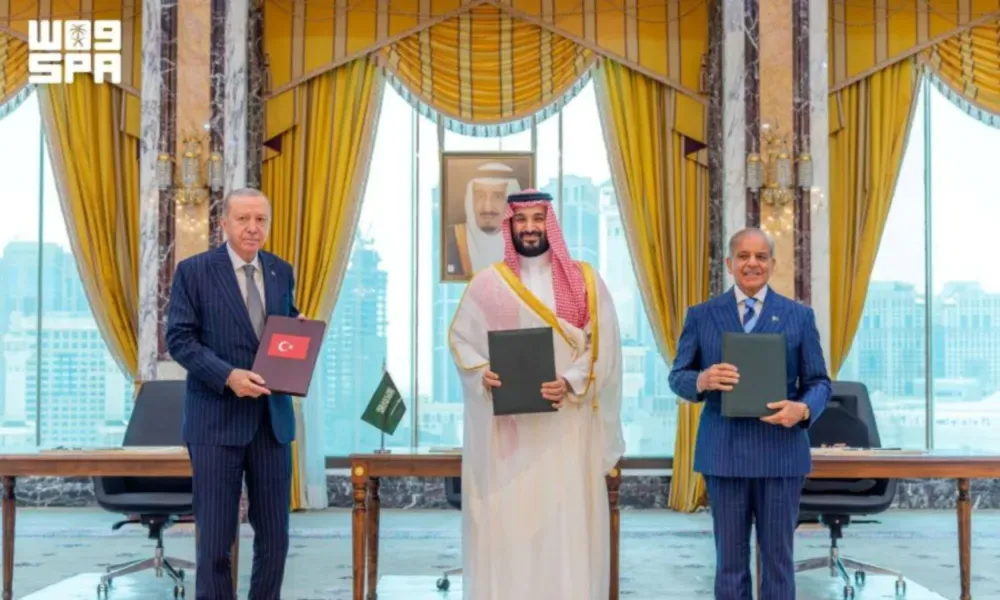

The Mecca Joint Defence Agreement between Saudi Arabia, Pakistan and Turkey, with the potential future inclusion of Egypt, is more than a regional diplomatic arrangement. It is also an indication of a new geostrategic approach to the region and a sign of a deeper shift in the balance of power in the Middle East.
The provision that an armed attack against one member would be treated as an attack against all carries clear political echoes of NATO's Article 5. Meanwhile, Turkish Foreign Minister Hakan Fidan's visit to Cairo yesterday, during which discussions reportedly focused both on Turkey-Egypt relations and on the prospect of Egypt joining the so-called Mecca alliance, highlights Ankara's view of the agreement as the nucleus of a broader regional framework.
This development inevitably has important implications for the strategy of the Republic of Cyprus and the direction it has taken in recent years regarding both the Cyprus problem and its regional partnerships.
Nicosia, and the Christodoulides administration in particular, has invested heavily in its strategic relationship with Israel, both bilaterally and through the trilateral Cyprus-Greece-Israel framework and other regional cooperation initiatives.
That cooperation undoubtedly has value.
However, it should not be transformed into an illusion of military security.
Cyprus has not become impregnable simply because it has developed strong ties with Israel or because it participates in regional cooperation structures.
Under current circumstances, the central question is whether Cyprus can genuinely feel secure while the Cyprus issue remains unresolved.
The island is located in a region where alliances evolve rapidly and geopolitical balances shift constantly. At the same time, the West in general, and the European Union in particular, continue to view Turkey as a country of major strategic importance, despite their stated support for a settlement of the Cyprus problem.
The assumption that Nicosia's alliances will, by themselves, create sufficient pressure on Ankara increasingly clashes with geopolitical realities.
This creates both a false sense of security and the illusion that Cyprus' partnerships can readily neutralise the risks it faces.
Those risks were highlighted by United Nations Secretary-General António Guterres during his visit to Nicosia at the end of last month, when he stressed that resolving the Cyprus issue is "absolutely critical, not only for the peace and interests of Cypriots but also for the stability of a region that is becoming increasingly and dangerously unstable."