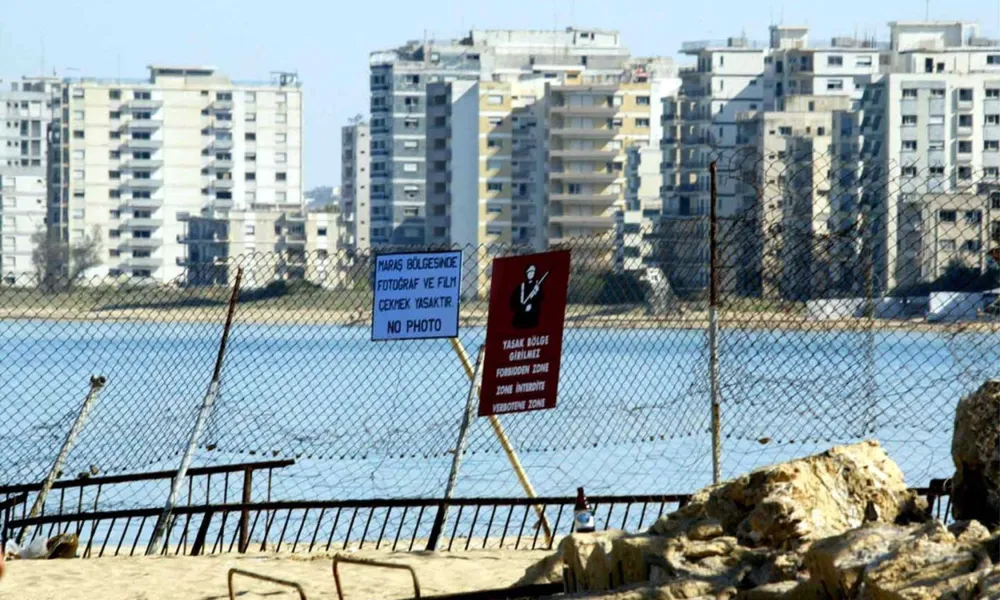

Fifty-two years after the Turkish invasion and the continuing occupation, the loss of use of Greek Cypriot property in the occupied areas remains an open wound passed from one generation to the next.
Thousands of property owners have been deprived, for more than half a century, of the ability to use, develop or benefit from their properties. This is a real and ongoing economic loss whose cost is not confined to a single generation, but is inherited by their descendants. For many, the issue is neither theoretical nor limited to the property dimension of the Cyprus problem. It is a daily reality.
Imagine owning a property worth hundreds of thousands, or even millions, of euros in the occupied areas while struggling to make ends meet in the government-controlled areas on a modest wage. Imagine trying to finance your children's education while struggling to cover the costs. Imagine attempting to meet basic needs while the cost of living and inflation steadily erode your disposable income.
Who, then, can condemn a refugee who, after waiting 52 years, turns to the compensation commission operating in the north?
Those who apply to the so-called compensation commission know in advance that they will not be compensated at the true value of their properties. However, when financial hardship becomes pressing and the prospect of ever being able to utilise those properties remains non-existent, economic reality often outweighs the political and legal dimensions of the issue. As a result, property owners are led to sell, sometimes at humiliatingly low prices.
In this way, properties that for decades symbolised return and justice become a form of personal financial relief. Even where there is no immediate financial need, many owners choose to sell because they believe their properties were effectively lost long ago.
How much longer must they wait?
For years, the answer has remained the same: when the Cyprus issue is solved, the property question will be resolved as part of a comprehensive settlement.
That expectation may once have had some political basis when there was a belief that an agreement was relatively close.
After 52 years, however, invoking a solution that is continually postponed into the future can no longer serve as an adequate response to the problems faced by people today, particularly those experiencing serious financial difficulties.
And this raises an obvious question: why should they not sell? Why should they not at least receive some financial return for a property they have been unable to use or develop for 52 years, with no certainty as to whether or when a Cyprus settlement will be reached?
The applications and the €776 million
According to the compensation commission's website, a total of 8,755 applications had been submitted by Greek Cypriot property owners in the occupied areas as of 14 August 2026.
The total amount awarded as compensation stands at £662,933,062, equivalent to approximately €775.9 million.
The injustice and DISY's proposal
For 52 years, owners of property in the occupied areas have been subjected to a profound injustice.
Other citizens of the Republic of Cyprus are able to use, develop and profit from their property. Owners of property in the occupied areas are denied that opportunity, not through choice, but because of the continuing Turkish occupation.
This is the essence of DISY's proposal to establish a National Fund for Loss of Use of Occupied Properties.
Speaking to Politis, party vice-president George Karoullas, one of the sponsors of the legislative proposal, argued that the state has a constitutional obligation to address the inequality that has been created.
Owners of property in the occupied areas did not choose to lose access to their property. They did not create the circumstances they now face. They cannot reasonably be treated as second-class citizens simply because their property lies in territory under occupation.
The Republic of Cyprus can and should acknowledge, through targeted policy measures, the economic damage caused by the loss of use of occupied properties.
To date, successive governments have chosen to defer the issue, hoping that it would eventually be addressed through a comprehensive settlement of the Cyprus problem.
The reality, however, is that 52 years have passed since the invasion, the occupation continues, and no breakthrough appears to be in sight.
It is difficult to ask a refugee to wait indefinitely while their property remains unusable, generates income for Turkish settlers, and offers them no opportunity for economic benefit.
If the state genuinely wishes to curb the sell-off of Greek Cypriot properties in the occupied areas, it must also address the reason people choose to sell in the first place: financial hardship and the inability to make use of their property.
For this reason, the proposal to establish a National Fund for Loss of Use deserves serious consideration by the House Refugee Committee, where it is currently pending.
Not because it was submitted by DISY, but because the problem is real, enduring and affects thousands of citizens.
I am not a refugee and I do not own property in the occupied areas. Nevertheless, I believe the state has a duty to find a meaningful and fair way to provide financial support for those people, who have spent 52 years paying the price of the Turkish invasion and occupation, as well as the price of the passions and personal ambitions of opportunistic politicians who now flirt openly with partition and a two-state solution.