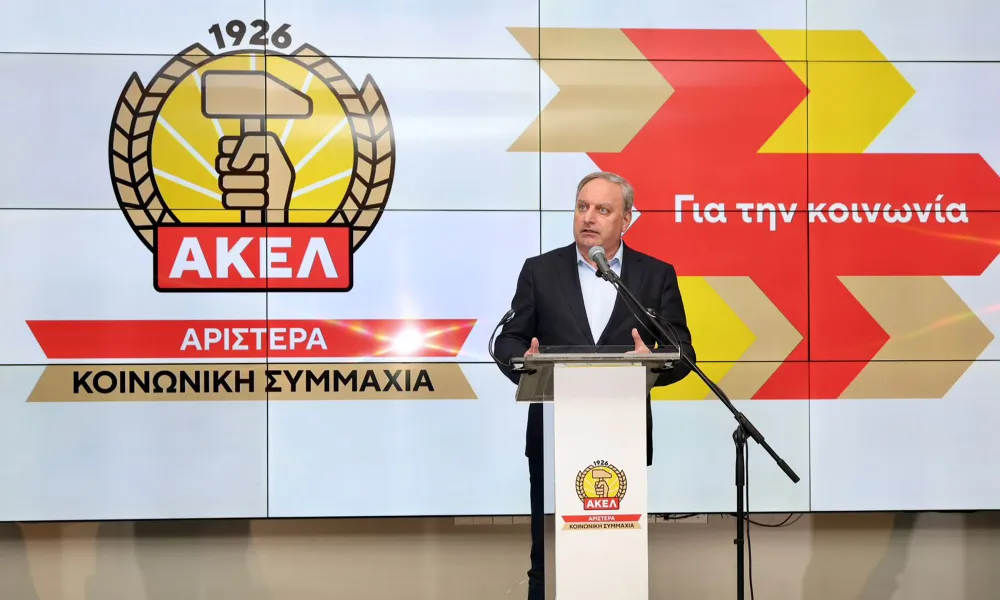

The process now under way within AKEL ahead of the 2028 presidential election is gradually moving beyond a theoretical exercise and academic-style debate. The atmosphere surrounding the issue, even though the parties still have almost a year and a half until the next electoral contest, is pushing AKEL to move at a faster pace, leaving behind a gradual, formal reconnaissance of the terrain and entering a particularly pivotal political process for the party.
Based on the information available, since the party is especially careful about what filters out from its internal discussions, the picture now taking shape essentially amounts to a political process of redefining the party's strategy in the face of the demands of modern Cypriot society.
The objective
The central stake for the party today is that whatever solution is proposed manages to produce the person capable of effectively leading a broad social alliance for "progressive change", as party officials themselves describe this necessity.
As far as Politis understands, a significant part of the debate within AKEL concerns the "imposition of external factors", such as the gradual shift currently taking shape in what might be called the country's human geography, and its dynamics, on the political life of Cyprus.
Society, and young generations in particular, are looking for new faces, free from the baggage of the past. This social demand weighs heavily on AKEL.
In short, this comes down to the fact that a persistent, demanding trend of renewal is gradually taking hold on the political stage, both in terms of the individuals involved and their age. The past five years have been marked by the election of a President under 50, a Speaker of Parliament and leader of the largest party under 40, and the emergence of a new figure who won a seat in the European Parliament and then entered the House of Representatives with his own party. Even, most recently, one of the losers of the last parliamentary election, EDEK, faced with its own existential impasse, has elevated a 27-year-old to its leadership.
These trends cannot be a coincidence, and AKEL is not ignoring them. Society, and young generations in particular, are looking for new faces, free from the baggage of the past. This social demand weighs heavily on AKEL, which already tried to respond to these shifts at the last parliamentary election, placing younger candidates on its lists and even succeeding in electing the youngest MP in Parliament, Ephraim Christou, in Limassol.
A realistic assessment
Among the names being floated in these discussions, one stands out clearly, and no one denies that it comes up in informal talks about AKEL's options: Andreas Mavroyiannis. It is not known to what extent the Mavroyiannis scenario dominates the thinking and discussions among AKEL figures, but the diplomat's previous electoral experience is certainly a major factor, given that he came within a whisker of the presidency at the 2023 election. However, AKEL's assessment of him is being made not in emotional terms at all, but, as sources within the party note, with "cold political realism, carefully weighing the advantages and serious disadvantages of a fresh candidacy."
The advantages...
According to what Politis has gathered, the positives of Andreas Mavroyiannis, as AKEL sees them, and on which no one within the party takes a differing view, are as follows:
- Andreas Mavroyiannis enjoys full public recognition, reinforced further by the major electoral battle of the last five years.
- His presence in the last presidential race, and the impressive 48% he achieved in the second round, demonstrated that he commands strong support.
- As a candidate backed by AKEL, despite his traditionally right-wing background, he managed to reach beyond the narrow party base of the left, drawing in young people and moderate citizens.
...and the disadvantages
On the other hand, other factors also feature in the party's deliberations, not necessarily as top priorities, but they are there nonetheless:
- By 2028, Andreas Mavroyiannis will be 72 years old. This has nothing to do with any covert ageism, only with the connection to the broader trend of renewal now gradually asserting itself among political leaders as well.
- There is uncertainty over whether 2023 can be repeated, since it is considered politically unlikely that the same "combination" of circumstances from the last election could recur, when DISY appeared deeply divided, leading a huge and crucial share of its supporters to swing en masse towards Mavroyiannis in the second round. Today, the picture is different, and DISY is not expected to experience the same internal rupture in favour of a candidate backed by the left.
- If Mavroyiannis runs without broader political alliances beyond AKEL, it is highly doubtful he could win the final round. He may comfortably reach the second round on the strength of AKEL's base, but there he would run up against a ceiling of support unless structural alignments are built with other political forces in the centre ground.
Given these concerns within AKEL, it is possible that Andreas Mavroyiannis could announce his candidacy without waiting for the backing of parties or other political actors, in effect, an independent announcement before AKEL's own decision-making process is complete. Such a move would aim to free him from dependence on AKEL's decisions, but would also be seen as a form of pressure on the leadership, which, for its part, wants to keep control of the timing of the party's internal deliberations.
Looking at other options too
Alongside the Mavroyiannis scenario, AKEL is also seriously examining the alternative route of putting forward a new, fresh face.
This reasoning rests on the party's need to fully align itself with the demands of the times. A younger candidate, meeting the expectations of both the party base and the wider society, could express a different spirit and bring a sense of renewal.
Andreas Mavroyiannis's evaluation by AKEL is being conducted not at all in emotional terms, but, as sources within the party note, with "cold political realism, carefully weighing the advantages and serious disadvantages of a fresh candidacy."
The leadership and the party's institutions know well, however, that this choice carries enormous risks, chief among them timing. It is neither too late nor too early, if the person in question has only limited public recognition.
It should also be recalled that AKEL has long struggled to make inroads with certain social and ideological groups, particularly the traditional right-wing or centrist electorate. An inexperienced or not widely accepted young candidate risks being confined within the left's traditional electoral limits, making victory in the second round impossible.
Faced with these challenges, Stefanos Stefanou set out AKEL's absolute "red lines" and criteria for choosing its 2028 candidate, making clear that the following are not options:
- A candidacy that does not prioritise a solution to the Cyprus problem on the agreed basis of a Bizonal, Bicommunal Federation (BBF) with political equality.
- A candidacy that would continue to serve today's model of governing by numbers and communications management.
- A candidacy that would serve the interests of the few, perpetuating the shadows of corruption and cronyism.
What the other parties are calculating
The equation for the 2028 presidential election does not depend solely on AKEL's internal decisions, but is decisively shaped by the moves of the other parties across the political spectrum.
At DIKO, despite currently supporting the Christodoulides administration, which, in order to keep the party close, granted a significant share of ministries to DIKO figures, party officials are keeping open the possibility of an independent course, or even of putting forward their own candidate, once again seeking a leading role in the centre ground.
ELAM, meanwhile, despite having effectively become a privileged interlocutor of Nicos Christodoulides, does not yet appear to have a clear, settled picture of whether it will stick to its traditional tactic, contesting the first round independently and then backing whichever candidate opposes AKEL in the second round.