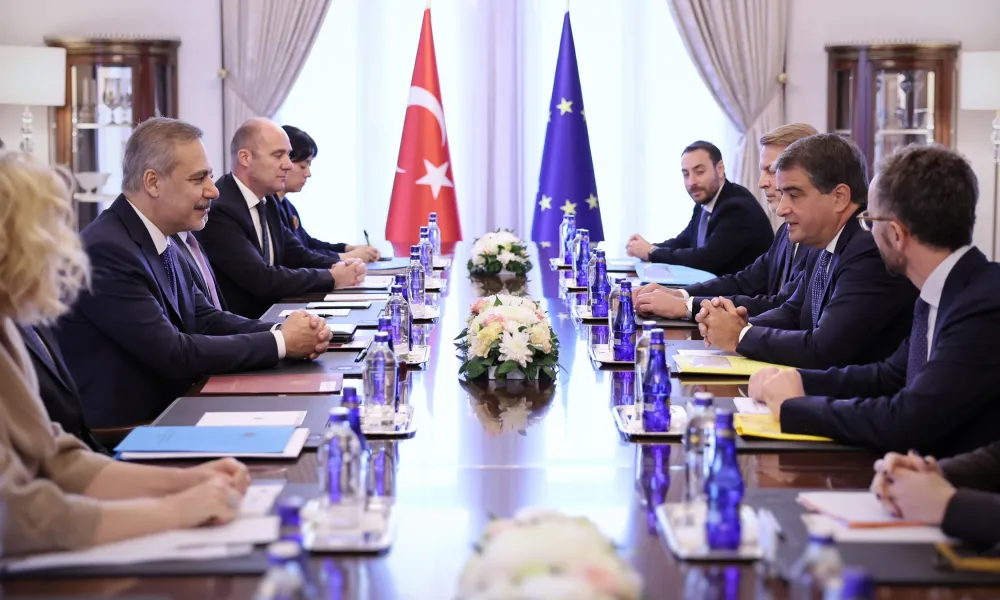

The most important result of Raffaele Fitto’s Ankara visit may be what it did not produce. Fitto, the European Commission’s Executive Vice-President for Cohesion and Reforms and its Special Representative for Cyprus, met Foreign Minister Hakan Fidan.
Before the meeting, the Greek Cypriot government’s spokesman said Fitto would carry a proposal to begin discussions on modernising the European Union-Türkiye Customs Union if Cyprus negotiations resumed from where they broke down in 2017. Greek Cypriot media reports presented the idea as a conditional exchange.
After the meeting, however, the Commission described a broader political connection. Progress towards a comprehensive Cyprus settlement, its spokesperson said, would create a “more positive environment” for advancing EU-Türkiye relations. The Commission did not announce a Customs Union offer, a timetable or a formal condition. The pre-visit claim remains an account of what the Greek Cypriot government expected Fitto to convey, not a published EU commitment.
That distinction matters. Brussels is saying Cyprus affects the climate of relations, but it has not publicly confirmed that Turkish economic interests will be unlocked only if Ankara accepts a prescribed negotiating sequence. Fitto and Fidan discussed a settlement within the United Nations framework for the benefit of Cyprus, Türkiye, the European Union and the wider Eastern Mediterranean.
Neither Ankara nor the Turkish Cypriot leadership recognises Fitto’s special representative role; they deal with him in his capacity as a Commission Vice-President, arguing that the EU cannot be an impartial mediator when Greece and the Greek Cypriot-run Cyprus Republic are member states and Turkish Cypriots were not consulted on his appointment. Fidan welcomed Fitto’s efforts “as a Commission Vice-President” to strengthen cooperation but argued that the Customs Union should not be linked to Cyprus. He warned against allowing the future of Türkiye-EU relations to be “held hostage” by the Cyprus Republic. The language was sharp, but the policy distinction was clear: Ankara is prepared to pursue practical cooperation with the EU while rejecting a Cyprus veto over every other strand of the relationship.
Cyprus is not the whole EU-Türkiye agenda
Fidan’s position is not a rejection of the European track. A day before the meeting, at a parliamentary occasion he set out four Turkish priorities: modernising the Customs Union, participation in the EU’s proposed “Made in EU” framework, progress on visa liberalisation, and participation in European security and defence mechanisms in a way that complements NATO.
Each has its own political and legal hurdles. Visa liberalisation, for example, still depends on Türkiye meeting the remaining benchmarks. Cyprus is a major obstacle in EU-Türkiye relations, but it is not the whole relationship. The question is whether Brussels will treat cooperation on trade, industry and security as interests in their own right, or make them contingent on a Cyprus process whose terms remain contested.
Who speaks for the island?
The dispute is difficult because the two sides do not view the Cyprus Republic’s role in the same way. It is the internationally recognised state and an EU member. It is also administered by Greek Cypriots and has not included Turkish Cypriots in a functioning partnership government since the constitutional breakdown of 1963-64. From the Turkish Cypriot perspective, Turkish Cypriot representatives were driven out of the institutions of the partnership state, rendering a new state of affairs; a Greek Cypriot-run state. The administration in the south cannot, therefore, claim to speak for the Turkish Cypriot community as well as for Greek Cypriots.
Treating its position as the island-wide voice leaves out the political equality built into the 1960 partnership—and central to any settlement.
The EU’s legal position also calls for precision. The whole island is part of the Union following the 2004 accession, but under Protocol No. 10 the EU acquis is suspended in areas where the Cyprus Republic’s government does not exercise control. The north is not outside the Union in the formal territorial sense; EU law is largely not applied there, and those areas are outside the EU customs and fiscal territory. That distinction captures the unresolved contradiction: Turkish Cypriots are treated as EU citizens, while the institutions and legal regime of membership operate through an administration in which they do not participate as a partner community.
The EU can prove its commitment
The EU’s credibility with Turkish Cypriots is inseparable from an unfulfilled commitment made in 2004. On 26 April, just before Cyprus joined the Union, the Council declared that it was determined to end the isolation of the Turkish Cypriot community and invited the Commission to bring forward proposals to support its economic development and integration. On 7 July, the Commission proposed a package that included a regulation to facilitate direct trade between the Turkish Cypriot community and the EU customs territory.
That regulation was never adopted. Greek and Greek Cypriot objections helped block it, with opponents arguing that direct trade could imply recognition of the Turkish Cypriot administration. The EU did adopt an aid regulation, but direct trade, the measure the Turkish Cypriot side considered essential to ending its isolation, remained unrealised.
Now, Ankara and the Turkish Cypriot leadership demand that the European Union should now demonstrate its sincerity as a supporter of Cyprus peace by fulfilling its 2004 commitment and adopting the direct-trade regulation it proposed. Such a step would help end the Turkish Cypriot community’s economic isolation and show that Brussels can honour its commitments to Turkish Cypriots, an essential basis for rebuilding trust in the EU’s role in the peace process. A carefully framed trade measure need not predetermine the island’s final status; it would give practical effect to the EU’s own stated aim of encouraging economic development and contact between the communities.
The 2004 referendum remains central to this history. Turkish Cypriots approved the Annan settlement plan by about 65 per cent, while Greek Cypriots rejected it by about 76 per cent. Yet the Cyprus Republic entered the European Union on 1 May 2004, gaining international representation and the advantages of membership while Turkish Cypriots remained outside the effective application of much of EU law. That outcome does not determine what a fair settlement should look like today. It does help explain Turkish Cypriot distrust of a process that asks them to make concessions first and depend on later assurances.
This history also underlies a core Turkish Cypriot demand. If negotiations resume but collapse again through no fault of the Turkish Cypriot side, particularly if the Greek Cypriot side is responsible, the island must not simply return to the status quo. Any renewed process needs a clear understanding of what follows failure, so Turkish Cypriots are not left once more with unfulfilled promises and no change in their political or economic circumstances.
A negotiating framework needs safeguards
Nor can “resume from Crans-Montana” settle the central questions. Nikos Christodoulides says negotiations should continue from where they broke down in 2017 and wants a date for an expanded 5+1 meeting. Tufan Erhürman has described the prospects as 51-49, cautiously favouring success, while stressing political equality and confidence-building measures. The leaders are due to meet on 24 November ahead of a possible trilateral with UN Secretary-General António Guterres, whose term ends on 31 December.
A renewed process needs more than a date and a familiar framework. It must specify how political equality, including rotation of presidency, will work, how Turkish Cypriots will participate effectively in decisions, how previous convergences will be treated and what happens if talks fail. Political equality cannot be deferred until the end of negotiations or reduced to safeguards against being outvoted.
Ankara’s two-state policy stands in tension with the internationally backed federal framework. A way forward would require the sides to test whether a flexible, limited common structure can be negotiated around the political equality of two communities and effective Turkish Cypriot consent. One possible model would place two politically equal states under a loose common roof, with limited shared competences, a rotating executive and a positive Turkish Cypriot vote on defined joint matters. That would preserve a common international personality and EU representation while recognising that neither community can be governed by the other.
Parallel progress, not another one-sided test
More crossing points, cooperation on emergency response and other practical contacts would improve daily life and show that dialogue can produce results. But checkpoints or friendly football matches cannot substitute for agreement on governance, security and political equality. Nor should practical cooperation require Turkish Cypriots first to accept an undefined return to the status quo.
Fitto’s dual role, as a senior Commission official and the Commission’s Cyprus representative, gives Brussels a channel into the process. It does not make the EU a neutral mediator in Turkish Cypriot or Turkish eyes. The Cyprus Republic and Greece are EU members; the Turkish Cypriot side was not even consulted before Fitto’s appointment. Ankara and the Turkish Cypriot leadership say they engage with him as a Commission Vice-President, not as an impartial Cyprus envoy.
The Ankara meeting has narrowed the immediate issue while leaving the wider opening alive. Fitto did not publicly present a concrete Customs Union-for-talks deal, and Fidan did not close the door to stronger EU cooperation. The next step should be parallel, measurable progress: a serious UN-led process with agreed principles and safeguards, practical improvements on the island, and EU-Türkiye work on trade and security that proceeds on its own merits.
A settlement could improve the atmosphere for the whole relationship, as the Commission argues. But Brussels can strengthen its credibility before any settlement is reached: it can fulfil the 2004 direct-trade commitment and show Turkish Cypriots that EU promises need not remain hostage to political objections.