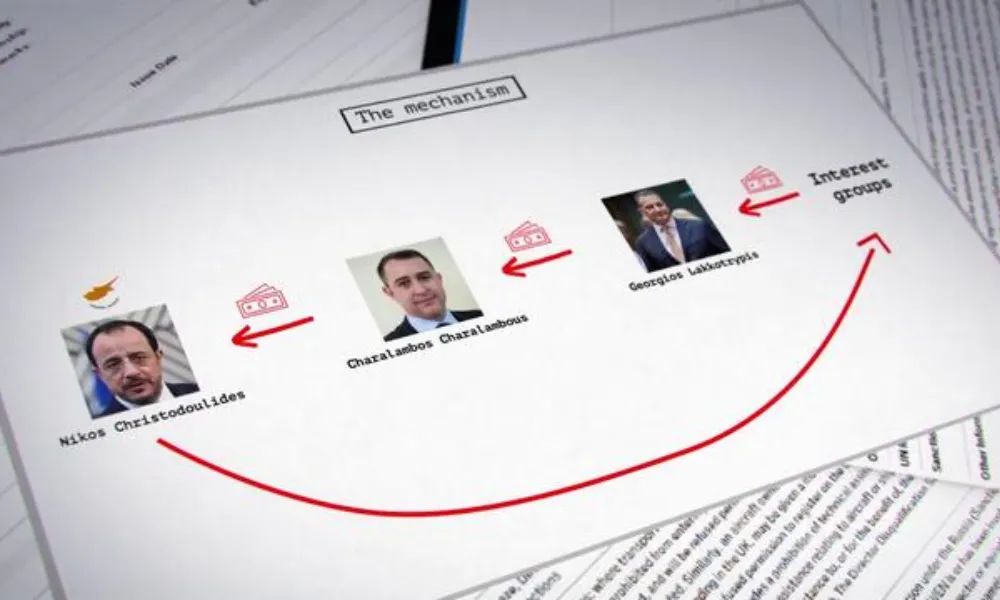
All aspects of the video posted on an account on the X platform will be examined by the police, now with the assistance and guidance of an independent criminal investigator appointed on Monday by the Attorney General.
The video was uploaded last Thursday to an account under the name “Emily Thompson”. Following findings arising from a detailed review of the footage, and amid strong pressure for an independent criminal investigation, Attorney General Giorgos Savvides appointed Andreas Paschalides as independent criminal investigator.
Paschalides is a former Supreme Court judge and current president of the Independent Authority for the Investigation of Allegations and Complaints against the Police. Under the terms of reference, he will conduct investigations in cooperation with the police into the possibility of any criminal offences having been committed by any person in connection with the video posted on the X social media platform under the account name “Emily Thompson”.
Scope of the investigation
According to the Attorney General’s announcement, the investigation will cover any issue related to the video, including its content, authenticity, origin, and the circumstances and motives behind its production and publication, as well as any other matter that may arise during the inquiry. It is stressed that the investigation must be completed as soon as possible and, in any case, within three months.
Background to the appointment
In recent days, strong criticism had been voiced over the failure to appoint an independent criminal investigator. Based on availabe information, the decision to do so was taken after a careful review and examination of the video, including how it was recorded, the process followed, and the statements made by those appearing in it.
The appointment was also decided after all three individuals featured had given statements to the police in the preceding days. Those who attended the headquarters of the Criminal Investigation Department and gave testimony were Charalambos Charalambous, former Director of the Office of the President of the Republic, Giorgos Lakkotrypis, former Minister of Energy who appears as an investment adviser, and Giorgos Chrysochoos, chief executive officer of Cyfield.
In their statements, all three described how events unfolded from their own perspective and provided investigators with information on the individuals they communicated or met with, the name of the company that was presented as interested in investing in Cyprus, as well as the locations and dates of meetings or discussions.
Based on all material currently before investigators, the appointment of an independent criminal investigator was deemed necessary.
Tracking the trail
As the investigation proceeds, evidence is being sought not only in Cyprus but also in London and Amsterdam, where meetings reportedly took place with alleged investors who presented themselves as representatives of the company Stratix Wealth, expressing an intention to invest €150 million in the energy sector.
Following the publication of the video, the company has effectively vanished, with both its presence and website disappearing, making it particularly difficult to identify the individuals involved in the contacts. Efforts are therefore being made to obtain information from the venues where the meetings took place, such as hotels and restaurants.
As part of assistance requested from foreign countries and through Interpol, steps may be taken to secure material from these locations, including footage from closed-circuit surveillance systems. A key objective is to identify the remaining individuals who appear in the video.
In parallel, investigators are pursuing all possible avenues to obtain the complete audiovisual material that was recorded, in order to gain a full and coherent picture of what was discussed during the meetings.
Applicable laws and potential offences
The investigative work will rely heavily on legislation related to the prevention of corruption, particularly the Prevention of Corruption Law (Cap. 161) and Chapter 154 of the Criminal Code.
Under Cap. 161, Articles 3 and 4 provide for the following:
Article 3: Transactions with agents indicating corruption
This article criminalises both active and passive bribery through “agents”, such as public officials or employees of private companies.
– Passive bribery (Article 3a): Prohibits any agent from accepting, receiving or requesting gifts or benefits as an inducement to act or refrain from acting in relation to their employer’s or principal’s affairs.
– Active bribery (Article 3b): Prohibits any person from offering or giving gifts to an agent for the same purposes.
– False accounts (Article 3c): Criminalises the use of false or misleading receipts or documents intended to deceive an employer.
– Penalty: The offence constitutes a misdemeanour punishable by up to two years’ imprisonment, a fine of up to €2,500, or both.
Article 4: Increased penalties in special cases
Article 4 provides for stricter penalties where corruption affects the public interest.
– If the transaction or matter relates to a contract with the Republic, a government department or a public organisation, the penalty is significantly increased.
– In such cases, imprisonment may reach up to seven years.
Chapter 154 of the Criminal Code, which addresses corruption in Articles 100–105, provides for the following offences:
– Bribery of a public officer: Criminalises a public officer who requests or accepts any benefit in connection with the performance of official duties.
– Extortion by a public officer: Prohibits a public officer from receiving remuneration beyond that lawfully due for performing official duties.
– Acceptance of gifts for showing favour: Relates to receiving a benefit in return for a promise of favourable treatment in pending or future transactions.
– Abuse of power: Punishes an official who commits arbitrary acts that harm the rights of others. Since 2021, the maximum sentence for abuse of power for gain has been increased to seven years’ imprisonment.
Parliamentary scrutiny
While the investigation continues on all fronts, the matter and its broader implications are expected to be discussed next week by the House Legal Affairs Committee. The issue has been registered for discussion on the committee’s own initiative.