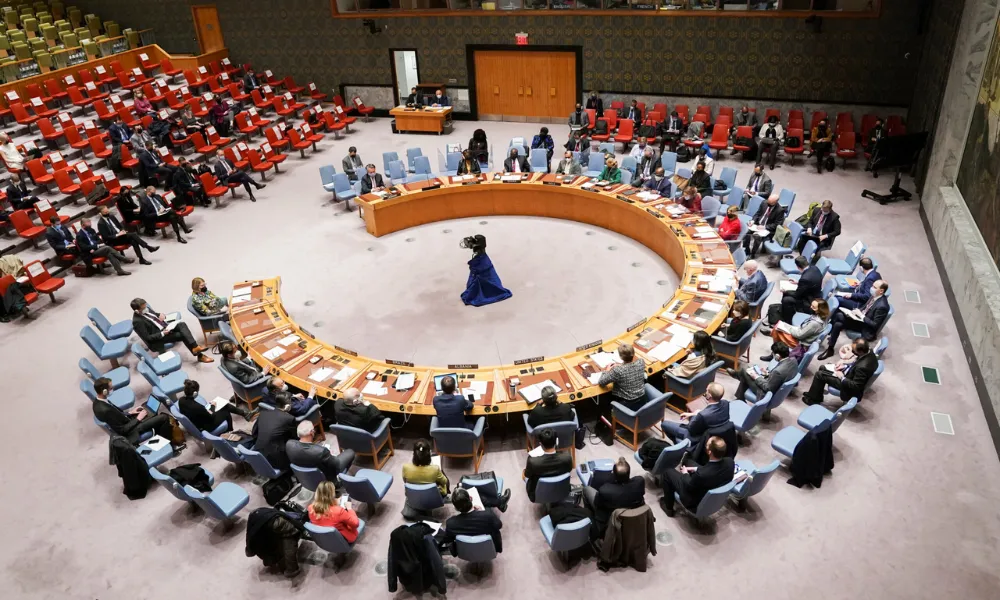
The United Nations Security Council adopted on Friday, with 13 votes in favour and 2 abstentions by Pakistan and Somalia, the resolution renewing the mandate of the UN peacekeeping force in Cyprus (UNFICYP) for one more year, until 31 January 2027.
The resolution reaffirmed the UN’s commitment to a comprehensive and just solution to the Cyprus problem, noting that “the status quo is unsustainable” and that it carries the risk of “irreversible changes on the ground”.
Political tensions
It stated that “the situation on the ground is not static”, and that “the lack of an agreement furthers political tensions and deepens the estrangement of both communities, risking irreversible changes on the ground, and reducing the prospects of a settlement”.
Although negotiations demonstrated broad support among Council members for the work of UNFICYP, they were relatively more complex this year due to diverging views on several key issues.
The United Kingdom, as penholder on Cyprus, circulated the first draft of the resolution on 16 January and convened one round of negotiations on 21 January.
After receiving written comments on two revised drafts, the UK placed a third revised draft under silence procedure on January 28. Pakistan "broke" the silence, after which other members also submitted comments.
No changes to mission
Several members — including Denmark, France, Greece and Latvia — expressed a preference for the version placed under silence. Subsequently, a fourth revised draft was placed in blue on January 29.
The adopted resolution renews UNFICYP without changes to the mission’s core mandate and tasks as previously outlined in Resolution 2771 (2025).
It reaffirmed the importance of achieving an enduring, comprehensive and just settlement based on a bicommunal, bizonal federation with political equality, as set out in relevant Security Council resolutions.
It also reaffirmed appreciation for the continuing personal engagement of the Secretary-General and his team, including his Personal Envoy María Ángela Holguín Cuellar, and strongly called upon the sides and all parties to deploy all efforts to engage actively with the Secretary-General and his team.
Work on Technical Committees
The resolution welcomed the intensification of dialogue between the two sides and the outcomes of informal broader-format meetings in Geneva (18 March 2025) and New York (17 July 2025).
It called on the leaders to continue their efforts to provide the necessary support and overall guidance to the work of the Technical Committees, in order to ensure their effective functioning and the advancement of confidence-building initiatives.
Moreover, the resolution welcomed steps taken so far — including the establishment of the Technical Committee on Youth - and encouraged further efforts by the leaders to advance remaining confidence-building measures.
It emphasised the importance of progress on opening new crossing points and the creation of a consultative body to ensure the meaningful participation of civil society in the peace process.
Green Line Violations
During negotiations, Council members discussed how to address ongoing violations of the military status quo along the ceasefire lines and the continued militarisation of the buffer zone, expressing diverging views on how responsibility should be balanced between both sides.
The resolution condemned “the continued violations of the military status quo along the ceasefire lines”, including “reported encroachment by both sides into the buffer zone”, “continued unauthorised constructions” and “installation of military-grade surveillance systems”.
It also expressed concern regarding the “blurring of distinction between civilian and military structures”, and called on all parties to take steps to de-escalate tensions in and around the Buffer Zone.
Socioeconomic disparity
Also the resolution recalled the Secretary-General’s finding that “the socioeconomic disparity between the two Cypriot communities has widened further”, warning that this may “lead to further estrangement on the island, and potentially affect prospects for a settlement”.
Pyla and Varosha
It called for further efforts to address this through “meaningful contacts” and encourages progress in intra-island trade and economic linkages.
The resolution recalled the status of Varosha, expressing “deep regret regarding the continuation of unilateral actions”, calls for “the immediate reversal of this course of action”, and warns that “any further unilateral action may prompt a response from the Security Council”.
Regarding Pyla, it noted continuing challenges, regrets that implementation of agreed arrangements remains paused, and urges renewed cooperation with UNFICYP as a confidence-building measure.
Women's participation
The resolution regretted the lack of “full, equal and meaningful participation of women”, supports the Action Plan on women’s participation, welcomes the Technical Committee on Youth, commends the work of the Committee on Missing Persons, urges progress toward a “mine-free Cyprus”.
The Council “decided to extend UNFICYP’s mandate until 31 January 2027”, states it will “continue to monitor the situation in Cyprus closely”, and requested two reports by the Secretary-General in July 2026 and January 2027 to assess progress and mission performance, the resolution said.
Cyprus has been divided since 1974, when Turkey invaded and occupied its northern third. Repeated rounds of UN-led peace talks have so far failed to yield results due to Turkish intransigence. The latest round of negotiations, in July 2017 at the Swiss resort of Crans-Montana ended inconclusively.
Ghost town
In 2025 the Secretary-General hosted two informal meetings on Cyprus, in March in Geneva and in July in New York, while a tripartite meeting with the Cyprus leaders was also held in late September, at the end of the UN General Assembly High Level Week.
María Angela Holguín, the UN Secretary-General’s Personal Envoy on Cyprus, is tasked to engage with the parties, while former European Commissioner Johannes Hahn, designated by the Commission as Special Envoy for Cyprus, is also expected to contribute to the settlement process, in cooperation with Holguín.
Varosha, the fenced off section of the Turkish occupied town of Famagusta, is often described as a ‘ghost town’.
UN Security Council resolution 550 (1984) considers any attempts to settle any part of Varosha by people other than its inhabitants as inadmissible and calls for the transfer of this area to the administration of the UN. UN Security Council resolution 789 (1992) also urges that with a view to the implementation of resolution 550 (1984), the area at present under the control of the United Nations Peace-keeping Force in Cyprus be extended to include Varosha.