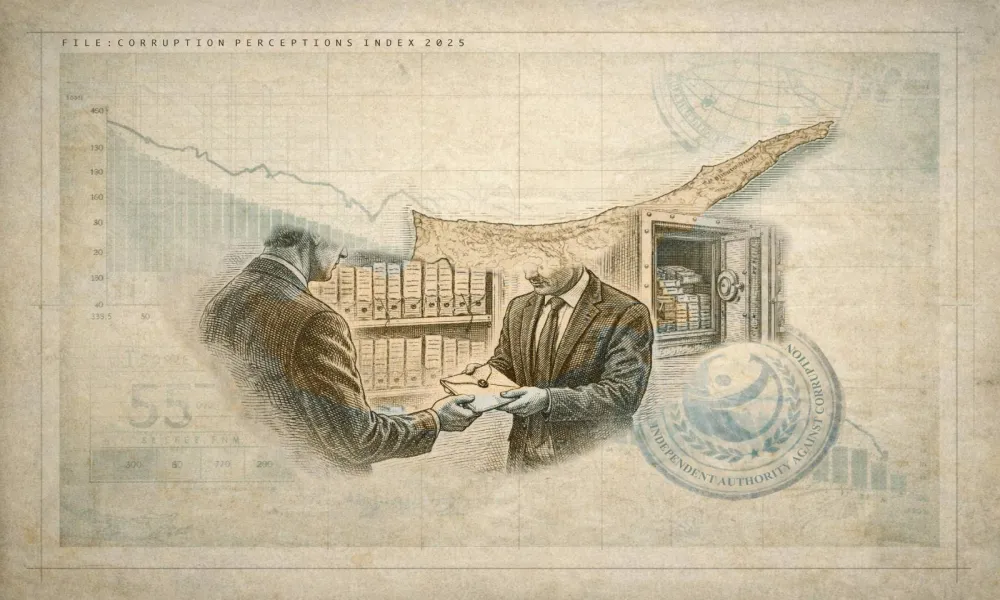

Despite steps taken to strengthen rule of law, increase transparency and tackle corruption, Cyprus remains on the downward trend on Transparency International’s Corruption Perceptions Index (CPI).
The country’s score decreased by one point in 2025, falling to 55. Since 2012, Cyprus significantly declined 11 points on the index, becoming “one of the lower performing countries in the EU,” according to a statement by Transparency International.
Loopholes
Cyprus’ score reflects “the loopholes that remain in the country’s anti-corruption system, as well as the failure to reform and implement several laws intended to ensure a clear separation between business and government,” Transparency International said.
The Berlin-based organisation, which annually measures the perceived levels of public sector corruption in 182 countries and territories around the world, emphasized that political finance transparency is the key area requiring reform in Cyprus.
“This has become especially evident following the recent alleged influence-peddling and campaign finance scandal that led to the resignation of the President’s Chief of Staff,” Transparency International stated.
Last month, a leaked recording that appeared to show senior officials discussing ways to bypass campaign spending limits and trade charitable donations for political access triggered the resignation of Cyprus’ first lady, who led a state-created charity, and the director of the president’s office.
The government described the video as misleading and potentially part of a hybrid attack aimed at undermining the reputation of the country, while the police announced a criminal investigation to assess whether the leaked video “documents criminal offenses or constitutes a coordinated attempt to destabilize the country.”

Concerns on the ongoing investigation
Flora Cresswell, a Regional Advisor for Europe at Transparency International told CIReN that the case of the video showed “a systematic issue within the country, not just this one case” and raised concerns on the quality of the ongoing investigation.
Cresswell stressed the need for an independent investigation “that doesn't have the involvement of political-appointed investigators.”
According to Cresswell, the specific case requires “a much wider sense-check review by the government.
“The government seemed to be more focused on the authenticity of the video rather than the actual allegations themselves, like, of influence-peddling, of campaign finance breaches, passport access, use of third parties,” said Cresswell, calling for the need to looking at existing loopholes and eliminating them with effective reform and enforcement.
In its statement, Transparency International underlined that “without fully disclosing donors’ identities, voters cannot assess to whom candidates and representatives are ultimately accountable,” adding that "countries like Cyprus are particularly vulnerable when political parties and candidates are not legally required to disclose their sources of income.”
Holistic strategy
According to the 2025 CPI, over the past decade, perceptions of corruption in Cyprus have increased, and experts and business professionals continue to view corruption levels as high.
Cyprus is described as “one of the lower performing countries ranking 18th in the EU of 27 member states. With a score of 55, Cyprus is significantly below the European average score of 64.
Top scorers globally in the European Union and EEA area are Denmark (89), Finland (88), Norway (81), Sweden and Switzerland (80) as well as some other traditionally well performing democracies such as Luxembourg and Netherlands (78), Germany (77) and Ireland (76).
“My recommendation to Cyprus is that this needs to be a holistic strategy that is looking at a whole suite of measures that aren't just introducing legislation, but also really looking at a concrete plan of addressing key corruption risks within the country, clear, resourced and monitored actions”, Cresswell told CIReN.
The Transparency International advisor referred to some Baltic countries that have improved in terms of their CPI score in the last decade due to well strategized approaches to data transparency, strong anti-corruption strategies, and an independent anti-corruption authority.
Estonia (76), Lithuania (65) and Latvia (60), which joined the EU in the same year as Cyprus in 2004, are performing significantly better on the Index.
Cresswell particularly spoke of the need for Cypriot authorities to have full transparency over political party donations and funding. “Cyprus is almost 10 years behind those countries, of what they've been able to do,” Creswell said.
Political donations
It is important to change the way political party donations are supervised, particularly in view of the upcoming elections in Cyprus in May, according to Transparency International.
“To detect undue influence in the public sector, national authorities must have full visibility into the sources of influence exerted on public officials. The legal framework should require political parties, candidates, and campaigns to legally disclose their sources of income, and ensure that income and expenditure through dedicated bank accounts are open to public scrutiny, enabling effective financial tracing,” it said in its statement.
Challenges ahead
The Transparency International defines the challenges ahead for Cyprus, including “ensuring the operational and functional independence of the recently established Authority against Corruption, making the lobbying register fully open to the public, and addressing weaknesses in the investigation and prosecution of corruption cases.”
Cresswell described the lack of checks and balances in the Republic of Cyprus as “one of the starkest examples” of a major loophole in the anti-corruption framework.
“The fact that those leading investigations involving the government are politically appointed, completely undermines the credibility of an investigation,” she said.
She noted that the quality and the oversight of prosecutions are also key concerns pointed out by the European Commission and the Council of Europe through GRECO on numerous occasions.
Global rankings
Transparency International CPI ranks 182 countries and territories by their perceived levels of public sector corruption on a scale of zero (highly corrupt) to 100 (very clean). The global average score stands at 42 out of 100, its lowest level in more than a decade, pointing to a concerning downward trend that will need to be monitored over time. Cyprus’ ranking is just above the vast majority of countries failing to keep corruption under control - more than two thirds - 122 out of 180 - score under 50.
EU Milestone
In December 2025, the European Parliament and Council reached a provisional agreement on a new comprehensive EU Directive on combating corruption, designed to harmonize anti-corruption laws, set minimum penalties, and strengthen corporate liability across member states. This directive aims to replace outdated frameworks, standardize definitions of offenses—including bribery, misappropriation, and illicit enrichment—and enhance whistleblower protection.
Transparency International considers the transposition of the EU directive as “a springboard, not a ceiling, for ambitious reform and enforcement” for all member states of the EU to develop anti-corruption strategies within the next three years in consultation with civil society.
By Kyriakos Pieridis, Managing Editor of CIReN