United Nations Secretary-General’s Personal Envoy on Cyprus María Ángela Holguín Cuellar said that revived Cyprus talks marked a rare opening following years of stagnation, but cautioned that without 'disciplined preparation, clear sequencing and tangible convergence on the ground, the process risks repeating earlier failures'.
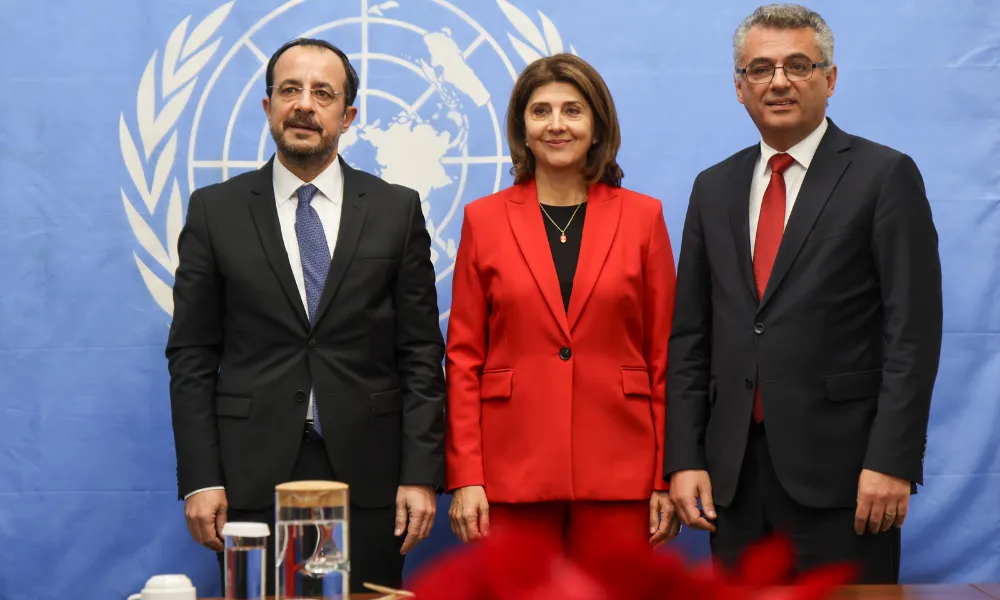
Speaking in an exclusive and wide-ranging interview with the ANKA news agency, Holguín, offered her most detailed assessment yet of the December 11th UN-led trilateral meeting with President Christodulides and Turkish Cypriot leader Tufan Erhürman, outlining both the opportunities created by that meeting and the structural risks that still surround the process.
Holguín said she left the meeting encouraged by the tone and quality of the exchanges, which she described as “profound, sincere and very direct.” She further emphasised that the dialogue remained at an early and fragile stage.
“Although the discussions are promising, the dialogue between the two leaders is still in its initial stages,” Holguín told ANKA. “Further steps are required to consolidate the early momentum and foster genuine trust, which would make it possible for the Secretary-General to host a 5+1 informal meeting.”
First UN trilateral since Crans-Montana
The December 11th meeting marked the first UN-led trilateral since the collapse of the UN-arranged Crans-Montana talks in Switzerland in 2017, a process widely viewed by Cyprus watchers as the closest the island has come to a comprehensive settlement since intercommunal violence erupted in 1963.
The talks collapsed, ushering in a seven-year deadlock marked by the absence of formal negotiations and repeated but inconclusive diplomatic initiatives.
Against that background, the December trilateral was significant not only for reopening leader-level dialogue under UN auspices, but also for its outcome. The meeting ended with the two sides agreeing to continue deliberations with the intention of reaching a Cyprus settlement based on “political equality as described in UN resolutions,” language that lies at the heart of long-standing UN parameters.
Substance over form at leader-level meetings
Holguín acknowledged that a substantial portion of the trilateral meeting was taken up by issues that could arguably have been prepared at the technical level. However, she said the long-standing experience and deep familiarity of both leaders with the Cyprus issue allowed them to quickly identify the core issues that must be addressed before entering full-fledged negotiations.
“Thanks to their experience and knowledge, both leaders were able to quickly identify the issues that need to be addressed,” she said. “But it would be important that a great part of such high-level meetings be more focused on substance and on taking decisions on pending matters.”
Looking ahead, particularly to periods when she will be away from the island, Holguín stressed that the role of the leaders’ representatives and negotiating teams will be critical in ensuring that future leader-level meetings are better prepared and more result-oriented.
“I am glad that the leaders’ representatives are already discussing ways to have more structured and more result-oriented efforts at their level,” she said. “Both negotiators are highly experienced and skilled. I am sure that they will be able to make an important difference.”
Immediate focus on confidence-building measures
According to Holguín, the immediate phase of the process will center on resolving outstanding issues related to a range of confidence-building measures with tangible benefits for daily life across the island.
“In the immediate phase, they will work on resolving outstanding issues related to a range of confidence-building measures that could have tangible benefit for the life of all Cypriots,” she said.
Such progress, Holguín emphasised, is not peripheral but essential. Without concrete gains on confidence-building measures, she said, it will be difficult to ensure the success of any deeper discussions on substance.
Among the measures under discussion, Holguín has consistently highlighted the opening of new crossing points as particularly significant, both symbolically and practically.
“If I had to single out one,” she said, “I would say the opening of new crossing points, because this is something that sends the loudest positive signal about the leaders’ political commitment to the process and has the most immediate and tangible impact on daily life.”
She pointed to the transformative effect of crossings first opened in 2003, asking rhetorically: “Can you imagine the situation of the island and on the Cyprus issue if no crossing points had ever been opened?”
A phase defined by opportunity and risk
Asked what distinguishes the current phase from earlier cycles that ultimately stalled at the level of confidence-building measures, Holguín offered a deliberately balanced assessment.
“I believe that this phase of engagement offers both opportunities and challenges,” she said. “The 11 December meeting represented an important step forward.”
At the same time, she cautioned that nothing should be taken for granted. In her view, the process now stands at a crossroads between two familiar but very different trajectories.
“Either the leaders and their teams will find the way to strengthen the nascent momentum and establish a real climate of trust that allows for a real deepening of discussions on substance,” she said, “or we witness the same protracted discussions on trust-building and confidence-building measures that have been on the table since March 2025.”
Holguín said her hope, and the UN’s objective, is clearly the first scenario. Achieving that, she added, would allow both sides to move forward in the coming period with the goal of organizing a new informal enlarged meeting convened by the UN Secretary-General.
Leader decisions versus technical work
Holguín also addressed the balance between political leadership and technical preparation, a recurring weakness in previous Cyprus processes.
“All issues on the table require or will require a political decision by the leaders,” she said. “But the technical committees can play an essential role in proposing ideas to the leaders and, even more importantly, in implementing decisions taken at the level of the leaders.”
In her view, the process would benefit if negotiators and their teams were more fully empowered to negotiate and agree on issues of a technical nature. While such agreements would still require endorsement by the leaders, this approach would allow leader-level meetings to focus on strategic decisions rather than technical detail.
“The leaders should spend as little time as possible discussing technical issues so that they can devote more attention to core substantive issues,” she said.
When a 5+1 meeting makes sense
Looking ahead to informal engagements planned for January and a further trilateral later in the month, Holguín said the principle of convening an informal enlarged meeting should not be questioned. What matters, she stressed, is ensuring that such a meeting has a realistic chance of success.
“The principle of convening an informal enlarged meeting should not be challenged,” she said. “At the same time, we need to ensure that we have a good chance of ensuring its success.”
The proposed 5+1 meeting would bring together the two Cypriot communities alongside UN Secretary-General António Guterres and representatives from three guarantor countries, Britain, Türkiye and Greece, with the aim of charting a path forward and ending the seven-year deadlock in Cyprus talks.
Holguín stressed that progress at the trilateral level must deepen before such a meeting is convened.
“If an enlarged informal meeting is organised prematurely,” she warned, “we could run the risk of having the nascent productive dialogue between the leaders and the related opportunities being derailed.”
Summing up her caution, Holguín invoked a familiar proverb: “The good is the enemy of the best.”
Diverging approaches on a 5+1 meeting
While the Turkish Cypriot side and the UN envoy emphasise careful sequencing and thorough preparation, the Greek Cypriot side and Greece have been pressing for a 5+1 meeting to be convened as soon as possible. Greek Cypriot officials argue that bringing the guarantor powers and the UN Secretary-General back into the process could inject momentum and international pressure into stalled talks.
Erhürman, however, cautions that unless the modality of the talks changes, the process risks repeating the fate of many previous efforts and ultimately ending in failure.
This divergence has become one of the defining features of the current phase. The question is no longer whether a 5+1 meeting should take place, but when and under what conditions.
Erhürman: political equality only “partly” accepted
In this context, Erhürman has articulated a more detailed framework for how talks should proceed. Speaking to ANKA in an earlier interview, he said that issues related to a settlement must be handled within a four-point methodology he has long advocated.
According to Erhürman, the foremost pillar of that methodology is political equality. He said this principle was only “partly” accepted at the December 11th meeting.
“Political equality cannot be considered complete unless rotating presidency and effective participation in decision-making are also accepted,” he said. Erhürman stressed that unless there is common ground on all elements of the first pillar, it would not be possible to move to the second stage of his methodology.
“At the moment, we are halfway through the first pillar of the four-point methodology, and we are at the level of political equality,” he said. “There is no agreement on the solution model.”
Four conditions for a meaningful process
Erhürman outlined his remaining conditions as follows: negotiations must proceed according to a clearly defined timetable, as an open-ended process is unacceptable; all convergences achieved so far must remain valid and should not be reopened for renegotiation; and if the process collapses again, Turkish Cypriots should not be forced back into the pre-negotiation status quo.
He said these conditions are intended to prevent a repetition of past cycles in which talks dragged on indefinitely, collapsed, and ultimately left the Turkish Cypriot side politically and diplomatically worse off.
Diplomatic sources told ANKA that while securing Greek Cypriot agreement on the first three elements of the “new methodology” appears possible, the final condition, which is often described as a “no return to the status quo” or “penalty clause”, would most likely need to be underwritten by the UN Secretary-General and the European Union.
“Talks for the sake of talks” rejected
Erhürman has also echoed Holguín’s warning against symbolism without substance. Referring to the possibility of a third 5+1 meeting, he told ANKA that going to such a gathering without concrete understandings already reached in Nicosia would be counterproductive.
Holguín is expected to return to the island toward the end of January. Erhürman said that only if those contacts produce tangible progress would it make sense for the parties to move to an enlarged format.
“We have never avoided talks, and we will not avoid them,” he told ANKA. “But we also do not consider it right to hold inconclusive meetings merely to create the impression that a process is under way.”
Narrow window, familiar risks
Cyprus diplomacy carries the heavy legacy of decades of failed initiatives, false starts and missed opportunities. The collapse of the Crans-Montana talks remains a defining reference point, shaping skepticism on all sides and reinforcing the costs of mismanaged timing and expectations.
Holguín’s approach reflects a determination to draw lessons from that history: prioritize substance over optics, empower negotiators to prepare the ground, and resist pressure to internationalize the process before convergence exists on the island itself.
Whether that strategy can translate cautious optimism into durable progress will become clearer in the coming weeks, as confidence-building measures are tested, negotiators intensify their work and the parties decide whether this renewed engagement can finally move beyond promises toward a viable negotiating framework.