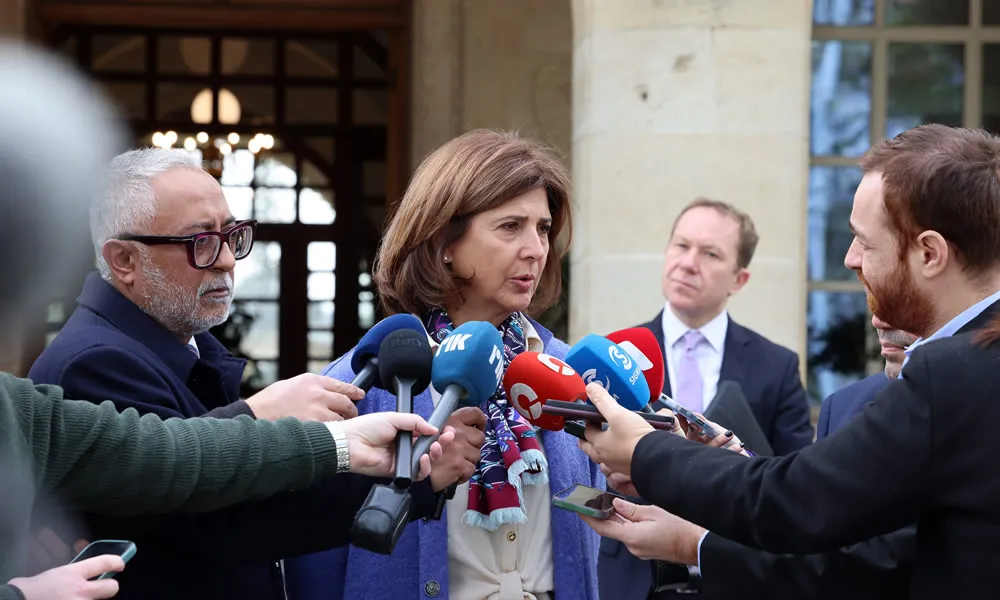
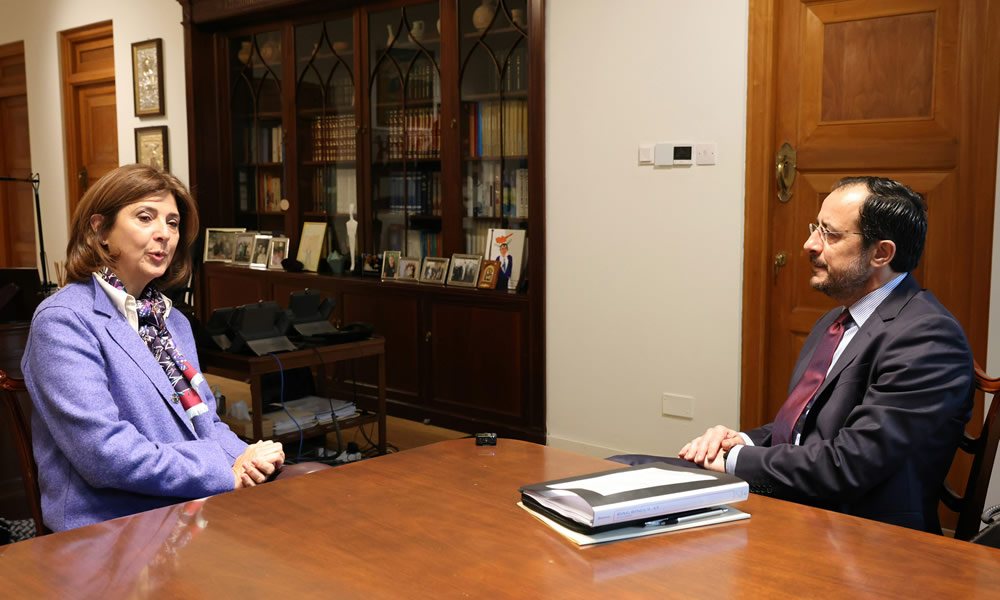
UN Personal Envoy María Ángela Holguín Cuéllar highlighted the lack of progress in the implementation of confidence-building measures (CBMs) after her meeting with President Nikos Christodoulides on Tuesday morning.
Speaking after the meeting, which lasted just under an hour, Holguín said that without progress, it would be “very difficult” to convene an enlarged meeting with guarantor powers.
The personal envoy said she was glad to be back and have her first meeting of the year in Cyprus, noting that her efforts focused on achieving progress to move things forward.
‘Not much progress’ to date
“I am trying to push for more progress in confidence-building measures,” she said, ahead of her afternoon meeting scheduled with Turkish Cypriot leader Tufan Erhürman.
“I hope there is progress. Until now there is not so much progress.”
In parallel with talks on CBMs identified during the ‘5+1’ meetings in 2025, Holguín said the leaders will discuss the four proposals on methodology tabled by Erhürman during the planned trilateral on Wednesday.
“We can talk about methodology, the four points that Erhürman put on the table some months ago. This is the issue of tomorrow. And I hope there is progress. If not, it is very difficult to organise a meeting of the ‘5+1’ without progress,” said Holguín.
‘5+1’ depends on leaders
Asked if an enlarged meeting was still possible for next month, the UN Secretary-General’s envoy on Cyprus replied: “It depends on them. It depends on the progress of the two leaders on the confidence-building measures.”
Speaking to reporters at the Presidential Palace, Government Spokesperson Konstantinos Letymbiotis said Holguín briefed the president on her meeting in Brussels with EU foreign policy chief Kaja Kallas and on the efforts to create a conducive climate for resumption of talks.
Asked to comment on the UN envoy’s apparent dissatisfaction with the progress achieved to date, Letymbiotis said the Greek Cypriot side has shown a constructive stance, not only through proposals submitted, but also in their approach to the proposals submitted by the other side.
Regarding the hold-up on progress, the spokesperson said there has been no change to the discussion held at the last ‘5+1’ meeting in July. He argued the Greek Cypriot side has tabled specific proposals, including a pedestrian crossing point, to improve the climate that have not been accepted to date.
He added that the government wants to see progress on CBMs but trust-building initiatives cannot replace substantive talks. The target remains a resumption of negotiations for a comprehensive settlement of the Cyprus issue. Letymbiotis noted that Christodoulides will present his proposal on how talks can resume during tomorrow’s trilateral.
The political will of the sides will be judged at the negotiating table, he added.
Erhürman’s methodology proposals
On the question of Erhürman’s package of proposals on methodology, the spokesperson said the president has given his response to the Turkish Cypriot leader’s points. He further noted that the issue of ‘political equality’ was recorded in a clear manner in the joint statement agreed at the last trilateral meeting in December, with reference to UN Security Council resolutions.
The Turkish Cypriot leader has made agreement on his four-point methodology proposal a necessary step to resuming peace talks.
In his statement, published in the UNSG’s latest report on his Good Offices mission, Erhürman argues that past experience demonstrates the need to prepare the ground and build trust first.
He clarifies that commitment to political equality includes a rotating presidency and effective participation (with at least one favourable vote). The other three points on methodology involve acceptance of past convergences leading up to Crans-Montana, ensuring the new process will be results-oriented and time-framed; and that Turkish Cypriots “will not be condemned” to their current status if the process fails despite their best efforts.
“This methodology constitutes, in no way, a set of pre-conditions,” he says while also noting that a new process “can only start once we agree in principle on our 4-point methodology in its entirety”.