
Across Europe and beyond, public opinion surveys, along with research and the language of international organisations increasingly point to a deeper loss of confidence in Washington as a stabilising force.
Recent polls capture the stark shift. In France, more than four in ten respondents now describe the United States as a hostile country, while only a quarter still see it as a friendly ally. A majority believe the U.S. could pose a military threat to France in the coming years.
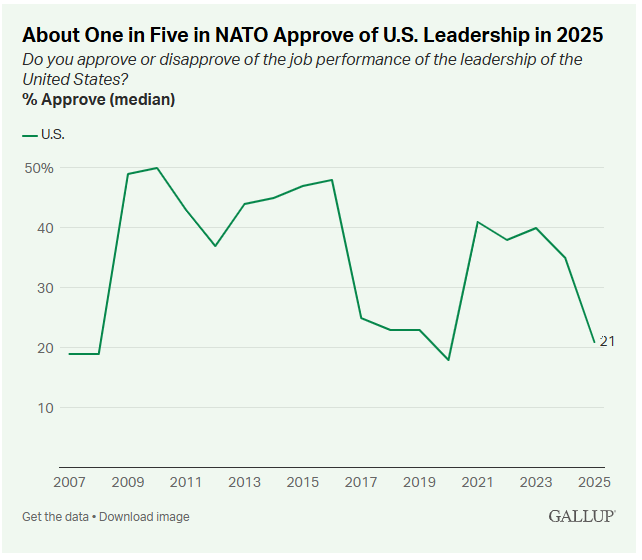
According to Gallup, approval of U.S. leadership across NATO countries fell sharply in 2025, reaching one of its lowest recorded levels.
The Pew Research Center, which tracks global attitudes toward the United States over time, has similarly documented declining favourability ratings in several advanced economies, alongside widening generational divides.
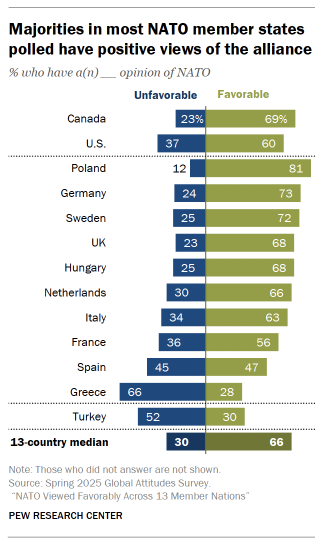
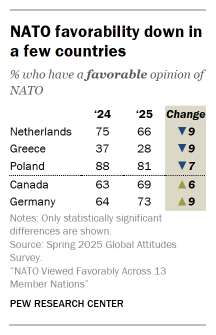
What distinguishes the current moment is that mistrust is no longer framed primarily as disagreement with specific policies. Increasingly, it is expressed as concern about unpredictability, coercion and the erosion of shared rules.
An assault on the rules-based international order
That concern was articulated this week by Amnesty International, whose Secretary General Agnès Callamard warned that Europe’s attempt to appease U.S. President Donald Trump is failing. Speaking at the World Economic Forum in Davos, Callamard argued that Washington’s recent conduct should be understood as part of a wider assault on the rules-based international order established after World War II.
Her remarks followed Trump’s renewed assertion that the United States would acquire Greenland “one way or another”, accompanied by threats of additional tariffs against countries that oppose U.S. policy. For Amnesty, such language is emblematic of a pattern in which economic and military power are used to pressure allies into compliance.
The credibility of Europe itself, Callamard said, is now at stake.
Findings from the European Council on Foreign Relations' large-scale polling across more than 20 countries suggests that public expectations of U.S. leadership are declining as perceptions shift toward a more fragmented, multipolar world. In many regions, the United States is no longer seen as the default anchor of global order, but as one power among several, increasingly willing to act unilaterally.
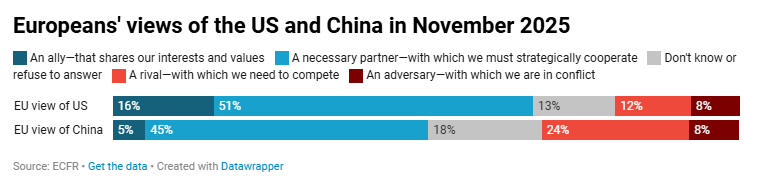
Reporting by Reuters and the Associated Press has documented how uncertainty over U.S. policy direction is influencing real-world decisions, from European defence planning to investment flows. German business groups, for example, have cited political volatility and trade threats as factors behind a slowdown in new investments linked to the United States. In security debates, the language has also shifted, from dependence to risk management.
The erosion of trust
There remains, even now, a recognition that the United States retains unmatched military, economic and technological power. What is increasingly in doubt is whether that power is still exercised within a framework that allies recognise as predictable and lawful. As one recent international survey put it, inequality, coercion and the weakening of the social contract are now viewed as interconnected global risks, not isolated domestic issues.
For European publics, mistrust toward the United States appears as a recalculation. The question is no longer whether Washington leads, but whether it can still be trusted to do so without rewriting the rules mid-game.
That uncertainty, rather than outright hostility, may prove to be the most consequential shift of all.