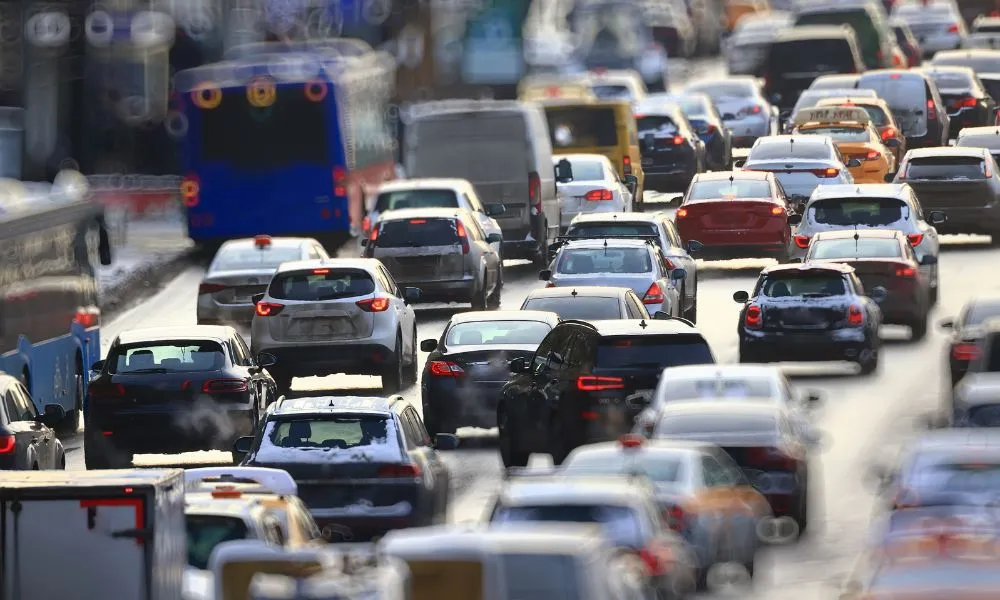
More than 120,000 vehicles cross Strovolos every morning, with over half having no destination in the municipality itself. At the same time, more than seven in ten daily journeys in Latsia and Geri are made by private car. These figures illustrate the scale of pressure weighing on the wider Nicosia area, where rapid growth has outpaced planning and infrastructure.
Strovolos as a transit corridor
With a population of 71,123 residents, Strovolos is the largest municipality in the capital, hosting almost 28 percent of Nicosia’s urban population. In practice, however, it functions less as a residential area and more as a major transit corridor for the entire city.
Its main avenues connect Lakatamia, Latsia, Geri, Aglantzia, Engomi and Tseri with the city centre and back. According to data included in the Sustainable Urban Mobility Plan, more than half of the traffic load in Strovolos is through traffic.
Residents describe daily congestion as routine. According to testimonies cited by Politis, leaving some neighbourhoods during peak hours can take up to 20 minutes, reinforcing the perception that Strovolos has become a passage rather than a place primarily designed for living.
Limited green space and environmental pressure
Traffic congestion is accompanied by environmental strain. Official data show that urban green space in Strovolos accounts for just 1.38 percent of the municipality’s total area. This corresponds to around five square metres of green space per resident, compared with a European average exceeding nine.
During summer months, temperatures in densely built areas are reported to be up to four degrees higher than in peripheral zones. While the municipality manages around 100 parks, including 64 with playgrounds, 350 tree-lined spaces and 19 kilometres of green medians, dense development has limited their effectiveness in meeting residents’ needs.
The need for a unified urban approach
Strovolos Mayor Stavros Stavrinidis has stressed that the municipality has long exceeded its administrative boundaries, operating as a central pillar of urban Nicosia. He noted that Strovolos hosts nearly one third of the capital’s population while absorbing a substantial daily traffic burden from across the city, with consequences for quality of life, air quality and neighbourhood function.
He further underlined that the lack of green and open spaces is a longstanding structural issue that cannot be addressed through piecemeal interventions. According to Mr Stavrinidis, a metropolitan-level planning approach is required, treating Nicosia as a single urban system rather than a collection of isolated municipalities. While the municipality continues to invest in park upgrades, public spaces and sustainable mobility, he warned that without central decisions on traffic and transport policy, urban resilience will remain under strain.
From farmland to dense development in Latsia and Geri
To the east and south of Nicosia, Latsia and Geri represent one of the most striking examples of rapid urban expansion. In June 2024, the two municipalities were merged into a single administrative entity following the Local Government Reform.
In 2001, the combined population stood at 18,575 residents. By 2021, it had reached 28,293, and today exceeds 35,000, marking an increase of more than 54 percent in two decades. Housing stock grew by 14 percent between 2011 and 2021 alone, while construction activity continues at a steady pace.
Areas that until recently consisted of farmland or low-density housing now host apartment buildings and residential complexes. Long-term residents point to seasonal congestion, particularly during weekends and holiday periods, exacerbated by proximity to major commercial zones and neighbouring shopping centres.
Daily mobility under strain
For residents across Strovolos, Latsia and Geri, congestion is part of daily life. Commuting times have increased, and routine journeys are widely described as exhausting.
In the unified Municipality of Latsia–Geri, 72 percent of residents rely on private vehicles for commuting. Main access routes to Nicosia are already operating at or beyond capacity, with new developments adding further pressure.
Mayor of Latsia–Geri Christos Pittaras acknowledged that development over the past two decades advanced faster than organisational capacity. He stated that population growth and intensive construction created opportunities but also placed significant strain on infrastructure, daily life and overall quality of living.
According to Mr Pittaras, the municipality has reached a critical point where progress cannot be measured solely in numerical terms or square metres. He emphasised that development must now adopt a human-centred approach.
Planning tools and transport challenges
Addressing residents’ complaints about congestion, particularly during peak morning and afternoon hours, Mr Pittaras described the situation as borderline. He noted that more than seven out of ten residents commute daily to Nicosia by car.
He also highlighted the revision of the Nicosia Local Plan as a critical planning instrument, aimed at regulating urban expansion while prioritising green spaces, educational and social infrastructure, and properly functioning neighbourhoods.
Road projects and pending implementation
Within this framework, the planned extension of Megalou Alexandrou Avenue is considered a key project. The Nea Lydra area of Idalion, home to around 500 residents, currently has only one access road, which has repeatedly flooded, leading to incidents of temporary isolation and safety risks.
The new connection is expected to provide a second exit, relieve local congestion and link the area more effectively with the road network of Latsia and Geri, as well as the motorway. Although a tender was announced in March 2025 with an estimated cost of €1.93 million, construction has not yet commenced.
Commercial growth without parallel public spaces
Commercial development in the area has also accelerated. Between 2009 and 2018, an additional 185,000 square metres of commercial land were added in Latsia and 65,000 in Geri. Around 80 percent of these zones have already been utilised, without a clearly defined strategy for future phases.
Residents note that while commercial facilities have expanded, public and green spaces have not kept pace, reinforcing concerns about the balance between economic activity and everyday quality of life.
Source: Politis Sunday edition