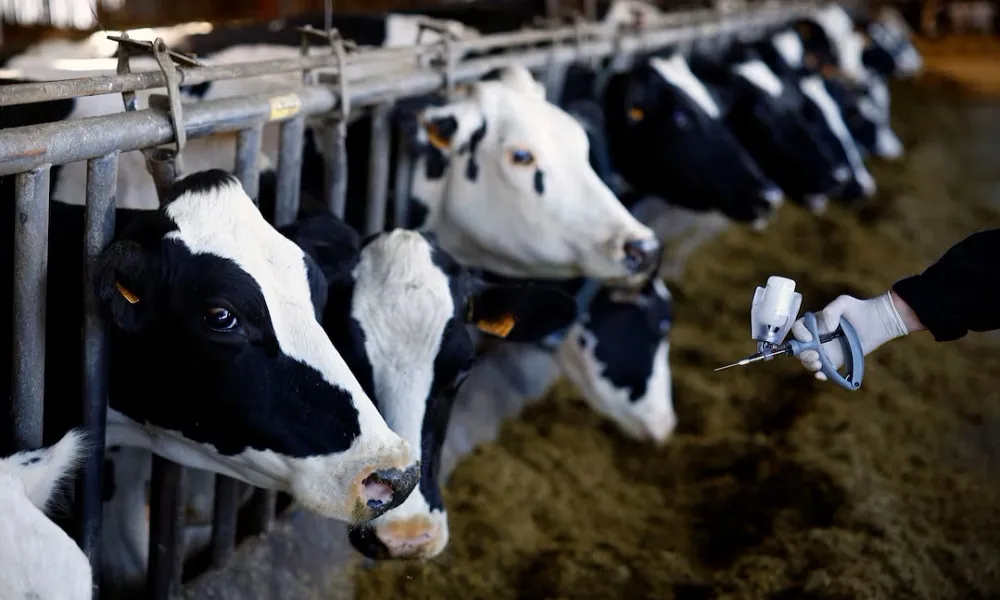
Vaccinations against foot and mouth disease are set to begin within a three kilometre radius of the affected area in Larnaca, after confirmation that the serotype identified is the same as that recorded in the occupied areas.
The Veterinary Services announced that 10,000 vaccine doses are expected to arrive from the occupied areas and will be administered with the support of private veterinarians already working with the impacted livestock units. A further 529,000 doses ordered through the European Union are expected in the coming days.
Vaccination plan and EU coordination
Speaking to the media, Veterinary Services spokesperson Sotiria Georgiadou stated that, so far, no additional positive cases have been detected among samples examined by the Veterinary Services laboratory.
She said that a meeting was held late last night with veterinary experts sent by the European Commission. The epidemiological situation in the infected area and within the ten kilometre surveillance zone was reviewed. A decision was taken to begin vaccinating susceptible animals, particularly sheep, goats and cattle, within the three kilometre radius inside the surveillance zone.
Ms Georgiadou confirmed that the initial 10,000 doses expected today will be used pending the arrival of the remaining 529,000 doses ordered from the European Union. A coordination meeting with private veterinarians and experts is to take place to establish a broader vaccination plan. Private veterinarians who already cooperate with the affected units and are familiar with the animals and breeders will be utilised.
The Minister is also scheduled to meet all involved parties to discuss support packages for livestock breeders.
Serotype identification and laboratory analysis
Responding to questions on vaccine availability, Ms Georgiadou said that vaccines are ordered through the European Union directly from the manufacturing company. She outlined the timeline, noting that the first suspected case was reported on 19 February, laboratory confirmation was issued on 20 February and further communication with the European Commission took place on 21 and 22 February. On 23 February, the Minister met the Commission in Brussels.
She explained that the virus has multiple serotypes and confirmed that the identified serotype is SAT 1, requiring a specific vaccine. The same serotype has been detected in the occupied areas. Samples have been sent to a reference laboratory for further analysis to determine whether there are common characteristics. She clarified that there are seven serotypes in total.
Culling measures and biosecurity controls
Ms Georgiadou stated that 263 cattle have been culled and that feed and hay will be destroyed. Culling will continue in other affected sheep and goat units following registration and cost assessment procedures. Burial sites have been opened and sampling continues.
Regarding exports, she said that halloumi exports have been secured. For other products, authorities are awaiting reactions. At present, halloumi exports remain unaffected.
On the future operation of affected livestock units, she said that disinfecting, inspections and cleaning procedures will continue for at least one to two months. Units will then be reassessed to determine whether animals can be reintroduced. She noted that contamination is influenced by factors such as humidity and pH levels.
Animals are expected to develop antibodies approximately two weeks after vaccination.
Ongoing safety measures and action plan
On the continuation of safety measures within infected units, Ms Georgiadou stated that authorities will assess how vaccinations proceed and determine whether to extend beyond the three and ten kilometre zones. Following completion of vaccinations and a period of two to three weeks, and depending on progress in other areas, further decisions will be taken. The issue is scheduled for discussion today.
All private veterinarians able to administer vaccines have been called to assist with coordination.
Addressing a breeder’s complaint that positive cases were identified later in the day after initially testing negative, she explained that once suspicion arises, a temporary restriction is imposed. Samples are taken and analysed, and upon confirmation of a case, written instructions are issued restricting the unit and outlining prohibitions. She suggested that there may have been a misunderstanding in the specific case.
Responding to claims by breeders that they had not been informed, she stated that once cases were reported in the occupied areas, breeders were notified by message and leaflet, invited to the Veterinary Services and attended seminars. She added that priority must be given to securing infected units rather than publicly disclosing information on specific cases.
Ms Georgiadou concluded that an emergency action plan has long been in place for all list A diseases, including foot and mouth disease and avian influenza, and continues to be followed.