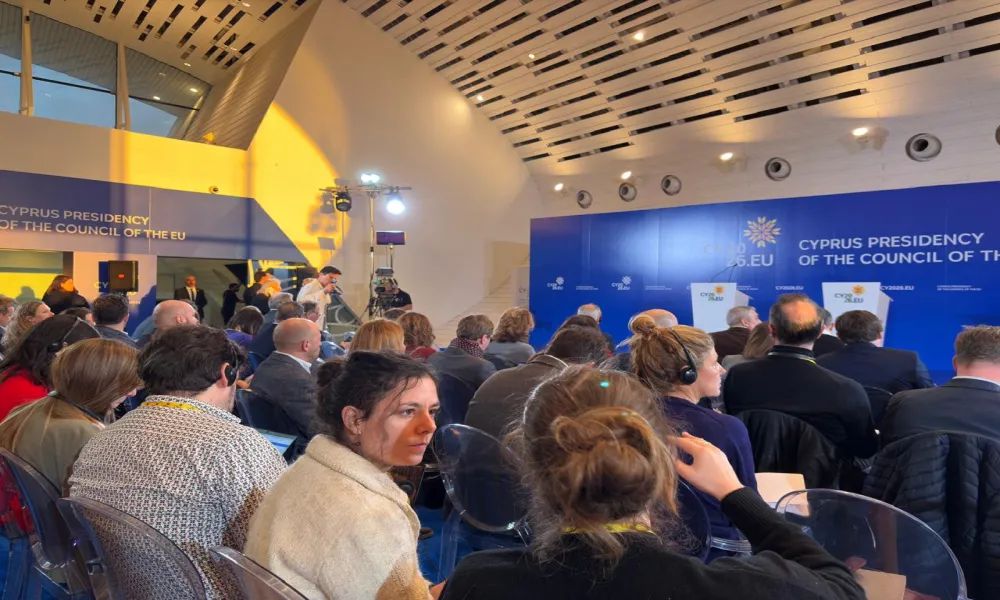
The first international journalist steps off the bus, looks around, squints into the winter sun and laughs.
“Where’s the beach??!!”
He’s immediately met with laughter from Cypriot colleagues, a few half-apologetic gestures in the direction of the sea just out of sight, and that familiar local instinct to welcome before explaining. Within minutes, the ice is broken. Cyprus, it seems, has already done part of its job.
By the time we reach the workstations at the Limassol port, the mood has shifted from curiosity to something closer to excitement. The port itself does some of the heavy lifting. There are comments about the light, the openness, the view. More than one journalist pauses mid-sentence just to look around. For a presidency event, it feels unusually alive.
The room hums. Laptops open, phones out, coffees multiplying. Conversations overlap in French, Italian, Flemish, English. Someone jokes that this already feels more European than Brussels on a bad day. There’s a sense that people are genuinely pleased to be here, which is not always a given on the EU circuit.
Behind the scenes, the discussions move fast and wide. Greenland comes up again and again, as a symbol of how quickly geopolitics is shifting north, south, everywhere at once. Iran follows. So does Trump. There’s a shared disbelief at the speed of it all, the sense that the ground keeps moving before anyone has time to adjust their footing.
In quieter corners, voices drop. Videogate is mentioned, carefully, with suspicion and curiosity in equal measure. No one quite knows where it’s heading, but everyone is watching. It feels like one of those stories that could either evaporate or explode, and no one wants to be caught unprepared.
Then we move into the press conference room, and the atmosphere tightens. The casual buzz gives way to anticipation. For a few minutes, it genuinely feels like we are the centre of Europe. One room, dozens of accents and a shared pause.
French, Italian, Flemish, Greek, English float through the air as journalists compare notes, line up questions, speculate quietly. Everyone is waiting for the same thing: confirmation that this warm Cypriot visit is more than good weather and good intentions.
There’s an unspoken test in the room. Can Cyprus convince a sceptical, overstretched Europe that it is serious? That it understands the moment? That it can broadcast authority from its small, exposed corner of the Union, right on the edge of a dangerous south?
When the two presidents finally appear, the room stills. This is the moment everyone will have to report back home. To newsrooms where Cyprus is often a footnote, if it appears at all.
Listening, I realise that part of what’s happening here has very little to do with individual policy announcements. Cyprus is not pretending it can control the storms around it. It is saying, instead: we know the waters are rough, but we are steering anyway.
As the conference wraps up and people begin filing stories, there’s a quiet sense that something landed. From this little corner of the south, Cyprus has spent the day doing something ambitious: asking Europe to look its way, and to take it seriously.
For now, at least, Europe did.