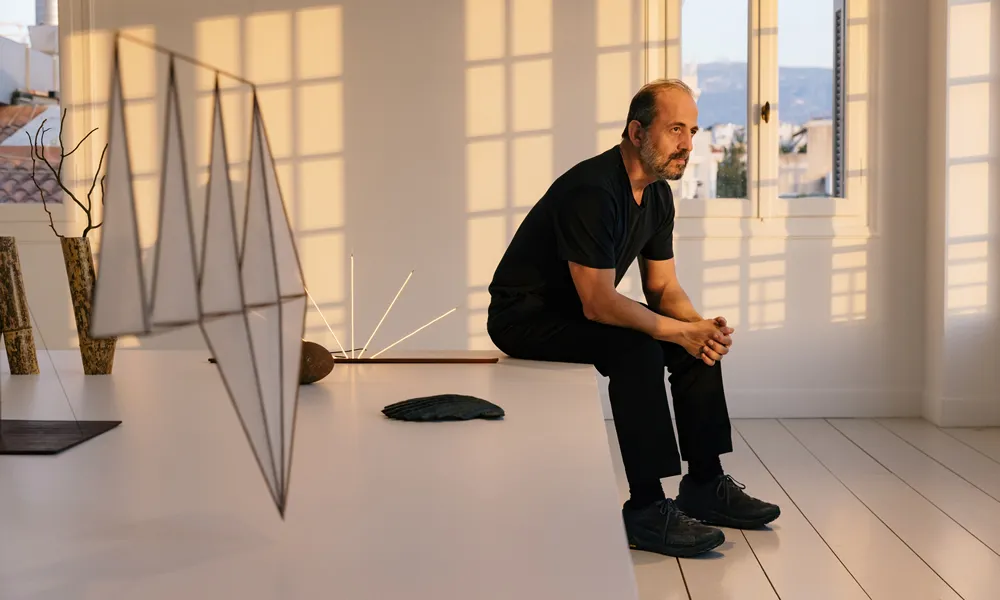

“This must be the light they have in heaven”, my ten-year-old said, coming out of the hall with Michael Anastassiades’ lights. It was a few years back, the first time I experienced the power of his work, at his exhibition Things That Go Together at NiMAC - Nicosia Municipal Arts Centre in Nicosia, where the artist showcased work from the previous twelve years, focusing mainly on lighting. The words of a child perfectly captured an atmosphere, the warmth, the silence, a landmark presence of Michael Anastassiades’ creative philosophy.
More recently I attended the opening of All Colours Will Agree in the Dark at Melas Martinos Gallery in Athens, a presentation again revealing his approach to bridging art, design and spatial storytelling. Curiosity and wit, perfectly rounded stones, fragments of wood and leaves, a black rendering of Pentadaktylos mountain. An unrelated harmony, a philosophy, unchanged since childhood.
Those who know him well smile when they discover the same Michael, losing himself in rivers searching for the best stones, wandering fields collecting leaves and wood. That same attentiveness continues, abstraction and precision meet in a process that transforms observation into an invention he had in mind in the first place, while at the same time reaching a point of communication where an object becomes intimate to someone else. While he calls himself a designer, Anastassiades’ territory is much broader, an artist who speaks through design, and whose work suggests there is still much more to come. In any case it seems as a singular philosophy.
His principles, rooted in the belief that quality is found in subtle detail rather than overt spectacle, and that objects, whether a light or a chair, gain meaning through interaction and context rather than imposition, inform his curatorial vision for the Cyprus EU Presidency 2026. In his interview with Politis to the point, Michael Anastasiades says that the strength of an artwork lies in its capacity to speak for itself, inviting viewers into a space of reflection and allowing time to be experienced and felt.
Perhaps it is precisely this patience, subtlety and quiet impact that Cyprus can aspire to leave as its mark during the EU presidency.
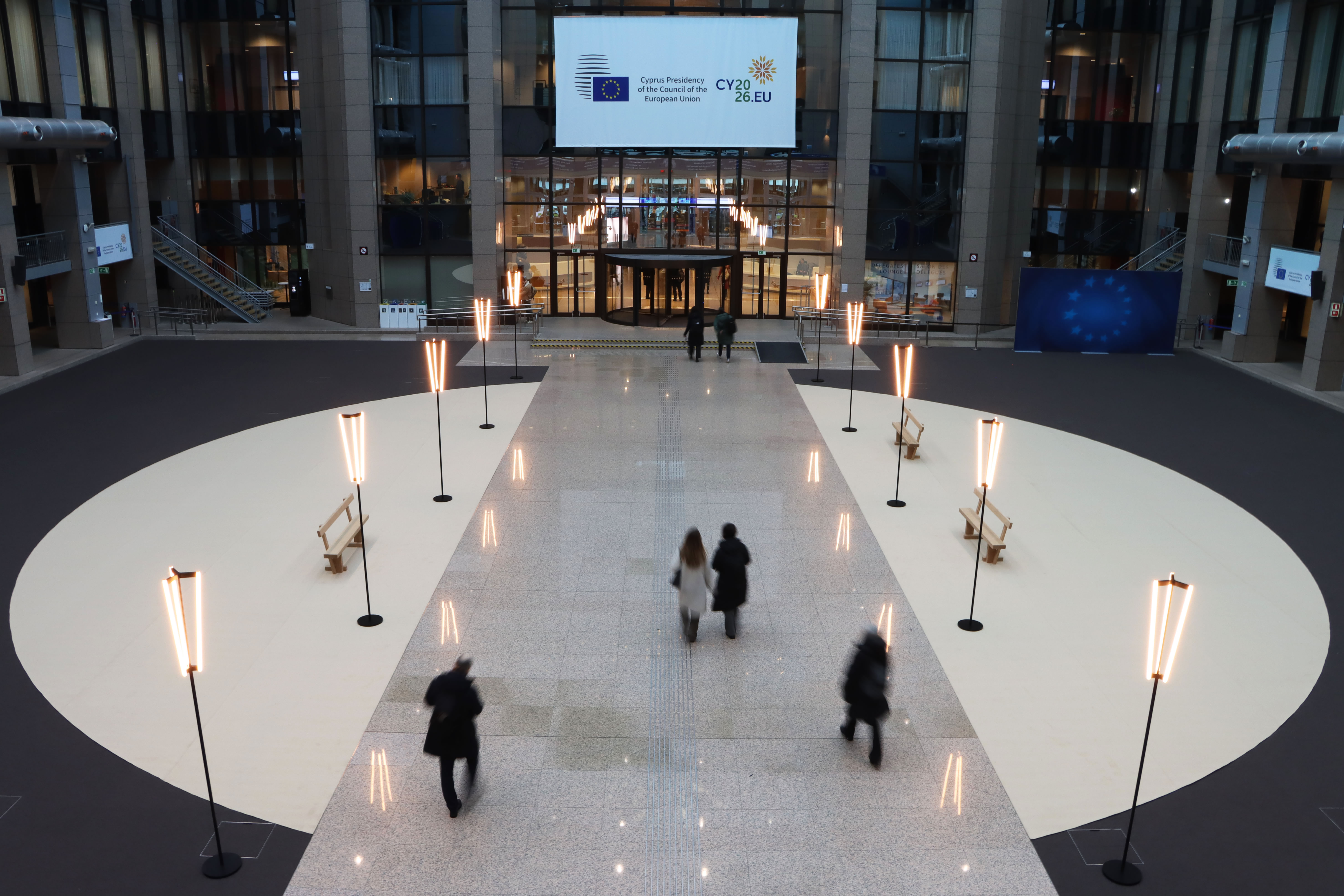
bridging Cyprus and Europe, inside and outside, and creating a dialogue between
the island’s weather and Brussels’ climate.
What triggers the initial spark of creation, and where does a new journey truly begin?
It is hard to define the beginning of a new idea and how the process starts is never constant. It is about how information gets absorbed and filtered and about accepting the possibility that it might not emerge into a new idea.
The most important part is to accept this as part of the process and to maintain a discipline with which you will eventually develop the work.
What motivated you to accept the invitation to curate the cultural dimension of the Cyprus EU Presidency, and can you explain what your role entails?
The proposal was a closed competition where a selection of participants were invited to submit their project. For this presidency, the role of the selected designer was more of a curator rather than a sole decision-maker. The idea was to capture the concept and the values with which Cyprus was entering the presidency.
How did you approach the curatorial aspect of this project?
I put together a team of several artists and made a proposal. Beyond the curatorial aspect, my role included coordination and meeting certain requirements regarding the design of specific spaces. The Justus Lipsius building has designated locations for each country leading the presidency to showcase installations or artworks. The main atrium, a huge glass-covered space with a very high ceiling, hosts large events and is essentially the backstage for all the activities.
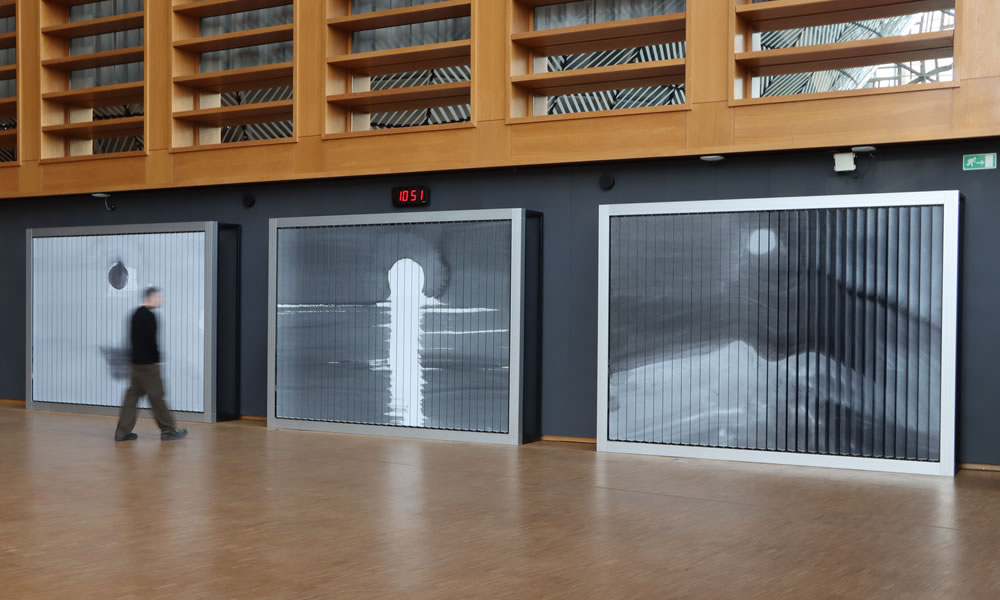
movement, gateways to Cyprus shaped by its climate, material and immaterial, now entering
into conversation with Europe’s own shifting atmospheres.
How do you navigate such an institutional and politically charged environment like Brussels?
My role is not to get involved in politics. From the Cyprus side, the message was that the selection of the team had to be inclusive: Marietta Mavrokordatou, a young photographer and video artist, Joanna Luca, a weaver, Penelope Ioannou, a writer and curator leading communication materials and Clio Hadjigeorgiou , who organised the communication documents. We also have Stelios Kalinikou, an artist using photography and video, and Polys Peslikas, a painter.
The Deputy Minister was very clear about the qualities and values they wanted the participation to reflect, and our proposal aimed at communicating those values effectively.
Would you say the work reflects a contemporary Cypriot design identity?
I don’t believe you can call it strictly “Cypriot” in identity terms. Many artists on the team have spent years abroad or are of Cypriot origin, and their work is influenced by many factors. It has certainly influenced how I work as well, even though I’ve been away from Cyprus for over 30 years. The creativity here extends beyond a national identity.
Speaking about your career path, how has your diverse background in engineering, art, yoga, and experimentation shaped your approach to large-scale commissions today?
I always thought of myself as a person that wanted to try different things out. It has been quite a journey. I’ve made choices that didn’t necessarily make sense at the time. I often started with what I liked least, from the bottom in terms of what would have been my least favorite choice and ended up figuring out a direction through the process of elimination. Growing up in a conservative environment with no creative encouragement, the idea was that you study to secure a job. Art was seen as something you do on the side.
I studied civil engineering in London and later I attended the Royal College for a master’s program aimed at engineers exploring creative paths, which allowed me to immerse in a creative environment. But I still wanted to move away from engineering entirely. I kept researching and pursuing freelance work for several studios, always keeping personal creativity at the core. Yoga and other explorations helped me maintain freedom in my work.
It sounds like mentoring, a kind of advice you could give to young creatives facing the same pressures you did…
I encourage them to focus on the journey rather than rushing to the end result. Many are drawn to social media and want instant outcomes, forgetting that meaningful work requires effort and patience. I remind them not to surrender to patterns defined by others and to stay open-minded.
"Times today are fast and superficial, making it difficult to maintain a connection with tangible, real experiences. And the loss in the real thing, our contact with physical things, unfortunately, is the biggest loss we are experiencing currently."
Can we escape?
Trying to escape is much more complicated. The whole system is structured so that it completely envelops you in this pattern.
Yet your exhibitions seem to stop time and create a sense of silence and timelessness.
Silence is exactly what any work, any creative work should do, really, it should speak for itself, you don't need to explain it, you don't need to define it, you don't need it, it needs to make you sit in silence and perhaps try to absorb what it is that what you see means to you, which is the most important, I think, quality that anybody should aim, anybody creative should aim for.
Once your lights and objects are in someone else’s space, how do you feel about their placement or use?
You cannot control everything. As a designer, you equip your pieces to survive multiple environments, but once released, they have their own life. It’s not about controlling their use but about ensuring they communicate their strength and quality, even in busy or unexpected spaces.
From your perspective as a Cypriot living abroad, how do you view Cyprus culturally?
Living abroad was a personal challenge and a way to be outside my comfort zone. Cyprus has incredible cultural wealth, both historically and artistically, but many people look outside for validation, which can cause confusion. Being abroad pushes you to work harder and understand whether your path is truly yours. I don’t live there, so I can’t fully judge, but I know I’ve been given opportunities, and I’m grateful. From my experience in the UK, support for designers and artists is generally insufficient, so Cyprus is not necessarily worse. You know what they say about the grass looking greener on the other side.
"I don't think that our career path should be defined by opportunities. Creative careers require creating your own opportunities."
If a European official sits on a chair or experiences the curated space at the presidency, what feeling about Cyprus would you like them to take away?
Indeed, I did design the chairs that we are using in the layout and decoration of the different spaces, but I wanted the work of the artists, my selection of artists, to convey the message. One of the major themes we tried to capture is the weather, meaning things that we grew up with in Cyprus, which may be different from other places, but also more abstractly, in terms of the future of our climate. Whether the visitors are sitting or simply surrounded by something quite simple, I hope they will be able to experience this.
Through simplicity, the ideas have been distilled to communicate all those values and qualities. It’s not about high-end design, creating domesticity, or making works meant to shock. I believe the quality lies in the subtlety of the work. My hope is that this conveys the correct message: we are not there to scream for attention, but to communicate through subtlety, which is far more meaningful. Quality is in the subtlety…
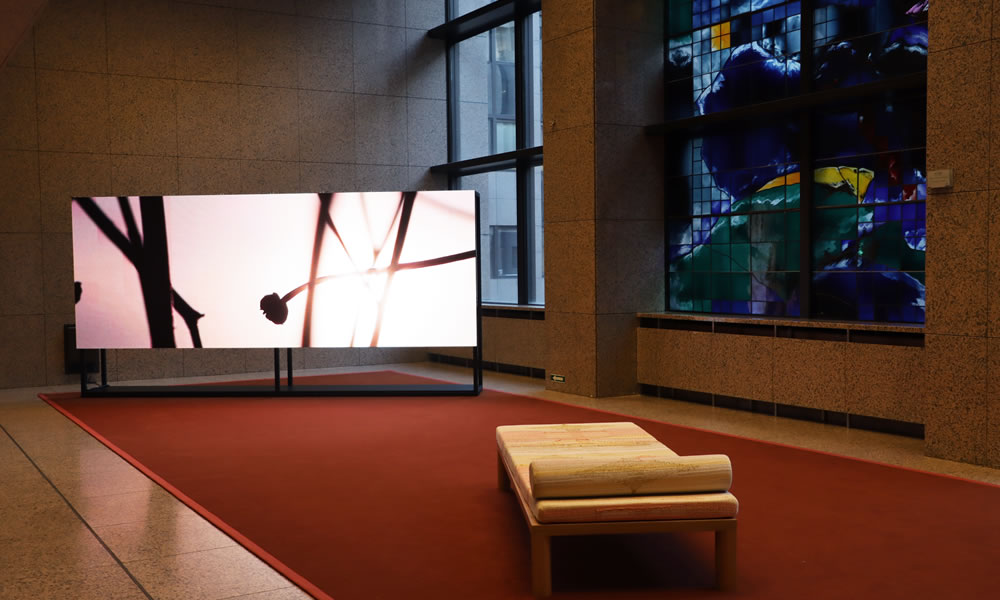
** Michael Anastassiades: Cyprus’ Global Design Visionary
As one of Cyprus’ most internationally acclaimed designers Michael Anastassiades has been chosen as the curator and creative force behind the cultural programme of the Cyprus EU Presidency 2026, organised by the Deputy Ministry of Culture.
More specifically he was selected to create and curate a series of installations and furniture designs at the Council of the EU’s Justus Lipsius and Europa buildings, where all meetings and proceedings of the European Union Council take place.
There, the Cypriot Presidency leaves its mark through an exhibition of works by Cypriot artists, curated by Anastassiades, alongside furniture he personally designed, with the aim of highlighting the aesthetic identity of Cyprus and the dynamism of contemporary Cypriot design.
As a child his first reference in design was the Cypriot architect Neoptolemos Michaelides, his father’s friend who built the family’s holiday house in Limassol. Trained as a civil engineer at London’s Imperial College of Science, Technology and Medicine before turning to a master’s degree in Industrial Design at the Royal College of Art, Anastassiades always sought his creative path. In 2007, he founded his own studio, Michael Anastassiades Ltd, focusing on lighting design. His minimalist yet poetic pieces became internationally renowned, solidifying his role as a contemporary powerhouse on the global design scene.
Today Anastassiades’ studio focuses primarily on bespoke lighting projects and is represented internationally by galleries including Nilufar in Milan, Friedman Benda in New York, and Taka Ishii Gallery in Tokyo. His collaborations include leading design houses such as Flos, Puiforcat, Lobmeyr, Herman Miller, Molteni, Cassina, B&B Italia, Valextra, Alessi, Mutina, and the Swedish design institute Svenskt Tenn. He has also held major exhibitions, including solo shows, the most recent in Athens, at Melas Gallery “All colors will agree in the dark”, reflecting his distinctive approach that bridges art, design, and spatial storytelling.