The first hours after the drone attack against the British military bases in Cyprus revealed something that perhaps should not have been surprising: panic and confusion. At a moment that required clear messages and composure, the image projected by the state was that of a government trying to demonstrate that it controlled the situation while in reality appearing at least uneasy and reactive.
The first statements by the President of the Republic followed the familiar line of reassurance. He stressed that Cyprus was not under immediate threat and that the competent authorities were closely monitoring developments. At the same time, however, the state was activating emergency procedures, meetings were being held, readiness measures were announced and discussions began about informing citizens regarding shelters and warning systems.
A dual response
This dual situation created concern rather than reassurance. On the one hand there was insistence that there was no reason for panic. Initial reports suggesting missiles had been launched from Iran towards Cyprus targeting the British bases were denied.
In an apparent effort to reassure Cypriot public opinion, Nikos Christodoulides, through his spokesperson, said he had communicated with British Prime Minister Keir Starmer, who assured him that no such threat existed and that Cyprus was not a target. This categorical approach by the President and the government spokesperson effectively avoided opening the scope of information and clearly communicating that Cyprus is already part of the crisis.
On the other hand, the government’s actions suggested a situation of heightened risk. For the average citizen, who suddenly sees efforts, even belatedly, to inform the public about emergency procedures, announcements about tests of warning systems and repeated meetings of the National Security Council, the message could not convey calm but rather the sense that something serious was taking place.
This image was reinforced by a series of decisions and announcements that appeared to reflect immediate reactions rather than an organised plan. Meetings were cancelled, statements followed one another and information circulated in fragments. In a country where the political leadership insists it has full awareness of its geopolitical importance, the picture conveyed suggested a very different version of crisis management, highlighting familiar weaknesses of the state apparatus.
The reality, however, is harsher than communication reassurances. The attack against the British bases reminded us of something that is often avoided in public discussion. Cyprus lies in one of the most sensitive geopolitical zones on the planet. The bases have for decades served as a crucial operational hub for Western military forces and for NATO in the Eastern Mediterranean. When these facilities become targets, Cyprus cannot pretend it stands outside the frame of the crisis.
A positive development, but what next?
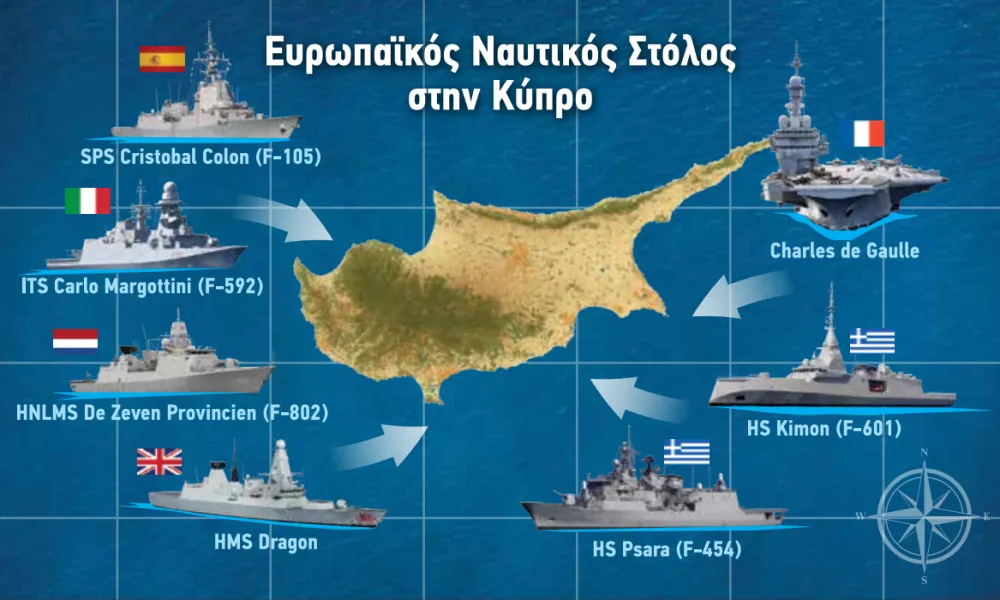
The fact that strong naval forces from European states are present or will arrive in Cyprus does not necessarily mean greater security. Their presence in the region is welcome. It was also right for Nikos Christodoulides to request this presence. At the same time, however, it confirms that the island lies geographically very close to a theatre of military operations. In such circumstances, security can never be taken for granted.
This new environment brings back into focus a broader question about the direction of Cypriot foreign policy in recent years. For some time, a narrative has been cultivated presenting Cyprus as a “geostrategic player” in the Eastern Mediterranean. A state that participates in regional cooperation axes, functions as a hub for energy and strategic planning and even acts as a factor of stability in a turbulent region.
Rhetoric and realities
This rhetoric may have been politically useful domestically, but it is far removed from reality. Cyprus is a small state which also faces an unresolved national issue. It is not merely divided; in practice it is partitioned, with the presence of the Turkish army and foreign military bases on its territory.
A country in such circumstances cannot behave as a power that leads or supposedly plays a central role in geopolitical alliances. When it attempts to project such an image, the result is often the adoption of narratives that serve domestic political needs more than strategic reality. Cyprus’ decision to align with the West and its European partners is clear and necessary. The problem does not lie there. The problem lies in the loss of balance observed in recent years.
In several cases, Cypriot diplomacy appeared almost uncritically aligned with specific policies and strategies, particularly regarding the war in Gaza and Israel’s broader regional strategy.
At the same time, the idea of regional “axes of cooperation” was promoted almost as a geopolitical counterweight in the region. In practice, however, such frameworks are always defined by the interests of the larger states that participate in them. A small country cannot direct them; it can only participate in them as long as its own needs are served.
In the international system, alliances are not acts of solidarity. They are instruments of interests. Every state acts according to its own strategy, its own agenda and its own assessment of costs and benefits. Larger states cooperate with smaller ones when it serves their interests and distance themselves when their priorities change.
Cost-free populism
For Cyprus, the problem is even more complex because beyond its geopolitical position lies the unresolved Cyprus problem. This issue is not simply one dimension of foreign policy. It is its core. Every strategic partnership and every diplomatic choice should be assessed according to whether it contributes, directly or indirectly, to creating conditions that could lead to a solution.
Otherwise, Turkey will not simply “consider withdrawing its troops and leaving Cyprus”, as Greece’s defence minister stated recently. A leading figure within New Democracy used the opportunity, as other Greek politicians have done in the past and continue to do today, to offer easy slogans and grand statements. He did not explain, however, how exactly “this is a good opportunity for Turkey to withdraw its soldiers from Cyprus”.
A dangerous narrative
When alliances become an end in themselves or a tool for domestic political projection, the substance is lost. And when a small country begins to believe its own communication narrative, it risks being drawn into roles it cannot sustain.
Cyprus does not have the luxury of geopolitical illusions. Its geography and its size impose a form of hard realism. That realism does not mean isolation or neutrality. It means awareness of limits.
The true strength of Cyprus has never been ambitious geostrategic roles. It has been its credibility as a place of stability, dialogue and humanitarian presence in a region of conflict, while keeping focus on resolving its own political problem. If Cyprus today appears to be part of the problem rather than part of the solution, then something has gone wrong in its strategy. The first step in correcting this is not communication management during crises, but a return to a calmer, more realistic and less imaginary understanding of the country’s role in the region.
Iran’s apology quickly contradicted
Neighbouring Gulf states will no longer face attacks from Iran unless strikes are launched against Iran from those countries, Iranian President Masoud Pezeshkian said yesterday morning on state television, referring to a decision taken on Friday by the country’s interim leadership council.
He went a step further, apologising for the attacks carried out in recent days in which 13 people were killed in Gulf countries since the start of the war. “I apologise to the neighbouring countries that were attacked by Iran,” the Iranian president said.
His statement raises questions, however. If the decision had indeed been taken on Friday night, under what circumstances were the United Arab Emirates struck on Saturday morning, specifically at Dubai’s international airport, the busiest airport in the world for international passenger traffic?
As the Ministry of Defence announced, “UAE air defence systems are currently intercepting missile and drone threats from Iran”, while interception operations were underway. The attack led to the temporary suspension of operations at the airport.