In Paphos in 1949, at a time of political constraints but intellectual alertness, the poetry of Kostis Palamas found a public platform and a collective audience. The Palamas Festivals, an institution born out of the vision of mayor Christodoulos Galatopoulos, were not merely a series of events but an act of cultural self-awareness.
Through the documented research of Lia Georgiadou, a pivotal moment in the intellectual history of Paphos is reconstructed – a moment when discourse, memory and national consciousness converged, leaving a legacy that transcends time. Her study sheds light on lesser-known aspects of the era’s cultural activity and highlights the contribution of local figures to shaping the city’s intellectual identity. At the same time, it documents the importance of the Palamas Festivals as an institution that strengthened literary tradition and fostered interest in Greek letters.
Galatopoulos, both as mayor and as a man of letters, admired Kostis Palamas and worked with dedication to spread and embed his work in Cypriot society.
At his initiative, Georgiadou notes, “Kostis Palamas Week” was established in February 1949, marking the first organised and institutionalised form of Palamas Festivals not only in Cyprus but across the wider Greek world. The events stood out for their scale, mass participation and multi-dimensional character, combining church and civic memorial services, school and cultural events, recitals and analyses of Palamas’ work.
Through this initiative, Paphos established itself as the “Palamas city” of Cyprus, while the celebrations became a reference point for cultivating national consciousness and Greek education during a critical historical period. Galatopoulos viewed the events not only as a tribute to the great poet but also as a means of intellectual awakening and education for the younger generation.
The programme
According to a report published in the Greek newspaper Ethnos on 19 January 1949, “Kostis Palamas Week” was scheduled to take place from 20 to 27 February 1949, with a rich and wide-ranging programme.
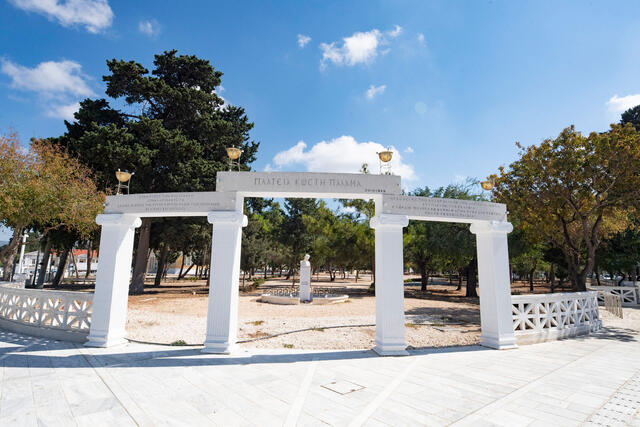
The celebrations began on Sunday 20 February with a religious memorial service at the Cathedral of Saints Theodore, officiated by Metropolitan Cleopas of Paphos. On the same day, a commemorative plaque was installed and a square in Ktima was renamed Kostis Palamas Square. Authorities also announced the establishment of an annual literary “Palamas Prize” for secondary-school students.
A commemorative event followed at the Paphos Greek Gymnasium, featuring a lecture on the poet’s life and work. On 22 February, an event took place at the Paphos Greek Lyceum, while on 24 February a civic memorial service was held at the Municipal Library.
The celebrations culminated on Sunday 27 February with a popular Palamas Festival at a city cinema, involving educational institutions and cultural bodies. Throughout the week, the city actively embraced the spirit of the events. Squares were illuminated, excerpts from Palamas’ work were distributed free of charge, and a commemorative publication was issued after the festivities ended.
Public interest was strong, a response largely attributed to the initiative and commitment of the mayor of Paphos. The municipal council, under his leadership, took key decisions to ensure the success of the events, including renaming Omonia Square as Kostis Palamas Square and sending invitations to the poet’s family.
Organisers also appointed speakers and poetry reciters, while special emphasis was placed on musical performances of works set to Palamas’ poetry. Particular mention deserves the establishment of a cash prize of £10 for the Palamas student competition, as well as the provision for participation by Turkish schools – a reflection of the educational and cooperative spirit that characterised the event.
During the week, literary lectures and memorial services took place, featuring prominent scholars and educators analysing Palamas’ work and influence. A notable initiative was the establishment of an annual student competition, the Palamas Prize, strengthening the link between the younger generation and the poet’s work. Fundraising also began for the erection of a bust of Palamas, while musical and poetic performances accompanied the events throughout.
The celebrations culminated with a religious memorial service and a final event at the Attikon cinema, featuring speeches, recitals and choral works based on Palamas’ poetry, attended by large crowds and church representatives. Although the poet’s children were absent, his daughter sent a letter of thanks, confirming the significance and impact of the celebrations.
When it became an institution
According to Georgiadou’s research, Paphos emerged as a pioneering centre for honouring and promoting the work of Kostis Palamas in the early 1950s. The Palamas Festivals of 1950, 1951 and 1952 illustrate the cultural and national importance Cypriot society attached to the great Greek poet.
In 1950, as part of “Palamas Week”, a nationwide fundraising campaign began for the erection of a bust of Palamas. The Municipality of Paphos contributed financially, while significant sums were raised across Cyprus, with Paphos covering the largest share of the cost.
The initiative bore fruit in 1951, when Paphos became the first city to erect a bust of the poet. The unveiling took place with ceremony on 20 May 1951 by Archbishop Makarios, as part of the 37th Pancyprian Games. The marble bust, made from Pentelic marble and sculpted by the Athenian artist Tombros, was installed in the square bearing Palamas’ name. Verses from the poem “Cyprus” were engraved on it, reinforcing the symbolic link between Palamas and Cypriot Hellenism. The ceremony featured poetry recitations, high-flown speeches and performances of the national and Olympic anthems.
That same year, the Municipality of Paphos established the First Palamas Competition, held at the Municipal Library. On 4 March 1951, a Palamas Festival was organised with writer Nikos Kranidiotis as keynote speaker, addressing the topic “Palamas and His Time”.
The events continued with momentum in 1952. On 10 February, marking the presence in Cyprus of Stratis Myrivilis, a Palamas Festival was held and regarded as the opening of that year’s celebrations. Myrivilis delivered the lecture “The First and Last Lamp of K. Palamas”, leaving a strong impression.
That year, Paphos also hosted other prominent figures from Greece, including composer and academic Manolis Kalomiris and writer Athena Tarsouli, who contributed lectures highlighting Palamas’ work.
As Georgiadou observes, this period proved particularly fertile for the Palamas Festivals, combining artistic creation, intellectual cultivation and national consciousness, and establishing Paphos as a major centre of cultural activity in Cyprus. The celebrations carried a strong patriotic pulse and a distinct Greek character, blending literary activity with clear national messages.
According to Palamas Festivals researcher Lia Georgiadou, the events functioned both as a means of intellectual development and as a vehicle for strengthening national sentiment, inspiring the Cypriot people in the run-up to their liberation struggles. In Paphos in particular, the establishment of “Palamas Week” gave the celebrations a long-term character, forging a closer bond between the local community and the broader world of Greek culture.