
In previously unseen material from an award-winning documentary, British painter David Hockney reflects on the importance of truly seeing, rather than merely looking, using something as ordinary as the colour of a road to make his point.
Hockney Unlocked is a series of 80 short films produced, directed and edited by Bruno Wollheim. The films draw on previously unreleased footage from his documentary David Hockney: A Bigger Picture, which he shot single-handedly over five years while working alongside the artist. Wollheim accompanies the clips with commentary shaped by a friendship of more than 30 years.
Few people pay attention to the colour of a road. Most of us simply default to the assumed ‘local’ colour of asphalt. For Hockney, however, this becomes an invitation to look more carefully and to question whether we really understand what the world around us looks like. This, he suggests, lies at the heart of painting.
He recounts a car journey with art critic and curator Marco Livingstone, who has written extensively on his work, and publisher Stephen Stuart-Smith. Together, they produced the 2011 book David Hockney: My Yorkshire.
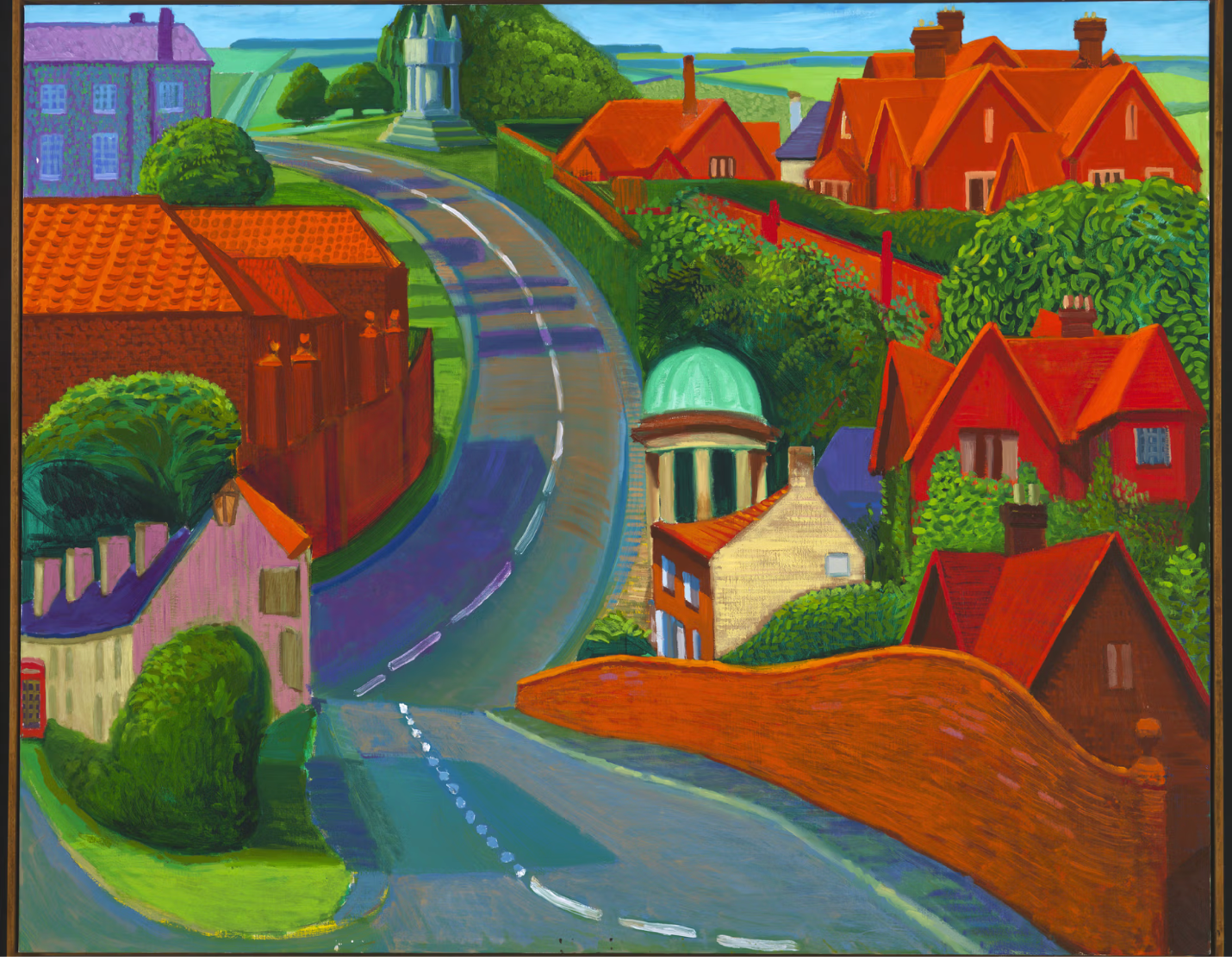
The Road to York Through Sledmere (1997)
The road occupies a central place in Hockney’s return to painting the landscape of his native Yorkshire in the late 1990s, initially for deeply personal reasons. His close friend Jonathan Silver, who founded the 1853 Gallery at Salts Mill near Bradford – Hockney’s birthplace – so he could exhibit his works, was terminally ill.
For years, Silver had encouraged Hockney to paint the local landscape. When he was diagnosed with incurable cancer in the summer of 1997, Hockney left California to be close to him. Each day, he drove from Bridlington, where his mother and sister lived, to Wetherby, passing through Garrowby Hill.
The first three Yorkshire paintings of that period capture sections of this journey: The Road to York through Sledmere (1997), The Road across the Wolds (1997) and North Yorkshire (1997). Hockney would bring the still-fresh canvases to Silver to show him his progress. A fourth work was dedicated to Salts Mill.
These paintings were imaginative reconstructions of a car journey, echoing earlier Californian works such as Mulholland Drive and Nichols Canyon from 1980.
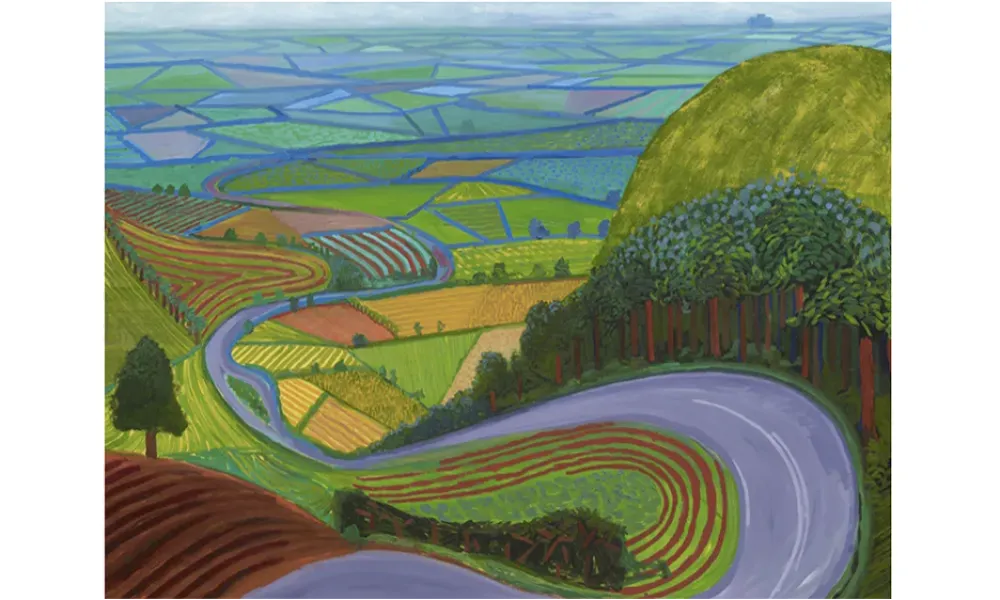
The motif of the road continued after his return to California in 1998 with a large painting of Garrowby Hill, now housed at the Museum of Fine Arts in Boston.
Art critic Marco Livingstone wrote in 2017: "...in The Road to York via Sledmere one feels the visceral impact of being catapulted at great speed along a road, the twists and turns of which invite comparison with a roller-coaster ride with its attendant giddy thrills."
Going up Garrowby Hill (2000)
Roads and paths feature prominently in Hockney’s watercolours and oil paintings of East Yorkshire from 2003 onwards. They lend immediacy and, at times, a sense of unease to the landscapes. Viewed together, the works evoke an almost cinematic, road-movie atmosphere.

In the closing moments of the video, Hockney reflects on how people are beginning to lose their sense of belonging. This concern was particularly present in his Yorkshire work, influenced partly by the emerging virtual world of cyberspace and partly by his awareness of domestic terrorism in towns near Bradford.
This added urgency and contemporary relevance to his depictions of the natural landscape.
The large watercolour featured at the beginning of the video, Trees & Puddles. East Yorkshire. 30 III 04 (2004), was later shown alongside works by J. M. W. Turner in the exhibition Hockney on Turner Watercolours at Tate Britain, held from June 2006 to February 2007.
The documentary David Hockney: A Bigger Picture is now available online.
Source: The Art Newspaper