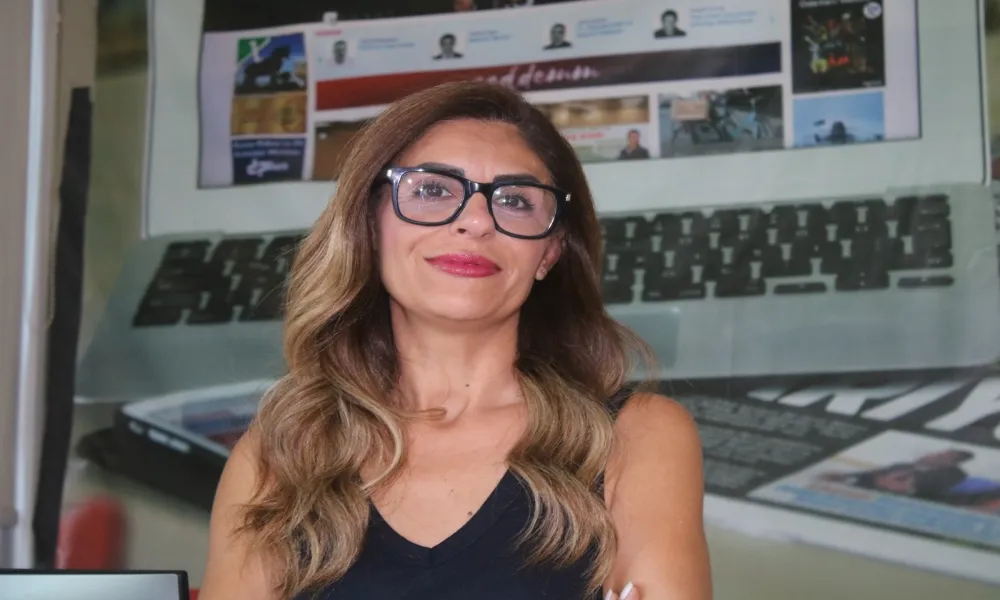
What do we see when we look at Cyprus beyond the familiar narratives of conflict and division? And what changes when the everyday experiences of people are placed at the centre? On the occasion of the first conference of the Cyprus Association of Social Anthropologists (CASA), its president, Theodoros Kouros, speaks about an anthropology that questions what is taken for granted, seeks out what often escapes dominant narratives and claims a more active role in Cyprus's public and cultural life.
How much of what we consider self-evident about Cypriot society is actually self-evident? The ways in which we remember and forget, our relationships with family, gender, work, migration and the environment, and even our daily habits, can reveal a great deal about how society is shaped. This is precisely where Social Anthropology is encountered: in the effort to understand not only what happens, but how people experience it and what it means to them.
In a Cyprus that continues to carry the weight of colonialism, conflict, division and displacement, while at the same time changing through new social and cultural realities, the anthropological perspective acquires particular significance. With this need for dialogue in mind, the Cyprus Association of Social Anthropologists seeks to create a common space for research, collaboration and public discussion.
Why was the Cyprus Association of Social Anthropologists created? What gap does it seek to fill?
Social Anthropology has been practised in Cyprus for decades, in universities, NGOs, research institutes and artistic and cultural settings, yet without any common space where anthropologists could meet, collaborate and engage in dialogue.
Although Social Anthropology is not widely known as a discipline among the broader public in Cyprus, it is worth noting that the island has a rich anthropological tradition. It has attracted important researchers from around the world, inspired internationally recognised anthropological studies and produced anthropologists who have contributed to international scholarly debates.
Nevertheless, Social Anthropology does not have an independent degree programme in Cyprus. It is taught across different fields and integrated into other disciplines, but has not yet attained the institutional recognition that, in our view, it deserves.
The association aims to make the discipline more visible. In practice, it seeks to bring together anthropologists working in different contexts and communities, support the professional development of its members and build bridges between academic research and the public sphere.
On an island where social issues are both intense and complex, anthropology has much to say. The association wants to give it the space to do so.
Usefulness
For someone with no direct connection to the discipline, what can Social Anthropology contribute to understanding contemporary Cyprus? Are there aspects of society that look different when viewed through an anthropological lens?
If I wanted to put it simply, I would say that anthropology teaches us to question what we take for granted and to continually ask why certain things appear natural or inevitable when in reality they are historical and social phenomena.
Social Anthropology also has another fundamental characteristic: it does not stop at describing what is happening. It seeks to understand why it is happening, how the people involved experience it and what it means to them.
Take the Cyprus problem as an example. Political analysis focuses on negotiations, plans and positions. Anthropology asks: How do people live division? How do they remember and how do they forget? What happens in meetings at crossing points?
But there are also other questions. Why do we exchange envelopes of money at weddings? Such questions are no less political. They are simply more everyday.
The same applies to issues that profoundly shape Cypriot society today, such as migration, tourism-driven development, urban expansion, environmental relations and new forms of inequality. In all these areas, anthropology sees what often escapes other narratives: the everyday experience of people.
Cyprus is a place marked by colonialism, conflict, division, displacement and refugeehood. How have these experiences shaped anthropological research on the island?
These experiences have, to some extent, defined anthropology in Cyprus.
For decades, anthropology on the island focused almost exclusively on ethnic conflict and on concepts such as memory, identity, nationalism, division and reconciliation.
This work has produced important and valuable scholarship. But this dominance also came at a cost.
Issues that did not easily fit into the conflict narrative, such as labour, class, gender, the environment, religion and other communities, often became marginalised or were interpreted through the lens of division.
Yet Cyprus is also many other things, and anthropology has a responsibility to see them.
There is also the question of who conducted the research. The colonial period left legacies that did not disappear with independence. For a long time, Cyprus was treated as a research field for foreign scholars.
This does not mean that such research lacked value, but it created relationships of dependency and asymmetry that the Cypriot anthropological community is now called upon to re-examine.
Independence
The association approaches anthropology not only as a field of study but also as a tool for solidarity, critical intervention and collective imagination. Where is the boundary between the researcher who observes and the citizen who intervenes? Can anthropology take a position without losing its critical independence?
This is a question that has occupied anthropology for decades and there is no simple answer.
But I think the question itself starts from an assumption that anthropology has long challenged: namely, that there exists a researcher who simply observes without influencing or being influenced.
In reality, there is no neutral observation.
There is even what is known as Labov's paradox, named after the linguist William Labov, who argued that when we observe speech, the act of observation itself changes the way people speak.
The same applies when we observe what people do, as anthropologists do.
When we enter the field, we bring our identities, values and relationships with the people we study.
Think of research on the traditional Sunday barbecue as a family ritual where men are generally outside and women inside the house. Wouldn't the researcher's gender affect where they have access, the conversations they have and the topics that arise?
Anthropological fieldwork therefore does not claim to be a transparent and universally generalisable process. It is a human relationship, with all the ethical responsibility that entails.
The question is not whether we take a position, but how we do so, with what consequences, with what transparency and with what responsibility towards those we study.
For example, in recent years, the genocide in Gaza has brought this question to the forefront. Anthropologists internationally have faced the question of whether they can remain silent.
For many of us, the answer was no.
Not because we abandoned scientific thinking, but because anthropology's understanding of violence, displacement and dehumanisation made neutrality impossible.
Solidarity in such cases is not a rejection of critical thought. It is a product of it.
Solidarity, of course, does not mean telling people what they want to hear. It means taking them seriously enough to speak about what is difficult, contradictory and uncomfortable.
The best anthropological research is often that which unsettles everyone's certainties, including those of the very people being studied.
The conference
The association's first conference, on 4 and 5 September in Limassol, is titled Our Common Grounds: Pasts, Presents, Futures of Anthropology in Cyprus. What does "common grounds" mean to you?
The title operates on several levels.
At its most literal level, it refers to Cyprus as the place that connects us and has brought us together in this dialogue.
But it also refers to the common ground we share as anthropologists: the questions, methods and concerns that make us a community even when we disagree.
There is, however, a third reading which is perhaps the most interesting to me: common grounds as the opposite of divided ground. It is a conscious choice to focus on what connects us without denying what separates us.
Finally, the plural form of "grounds" is not accidental. There is no single common ground or unified narrative for anthropology in Cyprus. There are many, and the conference seeks to bring as many of them as possible into view.
One of the conference themes concerns public and applied anthropology, from NGOs and policymaking to media, museums and the arts. How can anthropological knowledge move beyond universities and play a meaningful role in public and cultural life?
Anthropological knowledge already exists beyond universities.
Anthropologists work in NGOs, cultural institutions, museums and the media.
The problem is not that the knowledge does not circulate. It is that it is not always recognised as anthropological.
To increase visibility, we need to change our understanding of what public anthropology means. It is not simply the translation of academic ideas for a wider audience. It is a two-way relationship in which anthropology also learns from public debate.
Cyprus offers enormous possibilities.
Museums, for example, could become spaces for critical readings of history. Media outlets could approach migration and tourism not as statistical "problems" but as human experiences. The arts can communicate anthropological knowledge in ways that written texts cannot.
In presenting the conference you insist on an interesting distinction: not simply anthropology of Cyprus, but anthropology from Cyprus. What does this shift signify?
Exactly.
It is a way of saying that Cyprus has something to contribute to anthropology, not merely to serve as its field site.
This distinction is political.
Anthropology of Cyprus recognises the island as an object of study. That model has produced important knowledge, but it also reproduces asymmetries.
The alternative formulation changes that relationship. It says that there are anthropologists producing knowledge within Cyprus and that this knowledge is no less valid because it is produced on the so-called periphery.
There is also a decolonial dimension.
Who has the right to produce knowledge about whom, from where and with what questions is ultimately a question of power.
The shift we propose is not a rejection of international cooperation. On the contrary, our conference has a significant international presence and we welcome that.
It is, however, a rejection of hierarchy in the production of knowledge.
Who would you like to see attend the conference beyond anthropologists themselves?
A conference that speaks only to anthropologists has already partly failed.
Fortunately, we have many participants from the arts and culture sectors, which is something that excites us because the dialogue between anthropology and the arts is particularly productive.
Many artists already produce work that is deeply ethnographic without necessarily recognising it as such.
We also have strong participation from civil society and would love to welcome people from education, especially those concerned with how history and social realities are taught in schools.
Our conference includes public events for precisely this reason.
On Friday afternoon and evening there will be screenings of visual anthropology works and a public event introducing the association.
Anyone interested can also attend the conference sessions by completing the registration form available on our website.
Research
How easy is it today for a young anthropologist to remain in Cyprus, conduct research and earn a living in the field?
It is not easy.
The reality for most young anthropologists, and more broadly for social scientists in Cyprus, involves constant negotiation with precarity.
Temporary contracts and hourly paid work without long-term security are common.
The absence of a standalone social anthropology programme at Cypriot universities is part of the problem. There are few positions to be filled and no clear professional pathway.
The academic labour market in Cyprus is small, and anthropology has not yet achieved the visibility needed to attract resources and institutional support.
The association hopes to help create that visibility by supporting networking opportunities and advocating for greater recognition of social anthropology in Cyprus.
What long-term impact would you like the conference and the association to have?
The impact I would most like the conference to leave is the practical affirmation of a community.
The association's ambitions are broader and more long term.
We would like to support young researchers, contribute to public debate, build bridges with the arts, education and civil society and help ensure that Social Anthropology gains the institutional presence it deserves in Cyprus.
As for the larger question, Cyprus is a society accustomed to viewing itself through certain lenses: conflict, European integration and economic development.
Anthropology offers something different.
It offers the ability to see oneself as an object of critical reflection, to challenge what appears self-evident and to listen to voices that are usually not heard.
I do not know whether anthropology can change a society.
But I know it can change the way some people within that society see the world around them and themselves as part of it.
INFO
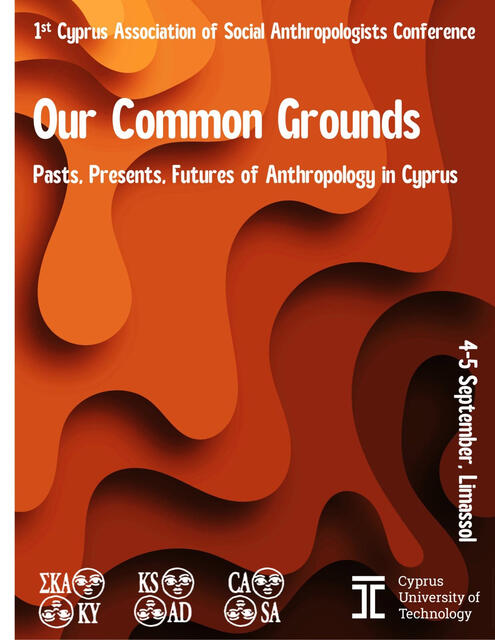
The 1st Conference of the Cyprus Association of Social Anthropologists (CASA), titled "Our Common Grounds: Pasts, Presents, Futures of Anthropology in Cyprus", will take place on 4 and 5 September 2026 at the Cyprus University of Technology (CUT) in Limassol.
The conference is co-organised by CASA and the university. The working language of the conference is English.
Further information, registration and the full programme are available at: www.cyprusanthro.org.