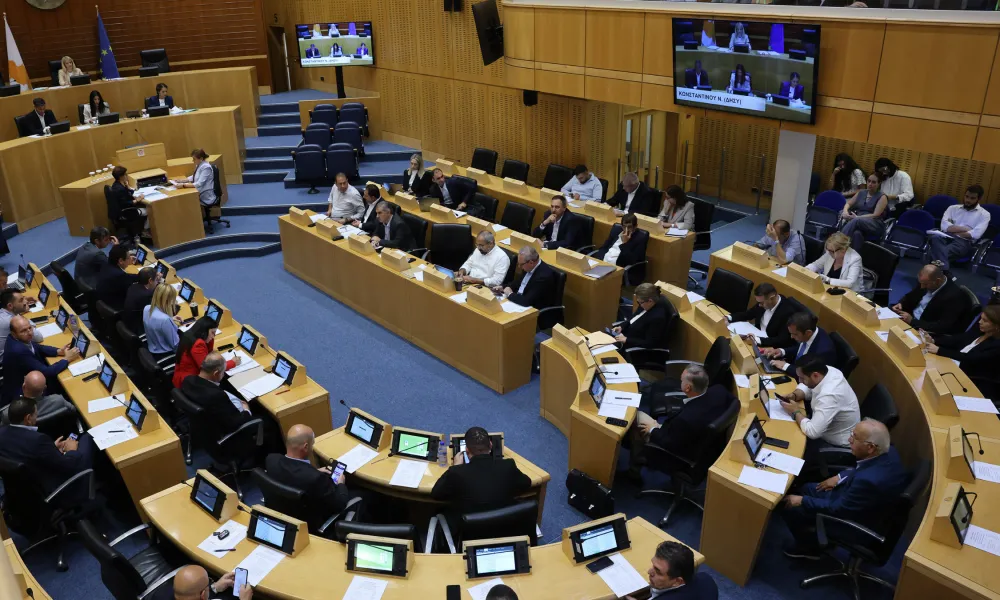

MPs’ Pothen Esches (asset) declarations for 2026 were published on 20 October and withdrawn the same evening, because they contained personal data of spouses and children that the law protects. A week later, the Ministry of Justice put out for public consultation a bill amending the system, with more frequent declarations and fines for those who fail to submit them. The two developments have reopened the debate on what the institution offers citizens, who checks it and where transparency stops when it touches on private life.
The leak
Under Law 112(I)/2024, the details of spouses, partners and dependent family members are exempt from publication, as are certain personal details of MPs themselves, such as telephone numbers and vehicle registration numbers. Such details were initially included by mistake in the 34 declarations that were posted. In a letter to the President of the House, MP Irene Charalambidou said that data on MPs’ underage children had been exposed, along with reconciliation statements submitted to the Tax Commissioner for review. MP Giorgos Pamborides spoke of possible criminal liability.
The President of the House of Representatives, Annita Demetriou, asked the House services to investigate and produce a factual report. She described the leak as a breach of personal data that should never have happened. She also expressed her displeasure that the debate had focused on the mistake rather than on the new transparency framework. The Office of the Commissioner for Personal Data Protection asked for the data to be removed from websites where it was still accessible and called on the media not to reproduce it. The corrected declarations were posted again on the afternoon of 21 October. The House was expected to notify the Commissioner of the breach the following day. According to the Commissioner’s Office, the assessment of such incidents can take anywhere from two weeks to two years.
The purpose of the institution
International research on institutional checks draws similar distinctions. The best-known comparative study, by economists Simeon Djankov, Rafael La Porta, Florencio López-de-Silanes and Andrei Shleifer, examined the rules of 175 countries and was published in 2010. According to its findings, publishing declarations is linked to better governance and lower corruption, whereas simply filing them with parliament does not have the same effect. The correlation appears in democracies and where declarations record sources of income and potential conflicts of interest. The researchers conclude that information on where wealth comes from is more useful than information on how large it is.
Dr Alexander Apostolides, a researcher at the Cambridge Centre for Alternative Finance and European University Cyprus and co-chair of Volt Cyprus, told Politis that the problem begins before the leak. “This is the main issue: the aim of politicians’ Pothen Esches has not been made clear.” Depending on the aim, the same system is judged differently. If the purpose is transparency, he says, the process has failed. If it is honesty, the question is whether we would consider it a success to catch an MP who had declared false information. If the purpose is to combat corruption, declarations would have to be compared before, during and after a term in office, which would require more intrusive checks and a thorough examination of every declaration.
Transparency and personal data
The limits of disclosure have also come before the Court of Justice of the European Union. In August 2022, the court examined a Lithuanian law requiring officials’ declarations of interests to be published online, together with details of their spouses or partners. It ruled that the extent of disclosure went beyond what was strictly necessary, and that even a spouse’s name could indirectly reveal sensitive data, such as sexual orientation. The ruling did not prohibit the publication of declarations, but it made proportionality a precondition.
Dr Apostolides does not believe GDPR necessarily stands in the way of transparency. “Other countries have GDPR too, and it doesn’t become an obstacle to Pothen Esches declarations,” he notes. The gap he points to mainly concerns politicians from wealthy families. A declaration records what is in the official’s name, but not their share of family assets. He proposes that politicians declare their share of joint accounts, without exposing their relatives, and that family trusts be declared, as other countries already require. Without such provisions, he says, the system has gaps that favour the well-connected and the wealthy, since they also have the means to avoid scrutiny.
What the declarations record
Of the leaders of the six parties in the House, five submitted declarations as MPs. In those five declarations, family often appears as the source of property. Annita Demetriou holds a half share in a building plot and a field acquired as gifts. Nicolas Papadopoulos declares six offices and a field received as a gift, and Christos Christou four fields, also received as gifts. Stefanos Stefanou states that he acquired his properties through borrowing, contributions from his parents and savings. Odysseas Michaelides declared 22 inherited properties with a value of zero, many of them in the north and consisting of small shares. The sources of liabilities are also recorded, such as the €28,560 loan from AKELdeclared by Stefanos Stefanou. In other words, the declarations show where the wealth came from, the element international research considers most useful. Its value, however, is not always comparable since, as the Michaelides case shows, a property can appear to have no value at all.
Who carries out the checks
The bill put out for consultation by the Ministry of Justice on 28 October was drafted by the Law Commissioner as part of compliance with the recommendations of GRECO’s Fifth Evaluation Round. It provides for an updated declaration every 30 months from taking office, to be published like the others. The Tax Commissioner would impose administrative fines of up to €5,000 on those who fail to submit a declaration or submit it late, plus €100 for each day of delay, up to a maximum of €50,000. The four assistant chiefs of police are added to the list of those required to declare.
A Phileleftheros report on 30 October also presented as a change the transfer of responsibility for checking MPs’ declarations from the House to the Tax Commissioner. Irene Charalambidou responded the same day in a post. She said that, under the law passed by the House, the Tax Commissioner already checks all declarations and omissions, that criminal offences are provided for and that internal checks no longer exist. She called on the ministry to explain why false impressions had been created. The 2024 law did indeed assign the Tax Commissioner the task of checking the declarations of current and former MPs. As Politis has reported, the Tax Commissioner has already identified a former minister who had not declared €2.4 million. The new element in the bill is a single mechanism for administrative fines.
In other countries
In other countries, the checks have been entrusted to independent authorities. In France, the High Authority for Transparency in Public Life was set up in 2013, following the case of then budget minister Jérôme Cahuzac, who had concealed a bank account abroad. The Authority forwards MPs’ declarations to the tax administration and monitors changes in their assets from the beginning to the end of their term. It can also publish a declaration accompanied by its own assessment, so that voters are informed. Before it was established, the checks on ministers were informal and the responsibility of the budget minister.
As early as its Fourth Evaluation Round, GRECO had recommended that Cyprus set up an independent and effective mechanism for checking MPs’ declarations. For Dr Apostolides, whether the Tax Commissioner is enough or a supervisory authority is needed once again depends on what we want the system to achieve.
“All this is also causing chaos, which serves neither the institution nor its purpose, a purpose we still haven’t even decided on,” says Mr Apostolides. The questions, he adds, must be answered and solutions found without delay, based on what works successfully elsewhere. He also notes that the debate has turned into a witch-hunt against politicians, which, he says, does not help either.