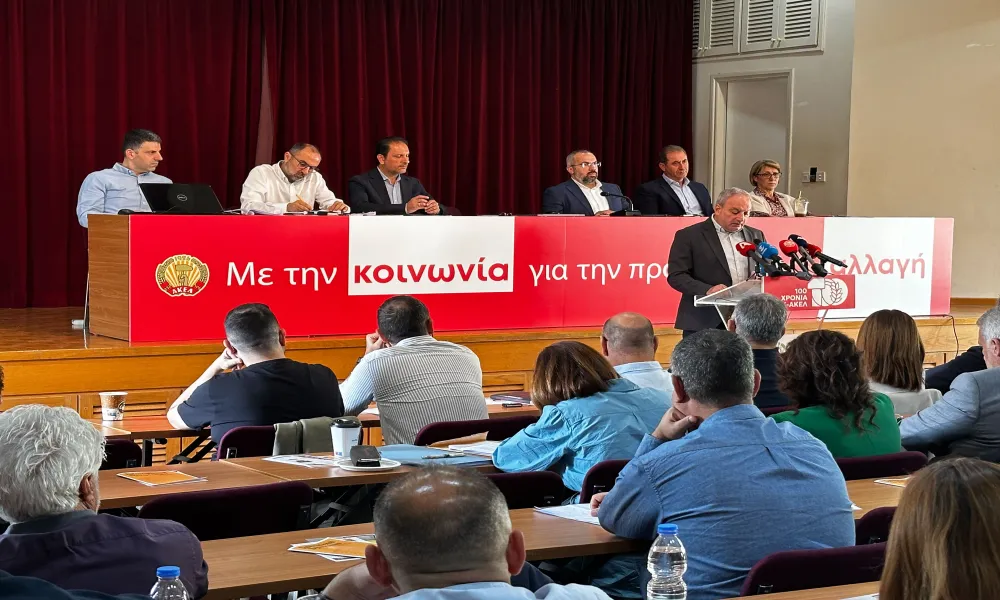

With yesterday’s plenary session of its Central Committee, the Progressive Party of Working People (AKEL) has formally launched an internal search. It is looking for a candidate it can realistically support in the next presidential elections, and it is also trying to converge with certain parties on a programme of government. Under the timetable the party has set, this process will go through many stages. The political framework the Central Committee adopted yesterday must now be put to the membership for discussion, and at this stage the party is not putting forward any names. It is clear, however, that the party cannot afford to lose time on internal consultations. It will therefore speed up the search for a person willing to accept the minimum framework set in advance by the leadership, while opening talks with other parties and movements.
The candidate search and the real problem
However important the search may be, the party risks losing sight of the real problem. AKEL does not simply have a candidate problem. Above all, it has a problem of political strategy, of social appeal beyond its own boundaries and of a convincing proposal for power. As long as its leadership avoids confronting these weaknesses, the search for the right person risks becoming yet another exercise in electoral management.
The first question to answer is why a party with AKEL’s historical record, organisational infrastructure and political presence still struggles to extend its reach into executive power. That has been true for the past fifteen years, since its own time in government from 2008 to 2013. Why does a significant part of society still view with reservation the prospect of a government in which the Left plays a leading role? And why does the leadership often appear more focused on preserving internal party balances than on shaping a new political identity? These are the questions that ought to dominate the internal debate. Instead, the public debate risks being reduced to speculation about names, leaks, exploratory contacts and calculations about who might be acceptable to the other parties.
The 2023 precedent
Many in AKEL argue that none of this applies. They point to the hard-fought battle the party waged in 2023 with Andreas Mavroyiannis as its candidate, who secured 48% of the vote. The figure is significant, but it cannot serve as an alibi for the absence of a strategic reorientation. That result was not solely the product of AKEL’s political appeal, although that appeal played its part, as the rise compared with its parliamentary election results also showed. Above all, it was linked to the particular conditions within the Democratic Rally (DISY) at the time, the crisis triggered by the candidacy of Nikos Christodoulides and the decision of a significant number of DISY voters to back Mavroyiannis.
To approach any candidacy rationally, AKEL’s leadership must resist the temptation to believe it can repeat that result simply by choosing another acceptable candidate. Political conditions have changed, and alliances are not the property of any party. Seen this way, AKEL once again faces a contradiction. It seeks to present itself as the force that can represent broader sections of society, and it has the qualities to do so, yet it still struggles to move beyond its traditional party reflexes. It wants a candidate who can attract voters beyond the Left. The question is whether it is prepared to accept the political consequences of such a choice.
The option of a party candidate
There is much talk within AKEL today about whether the party is able, and has the courage, to return to a party candidacy. In short, the possibility of a candidacy by General Secretary Stefanos Stefanou raises a substantive political question. Will AKEL choose a candidate who primarily expresses its party identity, or will it seek someone who can lead a broader political and social alliance?
A candidacy by the general secretary could secure full mobilisation of the party. On its own, however, it does not answer the question of broadening its appeal. AKEL must explain how it will reach voters who do not feel politically close to it. It must also explain how it will overcome the prejudices and reservations that still exist towards its political identity and, above all, its ideological distinctiveness. The problem is not whether Stefanou or any other party figure has political experience. The problem is whether the leadership understands that electoral victory cannot be a matter of rallying the party faithful. A party that wants to govern must be able to persuade those who do not vote for it. If that is not central to its strategy, the debate over the candidacy will remain confined to the party’s own audience.
Alliances and contradictions
The picture AKEL presents on cooperation with other parties is equally problematic. The contacts and discussions with other political forces, which are expected to begin if they have not already, are not enough. There must be specific political content explaining why different political camps could work together. ALMA, the Ecologists, EDEK, Fidias Panayiotou and possibly DIKO, although that prospect is clearly receding, are different cases with different political starting points and aims. AKEL cannot expect the others to line up behind its choice simply because they feel the current government has not met their expectations. Political cooperation requires mutual concessions, clear agreements and a common programme. It also requires AKEL to abandon the notion that alliances can be organised around its own decisions and plans.
Opposition and a proposal for government
AKEL has invested significant political capital in criticising the Christodoulides government as a continuation of Nicos Anastasiades’ two terms in office. Transparency issues, allegations of collusion between political and business interests, the effectiveness of the state, economic policy and developments on the Cyprus problem all give it ample ground for fierce opposition.
There is, however, a fundamental difference between denouncing a government and presenting a credible alternative. AKEL must say exactly what it would do differently in government. How would it tackle the problems of the economy? How would it curb the high cost of living and social inequality? How would it reform the institutions? What specific strategy would it pursue on the Cyprus problem, given a deadlock that has lasted decades? Distinct answers on all of these are what would show that an alternative proposal exists.
It is not enough to point out the mistakes of others. A party must prove that it has the knowledge, the plan and the political will to offer different solutions.
In short, the real question is not who AKEL’s candidate will be. It is whether the party still has the ambition, the political imagination and the self-confidence to contest power on terms that speak to today’s society. A political force with AKEL’s characteristics and its long history cannot keep asking society to change its mind about it without asking itself what it needs to change.
The pillars of a “progressive change”
At a Central Committee plenary of high political symbolism, held as the party marks a century since its founding, AKEL’s highest governing body yesterday set out its strategy for the February 2028 presidential elections. During the session, General Secretary Stefanos Stefanou presented the political framework for a “progressive change”. He put the need to confront powerful vested interests and to bring immediate relief to the social majority at its centre.
At the heart of his address was sharp criticism of the governments of DISY and of Nikos Christodoulides. The AKEL leader argued that “the current dystopia”, marked by widening inequality, soaring living costs and a housing crisis despite the wealth being generated, is the product of specific political choices. He set out a list of responsibilities running from the deposit haircut and the sell-off of the cooperative banking sector to corruption scandals, the “golden passports” and the deregulation of labour relations. On these, he stressed, DISY and the government are essentially one and the same, and are even preparing to back each other in the second round of the elections.
A broad progressive front
Against this backdrop, AKEL’s leadership made clear that its aim is not to follow an isolationist, narrow party path but to build a broad progressive front. The strategy provides for contacts, soundings and consultations with political and social forces on the basis of a common programmatic platform. The discussion of who will lead the effort is left to a later stage.
The general secretary also presented a specific political framework for this cooperation, built around seven core pillars:
- Solution of the Cyprus problem: resumption of talks on the basis of the agreed framework, and use of the Guterres Framework to end the occupation and achieve reunification.
- Strengthening the welfare state: targeted measures to tackle the cost of living and the energy and housing crises, and to protect labour rights.
- Containing the far right: isolating ELAM as a historic duty of progressive forces, to protect democracy and freedoms.
- A new economic model: sustainable growth with an emphasis on green energy, water resource management and environmental protection.
- Protecting strategic infrastructure: institutional safeguards against its mass sell-off to foreign capital and funds.
- Rule of law and institutions: zero tolerance of collusion and corruption, with independent institutions and accountability.
- A multidimensional foreign policy: a foreign policy grounded in international law and peace, free of subservience and of the militarisation of the region.