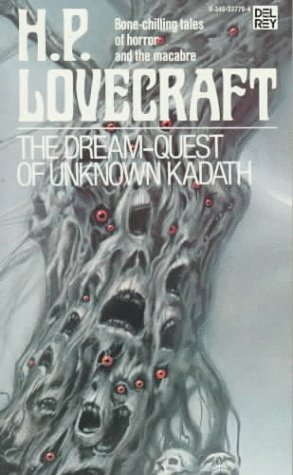
The novella occupies a unique place in Lovecraft’s oeuvre. Preceding the full dominance of his “cosmic horror” mode, it belongs instead to the Dream Cycle, offering a more expansive and symbolic narrative centred on the character Randolph Carter.
A journey through the dream world
At its core, the story follows Carter on a quest through the Dreamlands in search of the mysterious city of Kadath, believed to be the dwelling place of the gods. The narrative unfolds as an episodic journey, filled with strange landscapes, mythical beings and shifting realities, evoking a dreamlike odyssey rather than a conventional adventure.
Beyond its fantastical surface, the quest can also be read as an existential allegory. Kadath represents not only escape from reality, but the pursuit of an absolute ideal – a goal that carries its own risks and illusions. The journey becomes as much inward as outward, reflecting on desire, loss and the limits of human aspiration.
From prose to graphic form
In this edition, British illustrator I.N.J. Culbard reimagines Lovecraft’s atmospheric text as a graphic novel, translating its dense imagery and poetic tone into a visual language. His interpretation highlights both the narrative movement and the philosophical undertones of the work, making the story more accessible while preserving its ambiguity.
A different Lovecraft
The Dream‑Quest of Unknown Kadath stands apart from Lovecraft’s later, darker fiction, revealing a more exploratory and imaginative dimension of his writing. While elements of cosmic dread remain present, they are interwoven with a sense of wonder and mythic scope.
Through this combination of adventure, symbolism and visual reinterpretation, the book offers readers a renewed encounter with a classic work that continues to expand the boundaries of fantasy and philosophical fiction.