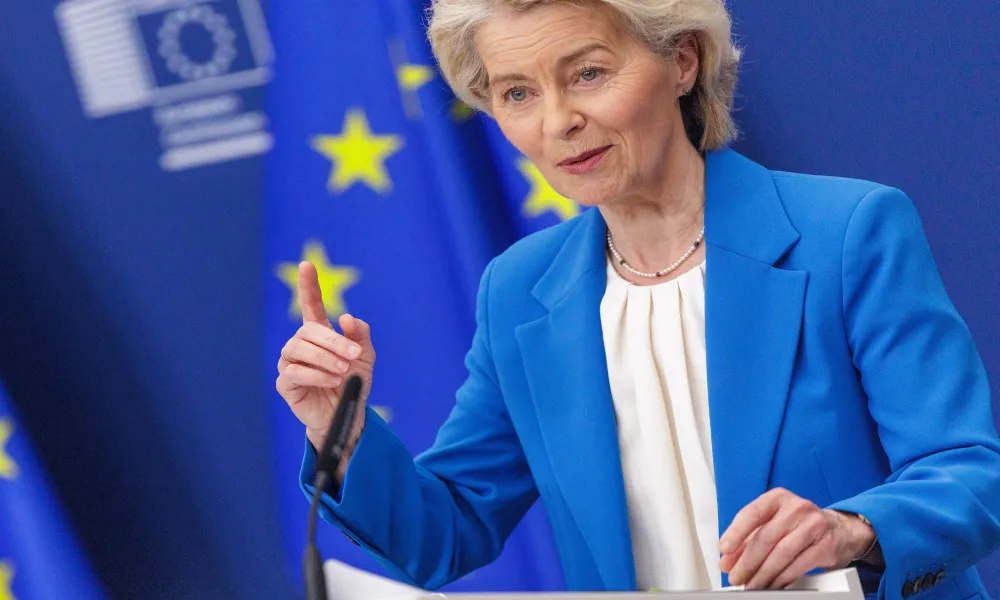

Ursula von der Leyen used her one-hour State of the Union address in Strasbourg to unveil a tailor-made status intended to bring Canada closer to the European Union, alongside measures on climate resilience, hybrid security threats, online child safety and migration. Canadian Prime Minister Mark Carney attended as guest of honour, days after a poll suggested growing Canadian support for closer ties with the bloc. According to Euronews, the Commission president said Europe faces "exceptional" challenges but insisted that "a stronger, independent Europe is now emerging."
'Associate membership' for Canada
Von der Leyen offered to create a new "associate membership" status to bring Canada closer to the EU, telling Carney: "We share one ocean, one set of values, one way of seeing the world. And we will now build our shared future as well." She described the move as the dawn of an "alliance for the future", covering cooperation in economic security, intelligent manufacturing, technology, defence, energy, critical minerals, batteries and the Arctic region.
Details of what "associate membership" would mean in practice were not specified, and it remains unclear how it would fit within the existing EU treaty framework. A previous attempt by the German chancellor to offer similar status to Ukraine was abandoned after objections from EU capitals. Von der Leyen said only that the new status would bring EU-Canada relations "to the highest level possible."
A poll by Abacus Data, cited ahead of the speech, found that 49% of Canadians supported EU membership, while 30% were opposed and 21% were undecided, figures Euronews linked to the political fallout from US tariffs and repeated statements by President Donald Trump about annexing Canada.
Climate action after the 'summer of truth'
Von der Leyen described the summer of 2026 as the "summer of truth," citing 660,000 hectares burned, 12 million tonnes of crops lost and more than 35,000 additional deaths linked to heatwaves across Europe. "Science is clear. Europe is warming at double the global rate," she said.
She announced a European Heatwave Plan covering early-warning systems, health preparedness, urban adaptation, cooling and protection for vulnerable groups. The Commission is also due to present a climate resilience frameworknext month identifying 100 of the bloc's most vulnerable territories. On insurance, von der Leyen noted that only around 25% of catastrophe losses in Europe are currently covered by private insurers, and announced a forthcoming Climate Insurance Alliance, alongside a European Water initiative and a European firefighting fleet.
New mechanism for hybrid threats
Defence featured prominently amid a series of hybrid attacks in Europe, some attributed to Russia. "Cyberattacks and sabotage, arson and drone incursions. They are ramping up every day," von der Leyen said.
She proposed a new mechanism, modelled on NATO's Article 4, that member states could trigger in response to a hybrid attack, launching political consultations to coordinate an EU response. Under NATO, Article 4 allows any member state to call an urgent meeting over a new threat, and precedes collective defence under Article 5. Von der Leyen also proposed a "European Security Council" bringing together leaders from Ukraine, the UK, Norway, Canada and other partners, though no timeline was given for how the body would be established.
EU Kids Act for online safety
On child safety online, von der Leyen announced the EU Kids Act, which would ban social media access for users under 13 and restrict it for those under 15. "We do not have to accept addictive features... we do not have to accept that girls have their photos used for AI-generated sexualised images," she said. The draft law would reverse the burden of proof, requiring platforms to demonstrate their services are safe by default.
On artificial intelligence, she said "the dangers of self-improving models are becoming ever more apparent," referencing what Euronews described as the Hugging Face incident. The Commission plans to convene leading AI labs, together with partners including the UK and Canada, to discuss model evaluation, verification and AI security.
Lessons from the Ceuta crisis
Von der Leyen addressed the Ceuta border crisis, in which an estimated 82,000 irregular migrants entered the Spanish exclave from Morocco in late July; most were subsequently deported. "Ceuta's border is a European border. Because Ceuta is Spain. Ceuta is Europe," she said.
She called for "solidarity" among all 27 member states and full implementation of the Migration Pact, and proposed an emergency framework to respond to mass border influxes, particularly where movements are "engineered and weaponised." According to Euronews, multiple reports have pointed to direct or indirect Moroccan involvement in the crossings, though the Spanish government has declined to attribute blame to Morocco. Von der Leyen said any emergency measures would apply "only under a strictly defined set of criteria," a framework that could allow for the suspension of asylum rights in specific circumstances. "We will always comply with our values and fundamental rights," she said, "but we will never compromise on protecting our borders."
Source: Euronews