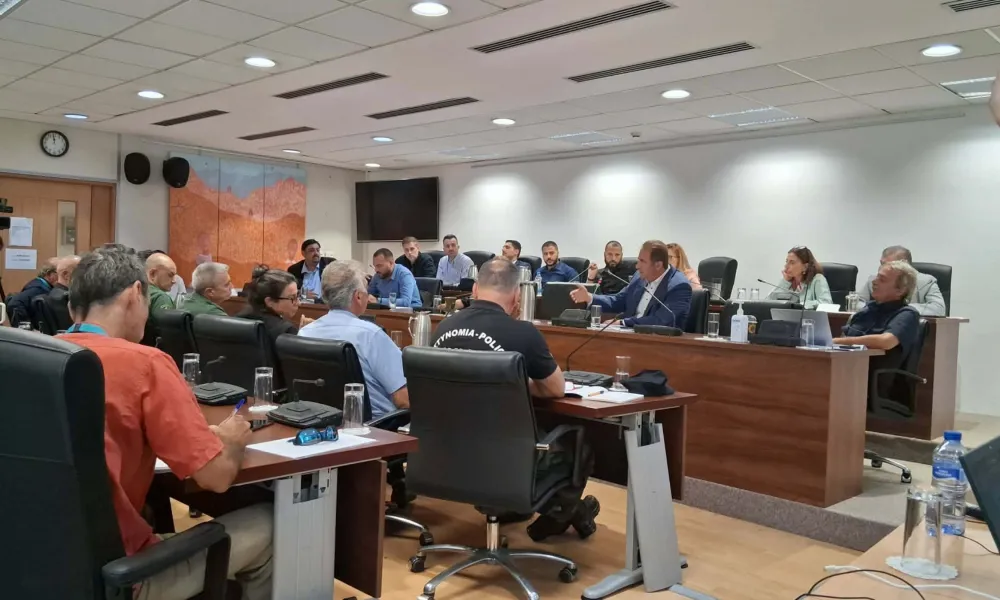

A heated debate unfolded before the House Environment Committee on Wednesday as MPs, environmental activists, hunting representatives and state agencies clashed over the activities of anti-poaching groups and the rights of lawful hunters.
The discussion focused on complaints by hunters of harassment by activists and concerns raised by environmental organisations that attempts are being made to curtail legitimate environmental advocacy.
ELAM raises concerns over specific activist groups
Opening the discussion, ELAM MP and Environment Committee chairman Linos Papayiannis explained why he and fellow ELAM MP Linos Ioannou Hadjigeorgiou had registered the issue for parliamentary examination under the title: "The impact of the activities of specific activist organisations and activists operating in the environmental sector and the assessment of the need for measures to address the phenomenon."
Papayiannis stressed that the discussion was not directed at all environmental organisations but specifically at Committee Against Bird Slaughter (CAPS) and another organisation that he said cooperates with it.
According to Papayiannis, concerns include:
- Alleged violations of criminal law.
- Entry onto private property.
- Interference with the work of law enforcement authorities.
- Obstruction of lawful hunting activities.
- Alleged contacts with the Turkish Cypriot administration in the north.
He told the committee that complaints regarding the mapping of Cyprus and alleged contacts with the occupied areas had previously been submitted to two former justice ministers without result.
Papayiannis also questioned why draft legislation dealing with such issues has remained under consideration by the Legal Service for approximately two and a half years without progress.
Police: Drone complaints come from poachers
In one of the most notable exchanges of the hearing, a police representative was asked whether complaints are received from citizens regarding activists allegedly harassing individuals through the use of drones.
The representative replied that such complaints are generally made by poachers.
The statement became a central point of the debate, with environmental groups later pointing to it as evidence that anti-poaching activists are primarily targeting illegal activity rather than lawful hunting.
Wildlife Service reports around 450 cases annually
Pantelis Hadjigerou, director of the Game and Fauna Service, said incidents involving activists entering private property to release trapped birds had been more common in the past than they are today.
Responding to questions from AKEL MP Nikos Kettiros, he said organisations such as BirdLife Cyprus and Terra Cypria were not involved in such actions.
"We have very good cooperation with environmental organisations such as BirdLife Cyprus, Terra Cypria and even the Hunting Federation on environmental issues," he said.
Hadjigerou added that the service currently receives complaints both from activists reporting poaching and from citizens reporting hunters operating near residential areas.
According to the official, approximately 450 cases are reported each year.
"The reality is that there is no poacher who has not been reported," he said, arguing that repeat offenders continue their activities because penalties are not sufficiently deterrent.
Warning over confrontations in the field
Hadjigerou also warned that direct intervention by activists while lawful hunting is taking place could have dangerous consequences.
He said such incidents could potentially lead to injuries or fatalities, adding that the government's proposed legislation aims to protect lawful hunters from harassment while carrying out legal hunting activities.
At the same time, he emphasised that the Game and Fauna Service does not conduct joint enforcement operations with activist groups.
"The activists call game wardens and report incidents. They contact us as any citizen would," he said.
According to Hadjigerou, there was one occasion on which activists themselves filed a complaint with police after concerns that a game warden had failed to report a poacher.
AKEL accuses committee of targeting environmental groups
AKEL MP Giorgos Loukaides strongly criticised the framing of the debate, arguing that environmental organisations were being unfairly targeted.
Addressing police representatives, he questioned whether activists should be viewed as adversaries or partners in environmental protection efforts.
Loukaides also rejected suggestions that complaints raised by Papayiannis reflected the views of the majority of hunters and argued that criminal elements involved in poaching have previously threatened game wardens.
He additionally criticised the committee's decision not to invite representatives of BirdLife Cyprus to participate in the discussion.
Committee chairman defends approach
In response, Papayiannis said it would have been impractical to invite all environmental organisations operating in Cyprus, estimated at around 15 groups.
He noted that such an approach would also have required invitations to the more than 200 hunting associations affiliated with the Cyprus Hunting Federation.
The debate comes amid heightened tensions between environmental activists and hunting organisations, with both sides arguing that their rights and activities require greater protection and recognition from the authorities.