
By Kyriakos Pierides
What among current developments points to a breakthrough in the long-standing deadlock?
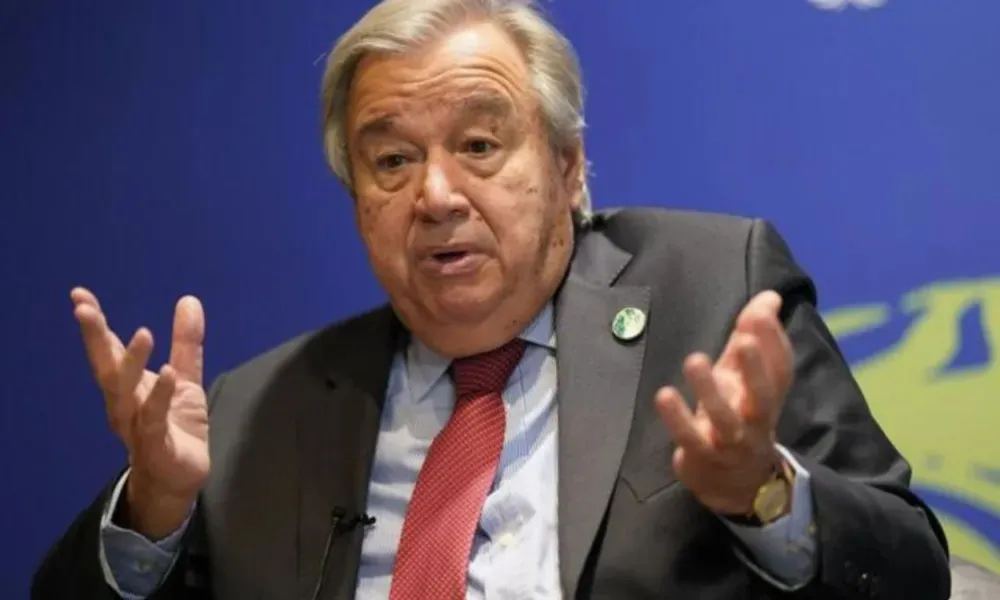
In the middle of a scorching summer, UN Secretary-General António Guterres will attempt the seemingly impossible: to place the Cyprus issue back on the negotiating track and push for its resolution. That is the purpose of his visit to Cyprus, where he will arrive on Monday evening (27 July) for talks with the island's two leaders.
What, then, suggests that the years-long stalemate can be broken?
Diplomatic activity
Over recent weeks, unusual diplomatic activity has been observed.
The very arrival of a UN Secretary-General on the island signals the launch of an initiative. Guterres is coming to Cyprus, but so far he does not appear to have secured anything tangible or binding from the parties concerned.
He will seek to produce a meaningful outcome, but there is no certainty that he will succeed.
Yet, as one of his predecessors famously remarked, “The United Nations was not created to bring us to heaven, but to save us from hell.”
The same applies to Cyprus. Guterres wants to try to persuade Cypriots to look at their future differently. Partition is deepening, while stagnation is no guarantee of stability and calm.
He will seek answers from the leaders and will also address the citizens.
Consultations
Since June, his Personal Envoy, María Ángela Holguín, has been conducting contacts among the parties concerned, including the two leaders and the guarantor powers.
Initially, her efforts created a degree of optimism, which was not subsequently confirmed.
Last week she returned to Brussels and Ankara. These contacts are noteworthy. However, they cannot be compared with previous UN initiatives that were built on methodical preparation and intensive consultation over negotiating documents.
It would be surprising if mature conditions for progress had been created after so much inactivity.
The UN remains at the forefront of efforts and the European Union is supporting its work. But the Guterres initiative is not backed by heavy diplomatic engagement involving key external actors.
Several weeks ago, reports emerged suggesting the existence of a comprehensive settlement plan based on a “loose” federation or a “confederation”. Once the Secretary-General's visit was announced, those reports faded away, leaving an entirely blurred picture behind them.
Clearly, no one can credibly claim that a ready-made plan exists while everything surrounding the negotiations remains in disarray.
To many objective observers, the Cyprus issue resembles the myth of Sisyphus. Many painstaking efforts reach the top of the mountain, only for the mythical hero to be forced to carry his burden all over again, returning to the starting point.
For several months now, the United Nations has been trying to determine where President Nikos Christodoulides stands today regarding the convergences on power-sharing, namely political equality, so that these can be matched with the positions of the new Turkish Cypriot leader, Tufan Erhürman.
Without movement on that front, Turkey is not revealing its position on guarantees and troops.
There is no indication of productive discussions or meaningful progress behind the scenes.
Without substantial convergence within Cyprus itself, it is unlikely that the Cyprus issue can gain momentum through parallel discussions on interconnected matters, such as EU-Turkey relations.
For that reason, Guterres' visit looks more like a desperate leap into the void.
The Cyprus issue reminds many impartial observers of the tale of Sisyphus. Numerous laborious efforts reach the summit, yet the mythical figure is compelled to begin the same ordeal again and again.
Likewise, both leaders in Cyprus say they are ready to continue from where things were left in Crans-Montana in 2017, but they remain far from meeting the conditions required for final-status negotiations focused on achieving a settlement.
Public opinion
The visit coincides with the sombre anniversaries of the 1974 invasion.
For Greek Cypriots, the commemorations of that tragedy create a heavy atmosphere that turns society back towards the past.
President Christodoulides recently reiterated his familiar red lines during an event at the Presidential Palace on 20 July:
“We are not discussing the dissolution, abolition, cancellation or undermining of the internationally recognised and lawful state.”
He also appeared to issue a warning directed at the United Nations:
“I will not discuss anything that points towards a two-state solution and/or a disguised confederation, or that contains any constructive ambiguities.”
Nine years ago, at Crans-Montana, there was no dilemma regarding the dissolution of the recognised state. Everything concerning federal reunification had already been agreed.
Today, however, the Cypriot leadership is warning of such dilemmas.
As time moves relentlessly forward, Cypriots remain trapped in their past.
Public indifference towards the Cyprus issue now dominates the island.
A majority of Cypriots keep their distance not only from the news but also from the historical events that shaped the Cyprus tragedy, particularly the younger generations who grew up after 1974.
An exception can be found in a number of small citizen groups preparing to welcome the Secretary-General to the island with memoranda advocating federal reunification.
The initiatives of the residents of Varosha also stand out.
They have experienced disappointment eight times in the past, seeing their hopes of returning to the ghost city of Famagusta dashed.
Today the city has reopened and become attractive mainly for what might be described as “dark tourism”, with visitors touring abandoned homes beside the golden coastline.
Their proposal is to transform Famagusta into a joint project of reconstruction and cooperation between the island's two communities.