A series of troubling findings regarding Cypriot students emerged from the recently published results of the OECD’s (Organisation for Economic Cooperation and Development) Programme for International Student Assessment (PISA) 2025.
Among the most concerning findings is that 43.5% of students fall below the baseline level of proficiency in all three core assessment areas, namely science, reading comprehension and mathematics, compared with 19.7% across the OECD. Meanwhile, only 4.6% are classified as high-performing students. The largest gaps are recorded in reading comprehension and science, while mathematics performance has declined further compared with 2022.
In an effort to shed light on the causes behind these results, and on how families and the state should address an issue that is critical to society’s future, we spoke with two specialists who have first-hand insight into both child psychology and the realities of learning.
Child psychologist Christos Poyiadjis and philologist Christos Lazanias spoke to Politis, attempting to interpret the findings beyond the scores themselves, each offering a different perspective on what is happening both inside and outside the classroom.
A relationship with learning under pressure
Christos Poyiadjis believes it would be an oversimplification to interpret the report’s findings solely as yet another failure of the education system or as proof that today’s children “are not interested” in learning.
In his view, what appears to be under pressure is something much deeper: young people's relationship with the learning process itself.
That means whether students see meaning in learning, whether they believe it is worth persevering when they encounter difficulties, and whether they feel secure enough to admit they do not know something, ask for help, make mistakes and ultimately try again.
The rules of the game
Mr Poyiadjis points out that this relationship is not shaped exclusively at school and that responsibility cannot be placed on a single factor.
School, family and society collectively shape the environment in which a child grows up, at a time when both access to information and expectations of instant gratification have changed radically.
Within this context, mobile phones, social media and now artificial intelligence are not, by themselves, the cause of the problem. They have, however, as he notes, changed the “rules of the game”.
Information is everywhere, answers arrive almost instantly and difficulties can be bypassed much more easily than in the past.
For that very reason, he believes schools can no longer base their value on possessing the answers.
Instead, they must demonstrate to children why it matters to think before accepting a ready-made answer, to question, to verify information and to tolerate uncertainty when a solution does not immediately appear.
School as a community
For Christos Poyiadjis, it is equally important that a child feels they are part of a community that recognises and needs them.
In his assessment, the low sense of belonging recorded in the findings carries particular significance.
As he explains, school is not only a place where knowledge is acquired. It is where trust in rules, cooperation, participation and responsibility are tested, and where children develop an understanding of whether their own voice has genuine value.
This does not mean, he clarifies, that a child who becomes disconnected from school will necessarily grow into an individualistic or anti-social adult.
There is, however, a risk that children may develop from an early age the perception that institutions are distant and transactional rather than places where citizens have a voice and a role.
New curricula are not enough
For that reason, he considers inadequate any educational reform limited to changes in textbooks, curriculum content or examination procedures.
The fundamental question, in his view, should be what exactly we want the overall school experience to produce.
As he notes, a system cannot ask children to think critically while primarily training them to search for a single correct answer; it cannot demand autonomy from students to whom it offers very few meaningful choices; nor can it expect resilience from young people who have learned to experience mistakes as failures.
He applies the same reasoning to the role of the family.
Parents, he argues, do not need to remove every obstacle from their children’s lives. Instead, they need to create the sense of security within which children can experiment, fail and discover through their own effort what they are capable of achieving.
For Christos Pogiatzis, therefore, the real significance of Cyprus’ PISA results is not the country’s position in the next international ranking, but whether schools can once again give meaning to effort and participation.
What is happening in the classroom?
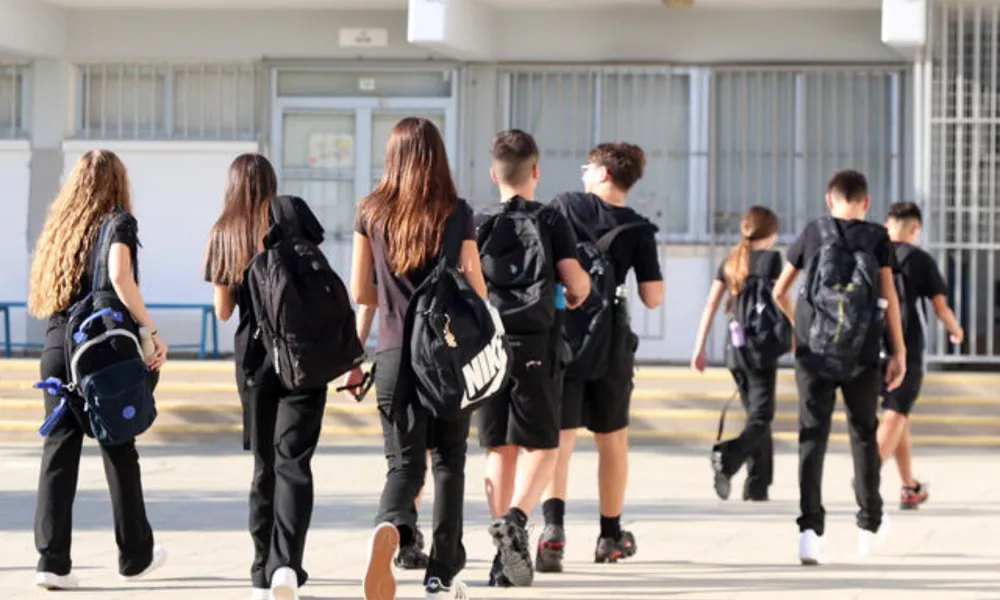
From his own perspective, philologist Christos Lazanias sees many of the behaviours reflected in the report on a daily basis in the classroom.
As he explains, some students read a text hastily and then try just as quickly to provide an answer, without devoting the time necessary for genuine understanding.
The difficulty becomes even greater when they are asked to follow complex instructions, connect pieces of information or justify their conclusions.
Consuming information
He observes that many students view knowledge more as a collection of isolated facts than as a process of synthesis and understanding.
The belief that any piece of information can be instantly retrieved from the internet or social media has, he says, in many cases reduced interest in expanding one’s knowledge.
He attributes part of this situation to the way younger generations have become accustomed to consuming information.
Short, often slogan-like texts, constant shifts between images and content, and an expectation of immediate answers have, in his view, created an environment where effort and perseverance are diminished.
However, he also identifies part of the responsibility in the way schools themselves have been taught to assess students.
When students are rewarded primarily for arriving at the correct answer, it is only natural, he explains, that they focus on reaching that answer as quickly as possible rather than developing their reasoning.
Low self-confidence is another issue he encounters daily.
Statements such as “I’m not good at this”, “I won’t manage it” or “I won’t pass the exams” indicate, in his view, that many children abandon effort because they have already assumed failure.
For this reason, he considers it essential to cultivate an environment where progress is recognised, effort is rewarded and mistakes are treated as part of learning.
The goal, as he puts it, is for children to learn to ask not simply “What is the answer?” but “Why is this the answer?”
A school disconnected from life
The philologist also focuses on the sense of disconnection that some students feel from school itself.
According to him, many children believe that the school experience is not sufficiently connected to real life and does not provide them with what they will need after graduation.
This perception is even stronger among students who are already working and have begun to encounter the practical demands of adult life.
The mobile phone
A major part of his observations also concerns the impact of mobile phones.
Although their use is prohibited in the classroom, he describes children who remain preoccupied with when they will next be able to pick up their phones, making it difficult for them to focus and concentrate.
According to him, this also affects the physical condition in which students arrive at school.
Many children admit to staying on social media or playing video games until two or three o’clock in the morning and then turning up to class the following day tired and sleepy.
Overprotection and autonomy
According to Christos Lazanias, the role of the family is crucial and extends far beyond monitoring mobile phone use.
The family is a child’s first learning and social environment and plays a major role in shaping how they understand responsibility and effort.
Overprotection, he argues, can ultimately work against children if parents intervene every time before they have the opportunity to try on their own.
Instead, he believes it is important for parents to allow children to face the consequences of their choices, avoid immediately providing solutions and even permit them to fail without shame.
The model he advocates is one of “supported autonomy”: the parent remains present, provides guidance and security, but gradually withdraws assistance as the child develops their own skills.
Radical changes
As far as the education system is concerned, Christos Lazanias believes that isolated corrections are not enough and that substantial, deeper changes are required.
These changes, he argues, should emerge through cooperation among all stakeholders and should be continually evaluated as they are implemented.
Teaching, in his view, must become more flexible and better adapted to the individual needs, abilities and learning pace of each child.
Above all, the success of an education system cannot be measured exclusively by standardised examinations and international rankings, but also by the extent to which it succeeds in shaping individuals who are autonomous, responsible and capable of developing throughout their lives.