
By Pavlos M. Pavlou
Four hundred years ago, after all the necessary factors had fallen into place, from the rediscovery of science in opposition to theology to the shaping of borders in Europe, a long process began that came to be known, in summary, as the Enlightenment.
One of the by-products of the Enlightenment was the development of nation-centred movements. Alongside science, rationalism, liberal ideas about governance based on law and humanism, there also emerged the belief that every nation was entitled to have its own state. This contributed greatly to the upheavals and trials experienced by many regions of the world, particularly over the past two hundred years.
To this day, many peoples around the planet are still searching for a future that combines nationhood, genuine independence, free for example from neocolonialism, and statehood. Or they seek to reconcile different ethnic or social-group elements in a functional way.
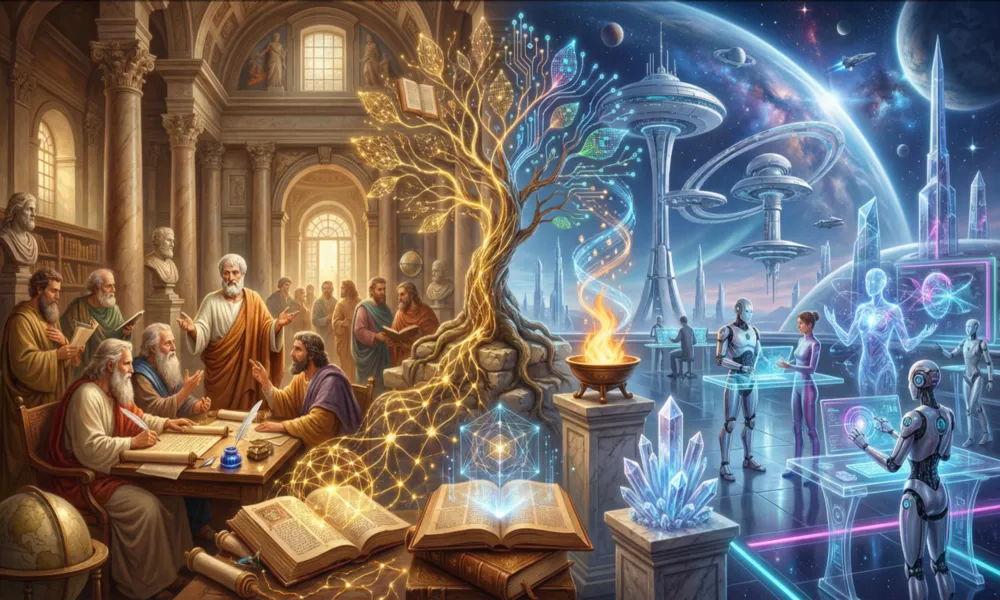
Given developments over recent decades, it appears that we are gradually entering a new era, that of Post-Enlightenment.
This is not an era that “abolishes” the Enlightenment. Quite the contrary. The Enlightenment still has a long way to go, particularly in demands for individual and political freedoms, science and intellectual thought, and a state based on progress and the rule of law.
What is changing is a shift in the centre of gravity.
Technology, AI, disorder arising from the rise of the national-populist far right as a symptom of postmodern uncertainty, and the pressure placed on rationalism by frenzied irrationality are giving increased importance to two factors:
(a) The structures of state operation, regardless of the ethnic composition of a state.
(b) Supranational structures and the multiple dimensions of alliances.
The “new” enemies
The pressure exerted by certain factors has now reached an unprecedented scale:
1. The permanent economic crisis
The global economy is experiencing something for which it was unprepared.
The economies of almost all states, large and small alike, remain trapped in a prolonged crisis.
In the past, periods of crisis alternated with periods of recovery and growth.
Today, the recovery phase and the growth phase in almost no country are entirely free from elements of crisis such as excessive debt and deficits.
This has significant social consequences.
It leads to an unprecedented concentration of wealth in the hands of a few, the impoverishment of large sections of the middle class, and a steady decline in social mobility.
2. The permanent geopolitical crisis
This is not simply the “Trump problem”.
Beyond the crisis in the Western Hemisphere, involving the United States, Europe, Latin America and Canada, tensions are also shifting from the Balkans to Eastern and Central Europe, involving Russia, Ukraine, Poland and the Baltic states.
At the same time, conflicts stretching from the Near and Middle East to India and Pakistan are imposing tremendous economic pressure on the entire planet.
3. Climate change
We are all experiencing its effects.
The issue is understanding that it does not affect all countries equally, nor all social groups equally.
In countries with weak structures and infrastructure, it is far deadlier.
And it is the clearest demonstration that state structures must now be placed at the centre of attention.
4. Large-scale technological development
Here too, we must constantly bear two things in mind:
(a) Rapid technological development increases rather than reduces social inequalities.
(b) It increases at a geometric rate the gap between well-organised states, which are capable of keeping pace with and participating in technological development, and less organised states, which struggle to keep up and do not participate in production, and therefore become purchasers rather than producers.
State structures
The list of “new” enemies could include many other phenomena, such as the re-superstition of the developed world.
New irrational fears are emerging, generating new unfounded narratives, or providing fresh fuel for old ones.
For example, anti-immigration neo-nationalism is having its strongest impact precisely in countries where the issue is small or virtually non-existent.
Yet the collective imagination is constantly searching for new enemies and new “communities”.
The crucial thing is to understand the shifting dynamics of priorities for a state, where the following must stand at the top:
I. Structures of governance
In the Post-Enlightenment era, how well organised a state is, how flexible and adaptable its structures are to changing conditions, and how much trust citizens place in those structures are emerging as among the most important priorities.
States that possess such structures will continually confront and resolve new problems.
States that do not possess them will be condemned to formal or informal disintegration.
A crucial subset of this battle is the rule of law index.
It is no longer a luxury.
It is an essential condition for survival.
II. Social cohesion
In the train of the new world, prioritising social cohesion policies is not a question of how “left-wing” or how “neoliberal” one is.
It should be a conscious objective of every government, regardless of ideological orientation.
The new conditions are generating powerful forces that widen the gap between social classes.
During the 2030s, this could evolve into an explosive internal mixture within states, with unpredictable consequences across all spheres of life.
III. The interstate cohesion of alliances
The way a state viewed others and formed alliances has always been critical.
Today, the actual content of alliances is more important than ever.
For example, the terms of the alliance between Venezuela’s new government and the United States translate in practice into a long-term arrangement that neutralises the country's main advantage and resource, oil.
That is why states must possess structures and social cohesion capable of preventing alliances of subordination.
After all, alliances change, such as Russia-China, or change temporarily, such as Turkey-Israel.
Only a robust and adaptable state can adequately confront the new world of constant change.
If anyone asks, “How does any of this concern us?”, the answer is that there is no state on the planet to which it does not apply.
Particularly a state such as Cyprus.
For example, under conditions of normal political life, all these issues ought to be central to our politics on four levels:
(a) In building a state governed by the rule of law. Anastasiades and Savvides will eventually leave. Our children and grandchildren will live with the consequences of Cypriot chaos.
(b) In our priorities within the European Union, the most important alliance Cyprus has ever belonged to. A policy of cohesion among states and societies, with deeper structures extending to the limits of EU federalisation, should be at the top of the agenda for Cyprus, and Greece.
(c) In relations with neighbours, through policies aimed at urgently resolving disputes, particularly with Turkey, rather than policies of surrendering ourselves to “the enemy of my enemy”, namely Israel.
(d) In the discussions themselves with the Turkish Cypriots, aimed at resolving the Cyprus problem.
Flags, symbols and symbolism have their place.
Provided they do not conceal the reality that is already here.
The basket
• ...on plasmapheresis (1): In order to neutralise every prospect of resuming negotiations after 2017, Nicos Anastasiades made dramatic public interventions with “new ideas” such as the 1960 Constitution and a loose federation. Since then, the ground has become so barren that Nikos Christodoulides no longer needs to do the same. He simply throws a certain number of individual “new ideas” onto the table every so often, and that is enough to ensure that nothing moves. Once there were four, then eight, then ten. Now we have reached the record number of nineteen.
• ...on plasmapheresis (2): Things in DISY are becoming increasingly difficult. The presence of three aspiring candidates is the least of the problems. The greater issue is the behind-the-scenes activity of the Anastasiades bloc in favour of the re-election of Nikos Christodoulides, with the covert, and at times open, cooperation of party officials with the Presidential Palace. The former president’s motivations are many. Some are directly related to who will handle the justice-related issues concerning him, and how. Savvides’ term is nearing its end, after all. Who will succeed him, and how close will the cooperation among the three be?
• ...on plasmapheresis (3): Plasmapheresis saves lives when it is carried out by serious medical centres and the appropriate specialists. When this is not the case, lives are lost. The referral of Drousiotis to the Assize Court, rather than at most a district court, the black van case, the attacks by Savvides, and Anastasiades, against the Anti-Corruption Authority, and a host of other incidents, are proof that society and the state are undergoing a plasmapheresis of prosecutorial justice in a “clinic” operating at the level of a shack.